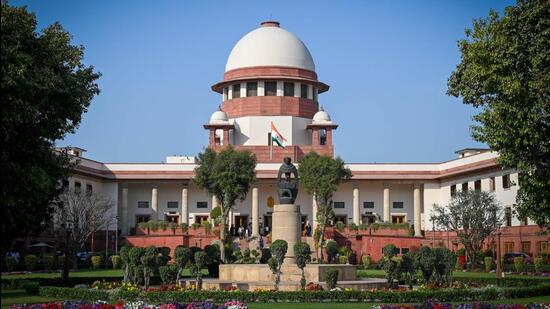
The Supreme Court will on Thursday rule on whether the control over Delhi’s bureaucratic machinery lies with the elected government or the lieutenant governor, a Constitution bench judgment that will become a key determinant in the struggle between the two power centres in the national Capital.
This aspect of the tussle – which originated in 2015 when the Aam Aadmi Party came to power in the city while the Bharatiya Janata Party ruled the Centre – relates to a Union government notification in May that year. It laid down that the Delhi government will have no legislative power over services as is the case under Entry 41 of State list under the constitution, which gives state assembles the prerogative on state public services.
The Constitutional question itself arose because, as explained by the Supreme Court when in May, 2022 it referred the matter to a five-judge bench, where the prerogative lies has not been specifically addressed in Article 239AA of the Constitution, which lays down the special provisions for the national Capital.
The verdict will be significant for AAP and BJP, which have had bitter scraps over several issues in a confrontation that has now snowballed into several Delhi ministers being arrested over corruption, with much of the battle fought via the office of the LG, who reports to the Union government.
{{/usCountry}}The verdict will be significant for AAP and BJP, which have had bitter scraps over several issues in a confrontation that has now snowballed into several Delhi ministers being arrested over corruption, with much of the battle fought via the office of the LG, who reports to the Union government.
{{/usCountry}}This is the second matter relating to the fight between the Centre and the Delhi government that will involve a Constitution bench verdict. The first, in July 4, 2018, interpreted the scope of power of Delhi Assembly under Article 239AA to hold that that besides land, police and public order (over which Centre has exclusive legislative authority), the LG cannot act independently on his own.
For the remaining issues, the matter was placed before a two-judge bench where the issue of legislative competence of Delhi Assembly over ‘services’ saw a split verdict in 2019. To resolve the dispute, the matter was referred to a three-judge bench and in May, ultimately sent to the five-judge bench.
The arguments before the Constitution bench hinged primarily on the interpretation of the phrase “in so far as any such matter is applicable to Union Territories” and “subject to provisions of the Constitution” occurring in Article 239AA (3).
The Centre had argued that the July 2018 verdict did not confer any legislative power on subjects other than land, police and public order.
The Union government moved an application to refer the dispute over services to a bench of nine or more judges as it claimed that the July 2018 verdict went against a 1997 SC ruling by a nine-judge bench in an NDMC case that held that Delhi is a Union territory and not a state despite having a legislative assembly.
The Delhi government, on the other hand, claimed that the July 2018 had settled the “services” issue as well and an elected government in the Capital cannot be made functionally redundant by denying it legislative control over subjects other than the three areas where there is a constitutional bar.
With regard to “transfer and posting” of officers, the Delhi government argued that if an elected government cannot exercise control over its officers, it will be belying the trust imposed by the electorate and will lead to insubordination as officers who will be answerable only to the Centre.
One of the possibilities is that the Court may decide in favour of the Delhi government. If so, it will have to be seen whether the Court will hold that executive power will run concurrent to legislative power. And further, as regards the three subjects where Delhi Assembly has no law-making powers, it cannot exercise any executive control over officers appointed in the departments falling under them. A positive verdict from the Court will mean that Delhi will get to exercise control over its officers (including those under the UT cadre) and most essentially, have a say in getting their choice of officers posted or transferred in various departments.
The other possibility lies in the verdict upholding the Centre’s argument. This will make governance in Delhi stickier and potentially escalate the fight between the AAP government and LG, affecting performance of several welfare measures initiated by AAP ahead of the Lok Sabha elections next year.
The five-judge bench’s verdict will also impact amendments brought by the Central government in 2021 to the National Capital Territory of Delhi Act which has been separately challenged before the apex court by the AAP government.
This amendment makes it mandatory for the Delhi government to seek LG’s opinion before taking any executive action or any decision under any law in force in the Capital. Following Thursday’s verdict, it needs to be seen whether Delhi government will insist on hearing this petition and that too by a constitution bench.
In a third scenario, the Constitution bench, while deciding on the issue of services may lay down a middle path that could delineate the powers to be exercised by Centre as well as Delhi government when it comes to controlling the bureaucracy.
The Centre had argued that considering the stature of Delhi as the national capital, it is imperative that the pre-eminence of the central government through L-G is maintained to ensure collaborative framework and to balance competing national and local interests.
The bench of Chief Justice of India (CJI) Dhananjaya Y Chandrachud, justices MR Shah, Krishna Murari, Hima Kohli and PS Narasimha which will deliver the verdict had observed once during the hearing, “One way to harmonize (the dispute before the Court) is to say that the executive control of Delhi will be exempted from the three areas (public order, police and land).”
Stay updated with all top Cities including, Bengaluru, Delhi, Mumbai and more across India. Stay informed on the latest happenings in World News along with Delhi Election 2025 and Delhi Election Result 2025 Live, New Delhi Election Result Live, Kalkaji Election Result Live at Hindustan Times.
Stay updated with all top Cities including, Bengaluru, Delhi, Mumbai and more across India. Stay informed on the latest happenings in World News along with Delhi Election 2025 and Delhi Election Result 2025 Live, New Delhi Election Result Live, Kalkaji Election Result Live at Hindustan Times.