The visibility of a city’s unevenness after Satya Niketan is a pattern we have all seen before. A tragedy, photo ops for ministers and officials, a reel of someone being scolded, and then the arrival of the “Peela Panja” – the yellow claw, the bulldozer.
Satya Niketan brings to your face a student housing crisis that the city does not acknowledge. No annual record from official sources tracks this population. One has to imagine it instead: from Delhi University to Jawaharlal Nehru University, IIT-Delhi to AIIMS, IGNOU to South Asian University, students arriving from across India and beyond. University housing does not come close to accommodating them.
What fills the gap is a paying guest and hostel economy that is dangerous and most often informal.
The average student arrives knowing almost nothing about Delhi’s rental market, and is still subjected to its rates, its obscure sub-tenancy arrangements, and its moral policing. These three conditions are not separate problems. They are interdependent. Because most PGs are never licensed or granted building-plan permission to operate as PGs, they function in a grey zone, and that grey zone survives by staying invisible – by keeping the house’s real use hidden from the street so as not to invite official attention.
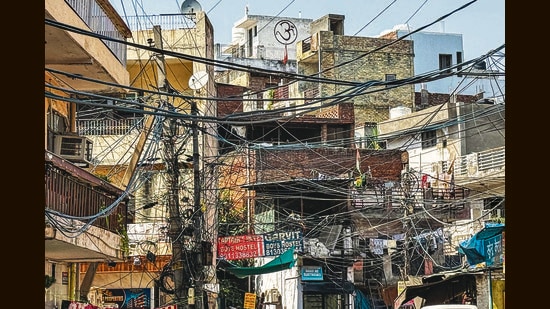
The authority meant to govern this never monitors its streets or recognises neighbourhood patterns to respond to it. One failure compounds the next, and these neighbourhoods calcify into something close to ghettos: open sewers, corridors narrowing by the year, a sky knit shut with wires. We resist the word ghetto in this city because it feels like it strips the place of dignity. But avoiding the word does not resolve what produced the condition.
{{/usCountry}}The authority meant to govern this never monitors its streets or recognises neighbourhood patterns to respond to it. One failure compounds the next, and these neighbourhoods calcify into something close to ghettos: open sewers, corridors narrowing by the year, a sky knit shut with wires. We resist the word ghetto in this city because it feels like it strips the place of dignity. But avoiding the word does not resolve what produced the condition.
{{/usCountry}}This is where the real argument has to start.
What placemaking has the city and its administration done to accommodate a migration of higher education students that is, by any measure, economically valuable? Delhi’s own state and central universities have not expanded student housing in any comparable way, despite holding the land to do it.
Private universities have answered the question in their own way. OP Jindal Global University in Sonipat has treated construction and education as inseparable from the start, an ever-expanding campus built to keep pace with its faculty, its schools, its pedagogy.
Delhi’s own planning authority has never run a housing scheme built specifically for students. The city has never treated its student population as a category worth designing for at the level of public space or purpose-built neighbourhood infrastructure, the way a university town elsewhere might zone a student quarter outright. Instead, neighbourhoods like Satya Niketan, Munirka, Mukherjee Nagar, and Kamla Nagar absorbed the demand on their own, dangerously.
Delhi is as much a student town as it is a town of judges, politicians, lawyers, and bureaucrats. The vulnerability of its students is the state’s to care for.
If the state identified these neighbourhoods and took on the maintenance of their public amenities, it could pull them back from deeper ghettoisation. If it looked closely at the pavements and walking paths in these areas, it would already know about the open sewers, the stinking drains, the houses extended past any reasonable limit.
Things were meant to change, especially since one party leads all agencies for the city. That concentration was supposed to be the argument for competence, for one hand finally able to move the whole machine.
Instead, it has produced only a faster reflex for the theatre of consequence and no reflex at all for prevention. A suspended officer is not a repaired sewer. A demolished building is not a housed student. The Peela Panja arrives with the cameras already rolling, because visibility, not care, is what this state has learned to produce on demand.
Dignity is not an abstraction. It is a right, especially for students. This dignity does not come from the landlord; it needs to come from the state that needs to build for its students, not leave them homeless. The bulldozer does not spell care. Until Delhi is willing to extend that care to the significant migrant student population, the claim that this city values its students will remain exactly that – a claim, dressed as concern, indistinguishable from indifference.
Anica Mann works on archaeology and contemporary art in Delhi. The views expressed are personal
Stay updated with all top Cities including, Bengaluru, Delhi, Mumbai and more across India. Stay informed on the latest happenings in World News along with Delhi Election 2025 and Delhi Election Result 2025 Live, New Delhi Election Result Live, Kalkaji Election Result Live at Hindustan Times.
Stay updated with all top Cities including, Bengaluru, Delhi, Mumbai and more across India. Stay informed on the latest happenings in World News along with Delhi Election 2025 and Delhi Election Result 2025 Live, New Delhi Election Result Live, Kalkaji Election Result Live at Hindustan Times.