The India Meteorological Department (IMD) extended the ‘orange alert’ for heatwaves until May 28 on Friday even as the Capital experienced another sweltering day on Friday. Amid the rising temperatures, residents in parts of the city reported water shortages, saying they were being forced to depend on private tankers and packaged water supplies.
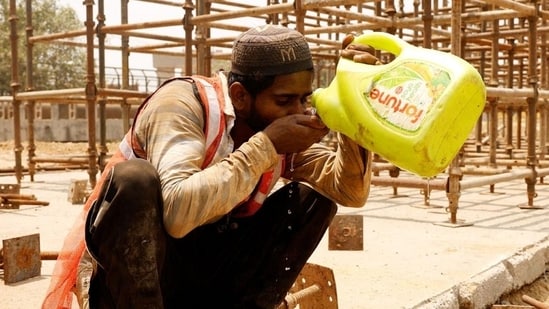
On Friday, the city recorded a maximum temperature of 43.3°C and a minimum of 29.3°C at Safdarjung, the base station. The highest temperature was recorded at the Ridge station (44.4°C).
Also read | Rain respite in Delhi, red alert in Andhra; Banda sizzles at 46°C: How heatwave is taking over India
The city, however, did not officially meet the met department’s criteria for the declaration of a heatwave. The IMD declares a heatwave when the maximum temperature is over 40°C, with the departure being 4.5°C or more above normal, or the maximum is over 45°C in the plains.
The maximum temperature on Saturday is forecast to be between 43°C to 45°C, and remain between 44°C to 46°C from May 24-28. An IMD official said the larger region around Delhi, including Haryana and Chandigarh, will continue to face heatwaves.
{{/usCountry}}The maximum temperature on Saturday is forecast to be between 43°C to 45°C, and remain between 44°C to 46°C from May 24-28. An IMD official said the larger region around Delhi, including Haryana and Chandigarh, will continue to face heatwaves.
{{/usCountry}}Meanwhile, complaints of irregular supply and low water pressure were reported from Vasant Vihar, Dwarka, Moti Bagh and parts of north Delhi.
Delhi’s daily water demand during peak summer reaches nearly 1,250 million gallons per day (MGD), while the average supply remains around 1,000 MGD, according to officials. The gap widens further during heatwave conditions due to increased domestic consumption and evaporation losses.
“The supply related issue has been going on for a week. On Friday too the supply didn’t come at the usual 7am. We reached out to the Delhi Jal Board (DJB), they told us the underground water reservoir will get filled by 11am, but it got filled by only 1pm. Fortunately, we didn’t have to get a private tanker to supply, but half the day went into managing water,” said Aby Johnson, general secretary of the Vasant Kunj Pocket-B Residents Welfare Association.
Expecting the issue to get worse, he said, the RWA has already asked residents to conserve water.
In north Delhi, Ashok Bhasin, president of the RWA, said the supply has substantially reduced in the area by around an hour.
“It used to come from 5.30am to 8am. Now it comes only till 7am. Also, the first 10-15 minutes the water is dirty and the pressure is also very low. However, the usage increases in summers and we have no option but to rely on these large cans. Because of high demand, the price of these has also increased from ₹30 to ₹40,” he said.
In Dwarka Sector 10, resident Meenakshi Arora said households in several apartment complexes were increasingly depending on private water tankers to meet daily needs.
“The morning supply is inconsistent and the pressure is too low for water to reach the upper floors. Societies are calling tankers almost every alternate day now. Tanker prices have also gone up,” she said.
A Moti Bagh resident, Rajeev Sharma said, “We are storing water in buckets and containers because there is no certainty about supply timings anymore. Earlier, the supply was stable, but now even a few hours of disruption affects the entire day, especially in this heat.”
DJB officials acknowledged the strain on supply. “Despite reduced availability of raw water from upstream sources, DJB and the government are working round the clock to ensure minimum inconvenience to people. Around 1,000 water tankers have been deployed across the city, with supply being monitored through nearly 13,000 fixed distribution points,” an official said.
The department added that on average, approximately 6,500 tanker rounds are being carried out every day to ensure water reaches affected areas across Delhi. “We are working on urgent solutions to improve the situation at the earliest,” the official added.
The shortage comes at a time when Delhi’s contingency plans to augment water production have also suffered setbacks. A planned increase in treatment capacity at Wazirabad water treatment plant was recently affected due to a rise in ammonia levels in the Yamuna, impacting raw water quality and disrupting operations.
Stay updated with all top Cities including, Bengaluru, Delhi, Mumbai and more across India. Stay informed on the latest happenings in World News along with Delhi Election 2025 and Delhi Election Result 2025 Live, New Delhi Election Result Live, Kalkaji Election Result Live at Hindustan Times.
Stay updated with all top Cities including, Bengaluru, Delhi, Mumbai and more across India. Stay informed on the latest happenings in World News along with Delhi Election 2025 and Delhi Election Result 2025 Live, New Delhi Election Result Live, Kalkaji Election Result Live at Hindustan Times.