
 E-Paper



Yamuna flood: Over 10,000 evacuated in Delhi
The river, swollen by heavy rains upstream and large releases from the Hathnikund barrage, showed no signs of abating.

 Prefer HTon Google


The Yamuna breached the 206-metre mark in Delhi for the first time this monsoon on Tuesday evening, forcing authorities to evacuate families from low-lying areas and triggering emergency measures across the capital and the wider National Capital Region (NCR).
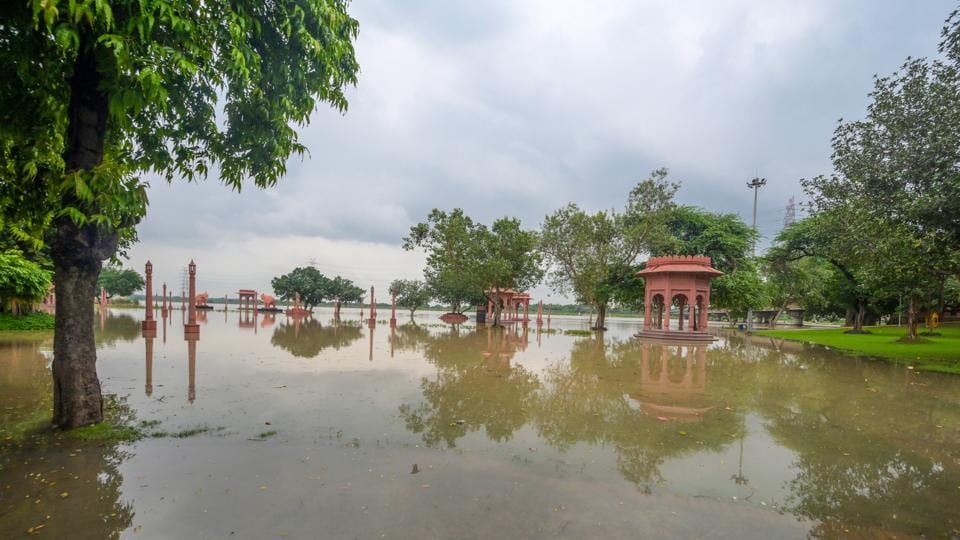
The river, swollen by heavy rains upstream and large releases from the Hathnikund barrage, showed no signs of abating, raising fears of another spell of urban flooding.
At 8pm on Tuesday, the water level at the Old Railway Bridge – which is representative of the city – stood at 206.3 metres, according to the Central Water Commission (CWC). The agency forecast the river to touch 206.9 metres by 7am on Wednesday, but warned that it will continue to rise, with the possibility of breaching the critical 207-metre threshold.
Historical data underscores the gravity of the situation. Records from Delhi’s Irrigation and Flood Control (I&FC) department over the past 63 years show that the Yamuna has crossed the 207-metre mark only four times, most recently in July 2023, when the river touched an unprecedented 208.66 metres, inundating vast swathes of the Capital.
Hathnikund drives surge
The rising water level in Delhi is directly linked to massive discharges from the Hathnikund barrage, located on the Haryana-Uttar Pradesh border. Triggered by incessant rainfall in the upper catchments of the Himalayas and northwestern India, the barrage recorded peak hourly releases of over 300,000 cusecs on Monday – the highest this season. At 9am, the discharge touched 329,313 cusecs, more than double the August 17 peak of 178,996 cusecs.
CWC data shows the barrage has maintained flows above 100,000 cusecs since early Monday, with levels ranging from a low of 142,024 at 6pm to 223,729 cusecs at 1am on Tuesday.
Typically, water released at Hathnikund takes 36 to 48 hours to reach Delhi, meaning Tuesday’s surge is likely the result of Monday morning’s releases. With flow at Hathnikund still high on Tuesday, officials warned that the Yamuna in Delhi is unlikely to recede before Thursday.
In the catastrophic floods of 2023, the barrage maintained discharges above 100,000 cusecs for five consecutive days, peaking at 359,760 cusecs on July 11, 2023.
Officials pointed out that with the city’s water levels already at dangerous levels, the discharge at Hathnikund on Wednesday and Thursday will prove to be critical for the city.
As water levels rose, authorities imposed a string of precautionary closures.
The Old Railway Bridge (Loha Pul), connecting Shastri Park with Salim Garh Fort near Red Fort, was shut to traffic at 4 pm on Tuesday. The I&FC department also closed four of its 22 drain regulators – at Vijay Ghat, Qudsia, Metcalfe, and Tonga Stand – to prevent river water from back flowing into the city’s drainage network.
Despite these measures, experts warned that continued high releases from Hathnikund leave little room for optimism. “Given the peak volume recorded, this flood spell is still less intense than some past events. However, the Yamuna has already started reclaiming stretches of its floodplain that have been encroached or altered,” said Bhim Singh Rawat, associate coordinator at the South Asia Network on Dams, Rivers and People (SANDRP).
Rawat cautioned that beautification projects along the floodplain – such as Vasudev Ghat, Asita East and West, Yamuna Vanasthali, Amrut, Kalindi, and Mayur Vihar floodplain parks – were likely to go under water by Wednesday.
Government gears up emergency response
I&FC minister Parvesh Sahib Singh Verma said on Tuesday the Delhi government had activated a comprehensive flood preparedness plan, placing all departments on high alert. “We are on a war footing. Officers, engineers, and ground staff are on 24-hour duty. From barrages to pumping stations, every mechanism is under strict monitoring,” Verma said, adding that he was personally reviewing coordination with the CWC, Delhi Jal Board (DJB), and the Haryana government.
Special focus, he said, was being placed on the Najafgarh Basin, one of the city’s most flood-prone zones. District magistrates in South West, South East, South, and Central Delhi have been instructed to keep contingency plans ready.
Officials said the government has deployed a robust response force: two chief engineers, five superintending engineers, 20 executive engineers, and dozens of assistant and junior engineers across vulnerable zones. In addition, resources pre-positioned include over 550,000 bags filled with sand, 3,400 stones, 14,370 wooden ballies, or planks, 58 boats, 675 life jackets, 24 generators, 10 fixed pumping stations, 42 mobile pumps, and relief kits across 82 high-risk locations.
DJB has stationed staff on round-the-clock duty at pumping stations to manage water discharge and prevent sewer backflow. “We are ensuring continuous monitoring of water discharge from Hathnikund, Wazirabad and Okhla barrages, with hourly updates and real-time coordination across agencies,” Verma said. All district magistrates have also been directed to prepare evacuation centres and relief supplies in advance.



Stay updated with all top Cities including, Bengaluru, Delhi, Mumbai and more across India. Stay informed on the latest happenings in World News along with Delhi Election 2025 and Delhi Election Result 2025 Live, New Delhi Election Result Live, Kalkaji Election Result Live at Hindustan Times.


