Experiment with e-learning options for the future
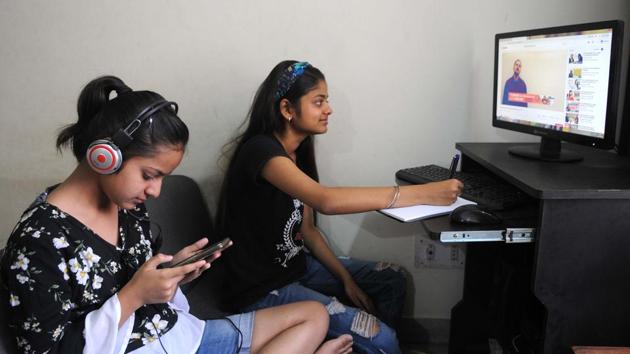
One can access educational videos through WhatsApp, Facebook and YouTube on smart phones. Authorities should hand out such devices free to needy students after enlisting the voluntary help of companies that manufacture them. It will be their historic contribution to a good cause during the lockdown. This expenditure would be peanuts compared to the huge sums of money squandered on building, infrastructure, and equipment in schools, which have a dismally low utilisation index. In fact, this has major scope for an experiment of far-reaching consequences. Its success would encourage the powers that be to test its validity as a sensible replacement for classroom taching. It would be “adventurous” digital learning that intelligently utilises electronic technologies to access educational curriculum outside of a traditional classroom. In successful cases, it could point to a wholesome course, programme or degree delivered completely online.
SS Bhatti
Get students to work together, support each other
Allow students to work together. One student may be good at writing while another may be more creative so they can support each other. Trying out new technology trends can actually be fun for not just the teachers but students too. As teachers adopt new approaches, they will find it gives new life into material and creates excitement among their learners. The significant benefits of integrating technology into the classroom are that it offers a certain degree of flexibility not found in the traditional model of education.
Kirti Dhall, Panchkula
Companies, NGOs must step forward
Post Covid-19 there a need to make children from both the economically and financially wrecked communities fit enough to continue with their right to education. NGOs, education assistance app companies and other major companies out there have an obligation in arduous times like these to divert their CSR budgets towards bringing the right e-learning resources and accessibility to the less privileged. The government is working a lot for the country and acting like a shield from the onerous world emergency in the wake of the Covid-19 and it is the duty of NGOs and financially brawny firms to lend a hand and help the country come out of the current catastrophe or else it’ll be curtains for our nation. Digital learning equity needs the much needed attention at the earliest.
{{/usCountry}}Post Covid-19 there a need to make children from both the economically and financially wrecked communities fit enough to continue with their right to education. NGOs, education assistance app companies and other major companies out there have an obligation in arduous times like these to divert their CSR budgets towards bringing the right e-learning resources and accessibility to the less privileged. The government is working a lot for the country and acting like a shield from the onerous world emergency in the wake of the Covid-19 and it is the duty of NGOs and financially brawny firms to lend a hand and help the country come out of the current catastrophe or else it’ll be curtains for our nation. Digital learning equity needs the much needed attention at the earliest.
{{/usCountry}}Rajesh Bansal, Panchkula
Common, larger medium will work
Children from all strata of society can access e-learning if they are educated through a much common and larger medium. Schools and authorities can do this by broadcasting video lectures for students on All India Radio or Doordarshan and various other radio stations on specified time for specified classes. Time schedules should be circulated through various radio stations. NCERT books should also be translated into audio and video form.
Saikrit Gulati
Train the teachers
Teachers should be given adequate training for online teaching. Secondly, computers and smart phones should be provided to all the students. Thirdly, all villages and remote areas should have access to wifi. Fourthly, fast net speed and data resource should be ensured.
Gurdev Singh, Mohali
Give laptops to students in govt schools
Digital learning for those who cannot afford mobile phones or laptops is possible only if each student gets a laptop in government institutions and teachers there are also given training in e-learning.
Gurpreet S Malhotra, Kansal
Companies should step forward to help
Given that the fight against Covid-19 the coronavirus is going to be a long one, both the government and private school managements have a critical role to play in the digital empowerment of less privileged students and teachers. Companies producing digital equipment such as mobile phones, tablets and laptops should produce extra pieces for people who need it. NGOs and civil societies too should help the poor access digital classes. The government should also start digital classrooms for the lower strata so they do not lack in knowledge. The taxes paid by the aware citizens of India should be spent in this social cause and for the empowerment of less privileged students and teachers.
Ishita Nara, Panchkula.
Government schools should facilitate e-learning
Students of the lower strata join government schools where fees are exempted and food etc are provided free. Some of these schools lack basic facilities such as boards and chalks for even writing or even class rooms so it would be unreasonable to expect them to have digital learning mediums. Let the government educational institutes get all the digital means to teach them at their premises (with social distancing rules in place) and ensure they are exposed to learning that matches with the quality of education in other top schools.
Suresh Verma
Time to create special devices, software
Economically weaker people, bereft of even the three Rs, have access to network with cheap mobile sets. Digital distance learning is in vogue with many a university such as IGNOU, for higher classes. The focus now has to shift for imparting instruction at the primary level. For this, need of the hour is to design cheap mono-frequency-module mobile sets with audio-visual feature and in-built hard disc having flexible software containing study material separately for each class to obviate its misuse. These can be distributed free to EWS-children. Contact numbers of consultant teachers can be publicised. To start with, the above mobiles can be designed for nursery to Class-5. Post-Covid-19 era would warrant a sea change in our lifstyle.
Lalit Bharadwaj
Start with educational TV programmes
While most of the children are able to access online lectures via the internet on smart phones or on desktops/laptops, there is still a group of children left behind, especially those who study in government schools. The government should start with certain television channels through which poor children can have access to education as now most of the families have television sets at home. The channels should have bifurcation according to different classes and lectures/programmes can be telecast during school timings.
Priyam Aggarwal, Chandigarh
Lend students a helping hand
The governments should provide digital facilities to needy students and teachers. The NGOs and civil society have not taken a keen interest in promoting digital classrooms in government institutions. It’s time everyone realised the critical role digital education can play for both teachers and students for ensuring the better future of the nation. It’s high time all key players came together to give especial attention to poor and government school going students.
Sumesh Kumar Badhwar, Mohali
Conduct English and technology classes
In the present scenario, it is very difficult to make lower strata people become tech savvy because either they don’t have smart phones, laptops or they are unable to handle apps like Zoom, Skype etc. Moreover, many are unable to understand the lectures in English. Audio recordings of lectures in Hindi can be sent to them. Those who are unable to access this facility can be taught later on when the schools reopen after the lockdown. For future e-learning, the government can provide them cheap smart phones at easy installments. The government should also make e-learning mandatory for specific topics to ensure teachers and students are familiarised with this process.
Abhilasha Gupta, Mohali