To avoid mass gatherings in view of Covid-19 outbreak, the Punjab government is planning a staggered procurement of wheat this season, which will begin on April 15. Besides, the farmers will be allowed to come to grain markets and other procurement centres on basis of invitation, which will be extended by the Punjab Mandi Board.
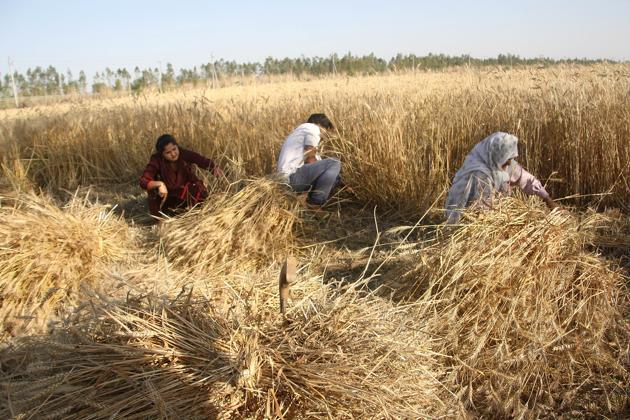
A bumper wheat crop of 135 lakh tonnes is expected to arrive for procurement in the state.
Agriculture secretary KS Pannu, who is chalking out standard operating procedures for procurement, said: “To ensure smooth procurement and also follow the instructions in the wake of Covid-19 outbreak, no farmer can enter a mandi without invitation of the Punjab Mandi Board through the market committee.”
Every day, a limited number of farmers will be issued coupons with holograms and more coupons will only be issued after the earlier produce is lifted, he said, adding that the coupon will work as curfew pass. “Each coupon will entitle a farmer to sell 50 quintals of wheat, which he will bring in his vehicle to the mandi. Arhtiyas (commission agents) will help market committees to issue coupons to farmers. The payment will be made through arhtiyas,” he said.
To maintain social distance, ground space at the mandis is being divided into 30ft x 30ft lots for heaps of 50 quintals each.
{{/usCountry}}To maintain social distance, ground space at the mandis is being divided into 30ft x 30ft lots for heaps of 50 quintals each.
{{/usCountry}}“We are making efforts to spread out procurement in terms of days and number of locations,” said food and civil supplies minister Bharat Bhushan Ashu.
He added: “It’s a mammoth task. We also have to ensure the safety of our farmers. We are making all arrangements for social distancing and other protocols to stop spread of the virus.”
1,900 RICE MILLS CONVERTED INTO PROCUREMENT CENTRES
To spread out procurement operations, the food and civil supplies department has decided to convert 1,897 rice shelling mills with large yard spaces into procurement centres.
“Apart from our regular 1,864 mandis and procurement centres, we have notified 1,897 rice mills as procurement centres, taking the total to 3,761, and we are in process identifying more. With this, we can reach out to farmers’ doorsteps, giving a cluster of two to three villages a separate facility for cleaning, packing and weighing of the grain,” said additional chief secretary (development) Viswajeet Khanna, who heads the state committee on harvesting and procurement.
He said the commission agents will help in bringing out the farmers turn-wise with their produce. “We are providing gloves, masks and hand sanitisers at all procurement centres.”
Meanwhile, IMD regional director Surender Paul predicted unsatisfactory weather conditions with sporadic rainfall, strong winds and sudden fall and rise in temperatures during April and May, when procurement operation is expected to be at peak.
Punjab Agricultural University vice-chancellor BS Dhillon suggested farmers to preserve freshly harvested wheat at their end as long as possible.
SHORTAGE OF GUNNY BALES, LABOUR
There is also a shortage of gunny bales required by procurement agencies for wheat storage as the jute mills in West Bengal that supply gunny bags to Punjab have stopped production. “Out of our requirement of 4.85 lakh bales, we are short of at least one lakh bales,” said food and civil supplies director Anindita Mitra.
She said the state government has written to the West Bengal government to allow production of gunny bags. She added that Punjab has also sought permission from the Centre to use polypropylene bags as an alternative.
“Shortage of labour is also a big concern as workers form UP and Bihar are not in Punjab now, so the state is banking on indigenous labour which is engaged in MNERGA works,” said Viswajeet Khanna, adding that harvesting and procurement requires 5 lakh work heads, who could be arranged from within the state.
The authorities have instructed that all trucks and harvester combines going from one village to another will be sanitised regularly.