
 E-Paper



Gurugram air quality slips to ‘poor’ post-Grap; Experts cite gridlock emissions
Experts from the University of Chicago’s EPIC India said stop-and-go traffic and idling engines sharply increase fuel use and urban emissions.

 Prefer HTon Google


A day after the Graded Response Action Plan (Grap) came into effect in the National Capital Region (NCR), several key stretches in Gurugram recorded a rise in air pollution levels, with air quality slipping into the “poor” category due to heavy vehicular congestion and dust from poorly maintained roads, officials and experts said on Wednesday.
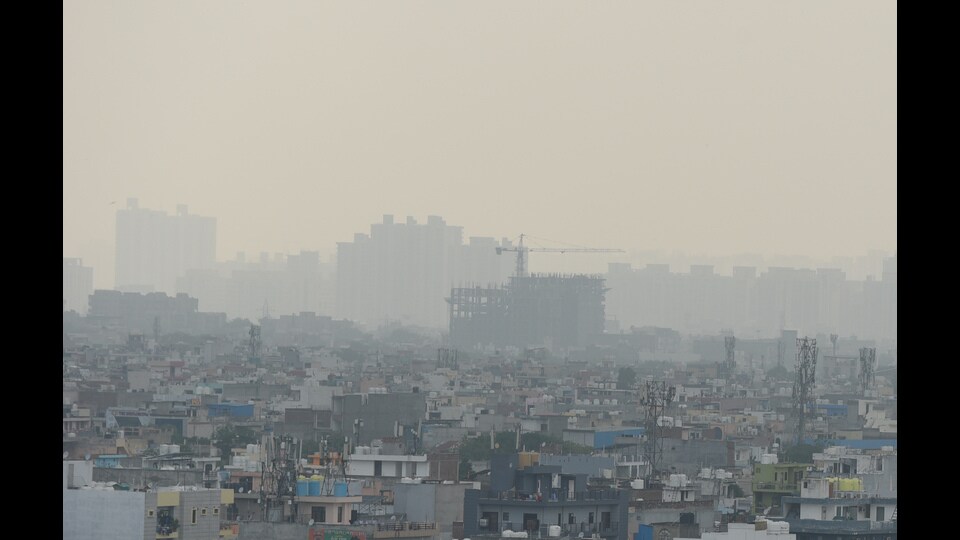
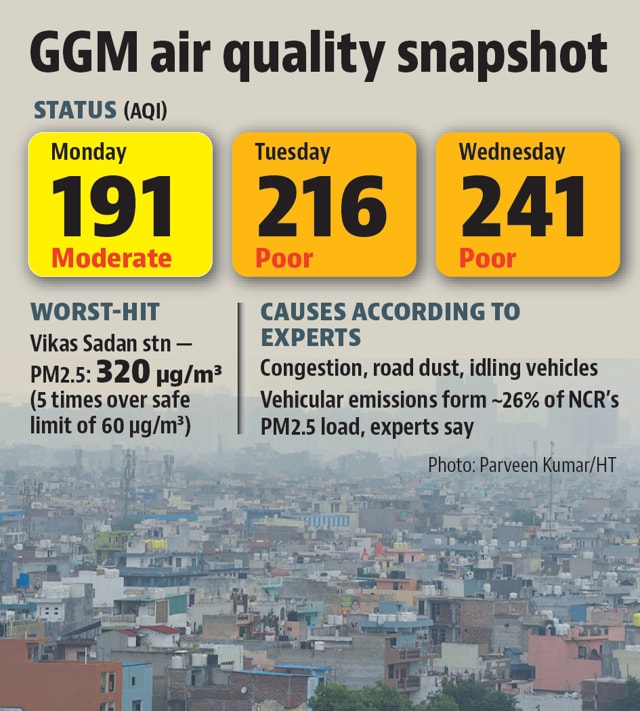
According to the Central Pollution Control Board (CPCB), Gurugram’s four continuous ambient air quality monitoring stations reported an average AQI reading of 241, up from 216 recorded on Tuesday. The Vikas Sadan station reported the worst air quality in the city, with PM2.5 levels touching 320 µg/m³ and both PM10 and CO levels exceeding safe limits. On Monday, the city’s AQI was “moderate” at 191.
District administration officials attributed the deterioration to massive congestion along the Delhi–Jaipur–Gurugram Expressway (NH-48), Shankar Chowk–Sirhol Toll Plaza, and the Gurugram–Faridabad Road. They said traffic jams, coupled with dust emissions and road damage, caused micro-level spikes in pollution.
An HT spot check found bumper-to-bumper traffic on a one-kilometre stretch of Old Railway Road near Rajiv Chowk underpass, where vehicles were stalled for nearly ten minutes during peak hours. Around 2pm, private regional air quality monitors reported AQI levels of 169 µg/m³ in nearby Civil Lines and Sector 14. At the same time, NH-48 recorded AQI 174.
Among other major routes, Sohna Road recorded PM10 at 227 µg/m³ and PM2.5 at 52 µg/m³, Gurugram–Faridabad Road showed PM10 129 and PM2.5 47, while Shankar Chowk–Cyber City logged PM10 156 and PM2.5 63.
Experts link gridlock to rising emissions
Kaushik Deb, executive director of the Energy Policy Institute at the University of Chicago (EPIC India), explained how long waiting times on roads significantly increase fuel consumption and emissions. “When vehicles move steadily at optimal speed, the engine operates in a more efficient regime, producing fewer pollutants. Congestion forces frequent acceleration and idling, worsening efficiency and spiking emissions,” Deb said.
He added that the region’s transport system was not designed for current commuting demand. “The mismatch between road capacity and vehicle volume leads to constant congestion, with vehicles occupying most of the carriageway and leaving little space for smooth movement,” he said.
Citing earlier research by the Centre for Science and Environment (CSE), officials noted that vehicular emissions contribute nearly 26% of PM2.5 pollutants in the city’s air. “Breathing toxic air every day in Delhi-NCR silently shortens years of life and traffic jams only make it worse,” Deb said.
Traffic police ramp up enforcement
To manage traffic during the festive season, Gurugram Police have stepped up enforcement across major junctions. “In the coming days, Gurugram police will increase deployment by assigning 10–15 officers at each traffic violation spot across the city for a week to challan and stop violations,” Vikas Arora, commissioner of police, said during a event at DCP headquarters.
Traffic police officials said easing bottlenecks is their top priority during the festiv
e rush. “Our officers are working extra hours to make sure that commuters don’t face inconvenience. To manage the seasonal changes, we periodically advise our zonal officers to maintain good health by wearing masks during work and carrying electrolytes with them,” said Satyapal Yadav, assistant commissioner of police (traffic highways and headquarters).

Stay updated with all the Breaking News and Latest News from Mumbai. Click here for comprehensive coverage of top Cities including Bengaluru, Delhi, Hyderabad, and more across India along with Stay informed on the latest happenings in World News.


