...
...
Next Story

Haryana to station cybercrime units in Jharkhand, WB

Haryana Police have stationed teams in Jharkhand and West Bengal to counter cybercrime, as these states are identified as primary sources of cyber fraud calls. Multiple teams have been deployed to identify gang members who dupe people from Haryana, resulting in nearly 50 arrests in the last month. Haryana Police receives around 1,200 calls of cyber fraud daily, and efforts are being made to block bank accounts and freeze SIM cards used by suspects. The police have noted a 20-30% reduction in cybercrime in the last two months.

Updated on: Dec 2, 2023, 05:34:03 IST
Advertisement

In a bid to counter the menace of cybercrime, Haryana Police have stationed their teams in Jharkhand and West Bengal, as they have identified these two states as primary sources of cyber fraud calls, said Shatrujeet Singh Kapur, director general of police (DGP), Haryana, during a review of the law-and-order situation in Gurgaon, on Friday.
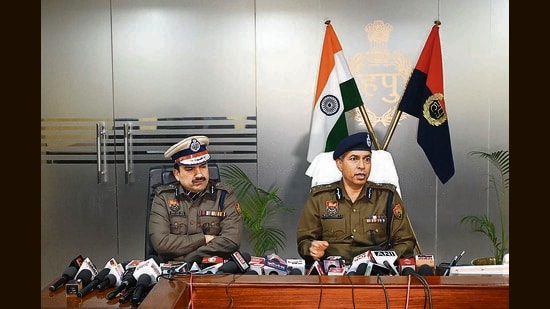
The Haryana DGP (right) at a press conference. (Parveen Kumar)

Multiple teams comprising cybercrime police personnel and officers — from Gurugram and Faridabad districts that have reported maximum such cases — were deployed in West Bengal and Jharkhand last month, to identify gang members who allegedly dupe people from Haryana.

“Jharkhand and West Bengal have been identified as the primary sources of cyber fraud calls targeting residents of Gurugram, Faridabad, and other districts in Haryana. Most calls to dupe people were made from these two states,” said Kapur. This deployment, police said, has led to a nearly 50 arrests in the last one month.

Kapur said that the decision was taken to ensure quick and swift resolution of the complaints.

“The teams we have sent coordinate with the local police and seek their support to identify gangs that are involved in cases of cyber fraud. Our teams there keep a check on the suspects based on technical surveillance of the phone numbers used to make calls. Raids are also planned and conducted with the help of the local police,” said the DGP.

Kapur said Haryana Police receives around 1,200 calls of cyber fraud daily, of which money transaction takes place in about 220-250 cases.

“We are coordinating with nodal officers of seven banks to ensure that money doesn’t get transferred in such cases. Efforts are also being made to ensure that bank accounts of these fraudsters, who are mostly from West Bengal and Jharkhand, are blocked on time,” said the DGP.

He said that they are working with nodal officers of at least four banks in Panchkula so that the accounts being used by the suspects can be frozen soon after any victim alerts the police by calling on 1930 or contacting the 112 call centre.

Apart from this, Kapur said that Haryana Police are coordinating with four big telecom companies so that their executves are available in real-time to block SIM cards used by suspects, immediately after a cybercrime is reported on the call centre.

“In the last three-four months, we have had several rounds of meetings with the governor of the Reserve Bank of India (RBI), its regional governor in Chandigarh, the Union ministry of home affairs, and the Indian Cyber Crime Coordination Centre for a crackdown on cybercrime. We have been able to increase bank account blocking rate by three times and have noted a 20%-30% reduction in such crimes in the last two months. We are now observing if this reduction continues to hold,” the police officer said.

Kapur added that the number of staff deployed on the cyber helpline number, 1930, has been doubled to 25 to expedite the resolution of complaints.

“Cyber criminals are using new methods to cheat people online. In such a situation, teams are conducting investigations and writing to banks and telecom providers to ensure they get the updates and deactivate the numbers being used by them. The number of awareness campaigns on cyber security have been increased so that people do not share personal information related to bank accounts with anyone,” Kapur said.

 
ABOUT THE AUTHOR
Leena Dhankhar

Leena Dhankhar is Senior Editor and Bureau Chief, Gurugram, at Hindustan Times, where she has spent over 17 years chronicling the transformation of one of India's fastest-growing urban regions. From starting her career as a crime reporter to leading the Gurugram bureau, her journalism has been defined by investigative reporting, in-depth storytelling and an unwavering focus on public interest. Over nearly two decades, she has reported extensively across crime, politics, civic governance, elections, real estate, environment, courts, sports, education and entertainment, covering Gurugram, Faridabad, Nuh and Palwal. Her reporting has exposed several major scams and systemic failures, including insurance frauds, waste management irregularities, illegal arms manufacturing units in Nuh, illegal mining in the Aravallis, organised crime networks and governance lapses affecting millions of residents. Known for her investigative work and exclusive stories, Leena has reported on high-impact national issues, including the Nicaragua charter flight carrying Indian migrants that was turned back amid allegations of human trafficking, exposing the growing network of illegal immigration rackets. Her work has also focused on gang wars, prison administration, juvenile crime, women and child protection systems, the functioning of the Juvenile Justice Board and Child Welfare Committee, and environmental challenges such as pollution, waterlogging and deteriorating civic infrastructure. Beyond hard news, Leena has extensively documented Haryana's rich heritage, forests and wildlife, bringing attention to the state's historical landmarks, biodiversity, conservation efforts and ecological challenges through immersive reportage and feature writing. Her journalism has consistently gone beyond breaking news. She has documented Gurugram's rapid urbanisation through long-form narratives and enterprise reporting on issues ranging from pothole-ridden roads, flooding and waste management to the changing social fabric of India's Millennium City. She also writes widely read feature columns, including The Outsider, Changemaker, and Concern for Gurugram, profiling people, places and ideas shaping the city's identity. Leena is the author of Gurugram School Murder, published by Juggernaut Books, a deeply reported account of one of India's most high-profile school murder investigations. She is currently working on her second book, an investigative work exploring some of India's most significant scams and fraud investigations. Beyond print journalism, she has expanded her storytelling through public speaking and digital media. She is a TEDx speaker and has produced podcasts exploring Gurugram's transformation, civic challenges and untold stories. Her work reflects a commitment to narrative journalism that combines rigorous reporting with compelling storytelling. A law graduate with an MBA in Human Resources, Leena brings a multidisciplinary perspective to her reporting, particularly on governance, public policy and legal affairs. She has travelled extensively across India to pursue investigative assignments, often reporting from remote locations and conflict-prone areas in search of stories that matter.

ABOUT THE AUTHOR
Debashish Karmakar

Debashish Karmakar is a principal correspondent with the Hindustan Times, Gurugram bureau. He has a vast journalistic experience of almost 14 years of covering crime, court, power, transport, administration, weather and other beats while working across various organisations. He has been covering Gurugram, Faridabad, Nuh, Palwal and other districts of southern Haryana for more than four and a half years. He has produced several breaking and exclusive stories while reporting from the ground where he maintains a strong presence on a daily basis. He writes news articles which are hard-hitting and accurate. With his strong bureaucratic sources, he frequently writes stories to expose the failure of the system forcing authorities to take necessary course-corrective steps. Besides crime, important convictions and court orders, he also writes on human-angle stories, on power issues and challenges faced by the residents on a daily basis in Gurugram and neighbouring areas. In the past, he worked for media houses like The Times of India, where he extensively reported on important government matters and daily proceedings at the Patna High Court. He has also worked in the electronic media and had done ground coverage on the Kedarnath deluge that wrecked Uttarakhand in 2013.

Catch every big hit, every wicket with Crickit, a one stop destination for Live Scores, Match Stats, Infographics & much more. Explore now!.

Stay updated with all the Breaking News and Latest News from Mumbai. Click here for comprehensive coverage of top Cities including Bengaluru, Delhi, Hyderabad, and more across India along with Stay informed on the latest happenings in World News.
Catch every big hit, every wicket with Crickit, a one stop destination for Live Scores, Match Stats, Infographics & much more. Explore now!.

Stay updated with all the Breaking News and Latest News from Mumbai. Click here for comprehensive coverage of top Cities including Bengaluru, Delhi, Hyderabad, and more across India along with Stay informed on the latest happenings in World News.
SHARE THIS ARTICLE ON
Notifications

Get breaking alerts directly from the newsroom

Notifications are on!You'll be notified when news breaks