The Municipal Corporation of Gurugram (MCG) is set to introduce a mobile app-based system to operate and monitor street lights across Gurugram, officials said, in a move aimed at improving maintenance efficiency and strengthening smart city infrastructure.
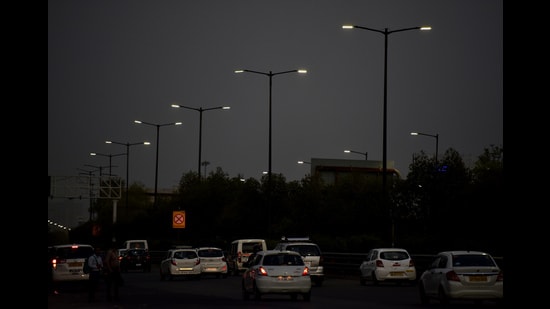
(Representative image) The civic body plans to gradually bring a majority of the city’s 125,000 streetlights under a centralised monitoring network. (HT Archive)
{{^htLoading}} {{/htLoading}}
Under the plan, nearly 25,000 street lights installed across colonies, old residential areas and villages, particularly those mounted on walls, rooftops or electricity poles, will be integrated with an app-controlled system in the first phase.
Currently, faulty street lights often remain non-functional for days due to delays in identifying and repairing faults. Officials said the new system will install control panels connected directly to a mobile application, allowing authorities to remotely switch lights on or off and monitor their functioning in real time.
The system will also include an alert mechanism under which automatic notifications will be sent to concerned officials if a street light malfunctions or fails to turn on, enabling quicker repairs. Municipal officials said the centralised system will allow street lights in an entire sector or colony to be controlled simultaneously.
{{^htLoading}} {{/htLoading}}
{{^usCountry}}
While some streetlights in Gurugram, especially in newer sectors and highways, operate through timers or light sensors, many in older colonies and villages still rely on manual or semi-manual systems, officials said.
{{/usCountry}}
{{#usCountry}}
While some streetlights in Gurugram, especially in newer sectors and highways, operate through timers or light sensors, many in older colonies and villages still rely on manual or semi-manual systems, officials said.
{{/usCountry}}
“To operate street lights in a modern and efficient manner, control panels and app-based systems will be installed. The lights connected to these panels will be managed through a mobile app, for which a detailed plan has been prepared,” said Vijay Dhaka, chief engineer, MCG.
Officials said Gurugram currently has around 125,000 street lights, and the civic body plans to gradually integrate a majority of them under a SCADA-based (Supervisory Control and Data Acquisition) centralised monitoring system. Around 50% of the lights will be integrated in the first phase, followed by expansion to the remaining areas. The proposed app-based SCADA system aims to centralise monitoring through real-time tracking, remote operation and automatic fault alerts, officials added.
Leena Dhankhar is Senior Editor and Bureau Chief, Gurugram, at Hindustan Times, where she has spent over 17 years chronicling the transformation of one of India's fastest-growing urban regions. From starting her career as a crime reporter to leading the Gurugram bureau, her journalism has been defined by investigative reporting, in-depth storytelling and an unwavering focus on public interest.
Over nearly two decades, she has reported extensively across crime, politics, civic governance, elections, real estate, environment, courts, sports, education and entertainment, covering Gurugram, Faridabad, Nuh and Palwal. Her reporting has exposed several major scams and systemic failures, including insurance frauds, waste management irregularities, illegal arms manufacturing units in Nuh, illegal mining in the Aravallis, organised crime networks and governance lapses affecting millions of residents.
Known for her investigative work and exclusive stories, Leena has reported on high-impact national issues, including the Nicaragua charter flight carrying Indian migrants that was turned back amid allegations of human trafficking, exposing the growing network of illegal immigration rackets. Her work has also focused on gang wars, prison administration, juvenile crime, women and child protection systems, the functioning of the Juvenile Justice Board and Child Welfare Committee, and environmental challenges such as pollution, waterlogging and deteriorating civic infrastructure.
Beyond hard news, Leena has extensively documented Haryana's rich heritage, forests and wildlife, bringing attention to the state's historical landmarks, biodiversity, conservation efforts and ecological challenges through immersive reportage and feature writing.
Her journalism has consistently gone beyond breaking news. She has documented Gurugram's rapid urbanisation through long-form narratives and enterprise reporting on issues ranging from pothole-ridden roads, flooding and waste management to the changing social fabric of India's Millennium City. She also writes widely read feature columns, including The Outsider, Changemaker, and Concern for Gurugram, profiling people, places and ideas shaping the city's identity.
Leena is the author of Gurugram School Murder, published by Juggernaut Books, a deeply reported account of one of India's most high-profile school murder investigations. She is currently working on her second book, an investigative work exploring some of India's most significant scams and fraud investigations.
Beyond print journalism, she has expanded her storytelling through public speaking and digital media. She is a TEDx speaker and has produced podcasts exploring Gurugram's transformation, civic challenges and untold stories. Her work reflects a commitment to narrative journalism that combines rigorous reporting with compelling storytelling.
A law graduate with an MBA in Human Resources, Leena brings a multidisciplinary perspective to her reporting, particularly on governance, public policy and legal affairs. She has travelled extensively across India to pursue investigative assignments, often reporting from remote locations and conflict-prone areas in search of stories that matter.