
 E-Paper



Operation Trishul: Army, air force conduct ‘Maru Jwala’ war exercise near Pakistan border
The Southern Command led the exercise under the supervision of Lieutenant General Dhiraj Seth (PVSM, AVSM), General Officer Commanding-in-Chief.

 Prefer HTon Google


The Indian army and air force conducted a large-scale joint exercise, ‘Maru Jwala’, in the Jaisalmer desert near the Pakistan border on the 11th day of the 12-day ‘Operation Trishul’.
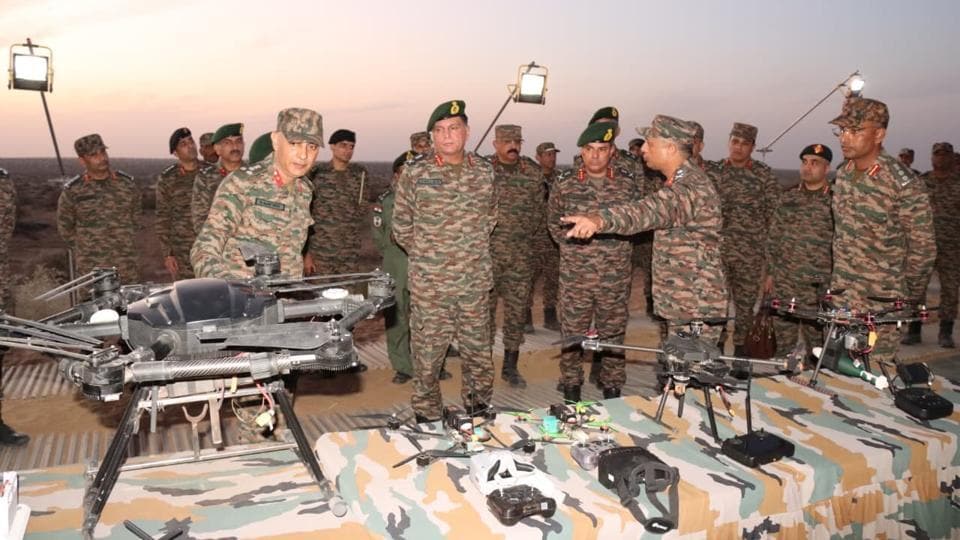
The drill simulated coordinated strikes on terrorist hideouts and enemy positions, highlighting India’s combat readiness and growing use of advanced technology in desert warfare.
The exercise began with drones identifying enemy locations and broadcasting evacuation messages to nearby villages. Once targets were marked, ground troops and air units launched simultaneous attacks. Mechanised infantry and armoured corps formations, supported by attack helicopters, executed the assault. T-90 tanks advanced under aerial cover, while drones supplied ammunition and robotic mule dogs delivered first aid kits to injured soldiers, showcasing the army’s adoption of automation and AI-driven logistics.
The Southern Command led the exercise under the supervision of Lieutenant General Dhiraj Seth (PVSM, AVSM), General Officer Commanding-in-Chief, who inspected the battlefield and praised the coordination between the Konark Corps and Battle Axe Division. He described the exercise as a live example of the Army’s JAI Mantra — Jointness, Atmanirbharta (Self-Reliance), and Innovation — emphasising that the army is not only guarding the borders but also driving India’s progress in defense technology and modernisation.
According to Defence PRO Lt Col Nikhil Dhawan, Lt Gen Seth also reviewed the operational preparedness of the Konark Corps during Exercise Akhand Prahar, a key component of Operation Trishul. The exercise validated the army’s ability to conduct integrated, multi-domain operations in close coordination with the air force.
Lt Col Dhawan said the Army Commander observed combined-arms manoeuvres, next-generation battlefield technologies such as drones and counter-drone systems, and field trials of newly inducted indigenous platforms. He also reviewed innovations developed by field formations, including home-grown drones, counter-drone equipment, and advanced force protection systems, reflecting the army’s focus on self-reliance and innovation.
Lt Gen Seth commended the participating formations for their adaptability, technological innovation, and operational excellence. He said ‘Exercise Akhand Prahar’ reaffirmed the army’s commitment to synergy and transformation across the multi-domain battlespace, strengthening India’s ability to respond swiftly and decisively to any threat along its western frontier.


