The kharif season is set for failure for the farmers in drought-affected villages of Beed district, Maharashtra.
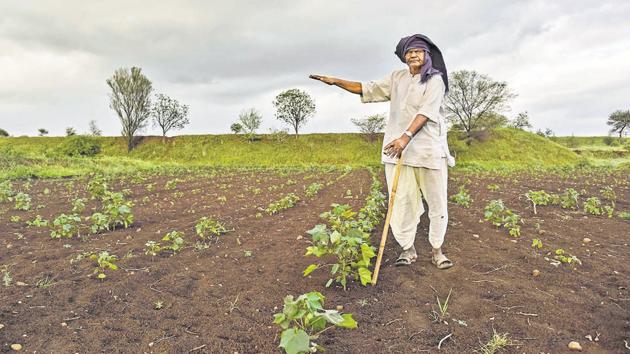
The two major kharif crops that farmers had sown - millet and cotton - have failed to perform in absence of sufficient rainfall in the initial weeks after sowing.
“The first trigger for drought, as per the drought manual, is receiving less than 50% of the season’s rainfall till July end. The July end reading for Beed was 47.98%,” said Rajendra Nikam, district agriculture officer of Beed district.
The villages around Rajuri Navgan village in Beed taluka and Dhanora villlage in Ashti taluka in the district recorded the lowest rainfall of the season. While the Dhanora circle received 119 mm rainfall, Rajuri received 120mm rainfall against the highest of 523.4mm in Majalaon on September 12.
“Look at this corn (millet corn). It has only grown this much. It’s harvest time now and by now it should have grown above our heads. Now I have only kept it to let it completely dry out and use it as fodder for my cattle as the fodder camps are shut,” said Ashok Namdev Gaikwad, a farmer in his sixties from Dhanora village who had sown in around 35 guntha (0.75 acre) land.
“We put the seed after the first rainfall because there was no other option. But since then, the rain has been like a saline drip in the hospital. It rains a few drops which is not enough to wet a person’s clothes even. How will a cotton crop grow in it?” said Sonaji Jamdade, over 65 years of age and a resident of Rajuri Navgan village in Beed taluka. In a good rainfall season, he could expect 15-20 quintal of cotton from his 2 acre land.
{{/usCountry}}“We put the seed after the first rainfall because there was no other option. But since then, the rain has been like a saline drip in the hospital. It rains a few drops which is not enough to wet a person’s clothes even. How will a cotton crop grow in it?” said Sonaji Jamdade, over 65 years of age and a resident of Rajuri Navgan village in Beed taluka. In a good rainfall season, he could expect 15-20 quintal of cotton from his 2 acre land.
{{/usCountry}}While millets are a short span crop, cotton needs more time to grow to its full length. While villagers in Rajuri had sown millet in the beginning of June, the ones in Dhanora had sown in the last few days of June owing to the fluctuating time of the first shower.
“By now, this plant should have had multiple flowers and grown at least thrice the height it is right now. That is possible only when it gets enough rain in the beginning. Now even if rains, it is of no use to my cotton,” said Bhausaheb Umaji Gavhane, 67, a resident of Dhanora village. However, not only did his crop suffer due to lack of rain but also developed rot around its stemp and turned its veins red. “After the first leaves start blooming, if you use chemicals, it will burn the crop. So I could not do that,” he said.
Gaikwad had also planted sesame around his millet crop but had lost that as well to a rot caused by lack of rain. “I had seen rot in a sugarcane crop but never this kind of rot on a crop like sesame,” he said.
Rot had spread through the green gram field of Kailas Ganpat Pawal, 35, of Rajuri Navgan village, which he had sown in addition to his millet crop. “This bean generally has a green cover on it. Now the leaves are chewed on by green worms and the beans are black. I still have 4-5 quintals of millet in 12 sacks that rot last year. This small patch could have given me green gram for my house at least,” he said.
The district, however, is dependent predominantly on rabbi crops, according to Nikam.
“There is some ground moisture (requirement for sowing) but it is going to be a risk to sow rabbi jowar that the farmers will take. The rabbi jowar and gram survival will depend on the returning showers of the season,” said Nikam.
The fear of survival of the rabbi crop was echoed by all the farmers we spoke to who had given up completely on the kharif crops.
Even if the season-end rainfall decides to grace the district, the farmers in Rajuri Navgan and Dhanora have accepted the kharif season to have been a failure.