Droughts, floods heat and cold waves have wreaked havoc on traditional farming. However, with the state government promoting alternative produce to enhance farmers’ income, climate-resilient dragon fruit farming is emerging as a ray of hope for many progressive cultivators.
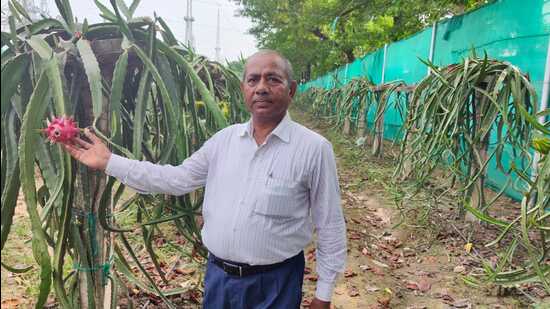
They include a handful who have started it in Sarangapur and Tengai villages in Chaka development block in trans-Yamuna area of Prayagraj district. One such progressive farmer is Chhote Lal Gautam who is cultivating dragon fruit on two-acre land in Sarangapur village.
“Crops were regularly getting damaged or failing owing to uncertain monsoon and problem in irrigating the crops. I could barely afford the losses and so I decided to go for dragon fruit cultivation on an acre of land in 2020 and got good results. I then expanded it to another acre,” said Chhote Lal, 66, a retired state government engineer-turned-farmer. Like him, Ravindra Pandey and Sunil Patel of Tengai village have also turned to dragon fruit farming and their income has increased manifold.
“Initial investment is higher as compared to traditional farming ranging around ₹10 lakh per acre because the plant needs a pillar for support and its installation is a labour-intensive job but what is unique about this fruit is that its production is not really affected by drought, floods or any other weather anomalies. It’s almost like a cactus plant which needs very little care and supervision,” said Ravindra Pandey, 55, who shifted from growing paddy to dragon fruit just two years back.
{{/usCountry}}“Initial investment is higher as compared to traditional farming ranging around ₹10 lakh per acre because the plant needs a pillar for support and its installation is a labour-intensive job but what is unique about this fruit is that its production is not really affected by drought, floods or any other weather anomalies. It’s almost like a cactus plant which needs very little care and supervision,” said Ravindra Pandey, 55, who shifted from growing paddy to dragon fruit just two years back.
{{/usCountry}}“These plants start bearing fruits in the first year itself. Generally, these plants starts flowering in May-June and bear fruits from August to December,” Pandey added. “One can earn a profit of around ₹10 lakh per acre from third year onwards with market price of the fruit ranging between ₹50 and ₹60 per piece which is then sold at double the price in retail by shopkeepers,” he added.
Deputy director (horticulture), Prayagraj, Krishna Mohan Chowdhary said in accordance with the state government’s initiative, the horticulture department is encouraging farmers to cultivate new varieties of crops which are not only climate-resilient but also profitable for them owing to their high demand.
“We presently have only a handful of farmers growing dragon fruit in Prayagraj region but we are encouraging more to switch to it. The state government provides financial assistance of ₹30,000 per hectare for a farmer who cultivates dragon fruit besides the technical assistance that the state horticulture department provides them,” he said.
“Once planted, the dragon fruit yields a harvest for the next 25 years with nominal expenses on insecticides and general maintenance,” Chowdhary added. Farmers who have started dragon fruit cultivation say its plant is not only strong enough to survive dry spells when almost every crop withers, but it is also resistant to pests.
“Also, due to its cactus-like spiny exterior, no cattle dares to even approach these plants, which is a blessing for farmers in the area who are struggling to deal with crop damage due to stray cattle menace,” they say.
“Even when the temperatures hover between 42 and 44 degrees Celsius, the plant does just fine. It turns slightly yellowish during extreme heat but returns to its original colour once the temperature climbs down,” the farmers say.