The early onset of summer this year has hit wheat production in Uttar Pradesh. The state alone contributes more than 25% of India’s total wheat production.
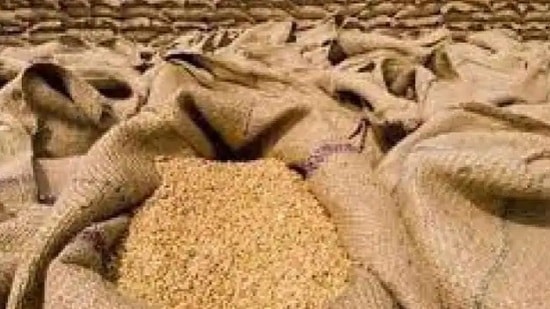
For representation only (HT File Photo)
A recent survey by the state’s agriculture department put the total wheat production in UP in 2022 at 359 lakh metric tonnes (LMT) which is 16 LMT less than the wheat production recorded in 2021.
{{^htLoading}} {{/htLoading}}
Wheat production as well as total food grain production had been on the rise for the last few years largely because of favourable monsoons.
“Compared to the previous year, the wheat production this year is estimated to have fallen by around 16 lakh MT given the fact that wheat production in 2021 was recorded to be 375 LMT against 359 LMT this year,” Rajesh Gupta, agriculture director, statistics, said.
“The early arrival of summer this year is the main reason for the decline in the wheat productivity and production in the state,” he added. Since the temperature started to be high right from March, the wheat grains germinated or ripened prematurely because of which both quality and quantity suffered heavily resulting in low production, he explained.
{{^htLoading}} {{/htLoading}}
{{^usCountry}}
The survey also found that unlike in 2021 when the average wheat production was found to be 38.04 quintal per hectare, this year the output shrank to 36.81 per quintal, sowing having been done on around 98 lakh hectares of area.
{{/usCountry}}
{{#usCountry}}
The survey also found that unlike in 2021 when the average wheat production was found to be 38.04 quintal per hectare, this year the output shrank to 36.81 per quintal, sowing having been done on around 98 lakh hectares of area.
{{/usCountry}}
According to Gupta, the wheat crop needs a longer cold spell for optimum output but the early onset of summer and heat waves adversely affected the wheat production in the state.
UP, which is the highest wheat-producing state in the country, grows around 100 LMT as market surplus which is sold to government agencies at the minimum support price (MSP) and the private traders at the market price.
Government data shows that UP produces 20% of the country’s total food grain feeding the country’s 16.9% population. This is despite the fact that the state’s share in the country’s cultivatable land is only 11.8%. Wheat alone accounts for more than 50% of the state’s total food production.
Brajendra K Parashar is a Senior Journalist with the Hindustan Times, based in Lucknow, with nearly three decades of experience covering governance, public policy, politics and development in Uttar Pradesh. Over the years, he has reported extensively on key sectors, including energy and renewable power, mobility and transport, road safety, agriculture and allied sectors and issues related to farmers, rural development, taxation under the Goods and Services Tax (GST) and public administration. A seasoned political correspondent, Parashar closely tracks the Bharatiya Janata Party (BJP) and has covered every major election in Uttar Pradesh right from three-tier panchayat elections and urban local body polls to Assembly and Lok Sabha elections. He also reports regularly on the proceedings of the Uttar Pradesh Legislature, bureaucracy, governance, policy decisions and administrative developments with focus on their impact on public life. His reporting is known for its strong analytical approach, extensive use of official data. His areas of interests include investigative journalism, long-form political and policy analysis, data-driven reporting, elections and institutional reforms. Parashar holds a postgraduate degree in Political Science with First Division from Aligarh Muslim University (AMU), followed by a Diploma in Journalism and Mass Communication from the same university. His inclination towards journalism began during his student days, when he regularly contributed letters to editors and articles to newspapers and magazines. In the mid-1990S, his essay, “Should India Switch Over to the Presidential Form Of Government?”, published in Politics India magazine edited by noted constitutional expert Subhash C Kashyap, was adjudged the best entry in a national competition. His work has received professional recognition, including the Hindustan Times Journalist of the Month Award for an impactful series on drinking water issues during the 2010 Lok Sabha election campaign. Originally from Kasganj in western Uttar Pradesh, Parashar is currently based in Lucknow where continues to report on politics, governance and public policy.