E-Paper



Element of surprise key to staying future ready in tech-driven warfare, says Rajnath Singh
Research, element of surprise key to staying future-ready in tech-driven warfare, says defence minister at North Tech Symposium 2026 in Prayagraj

 Prefer HTon Google


Defence minister Rajnath Singh on Monday stressed the need for sustained investment in research and the cultivation of the “element of surprise” to ensure preparedness in an era of rapid technological transformation.
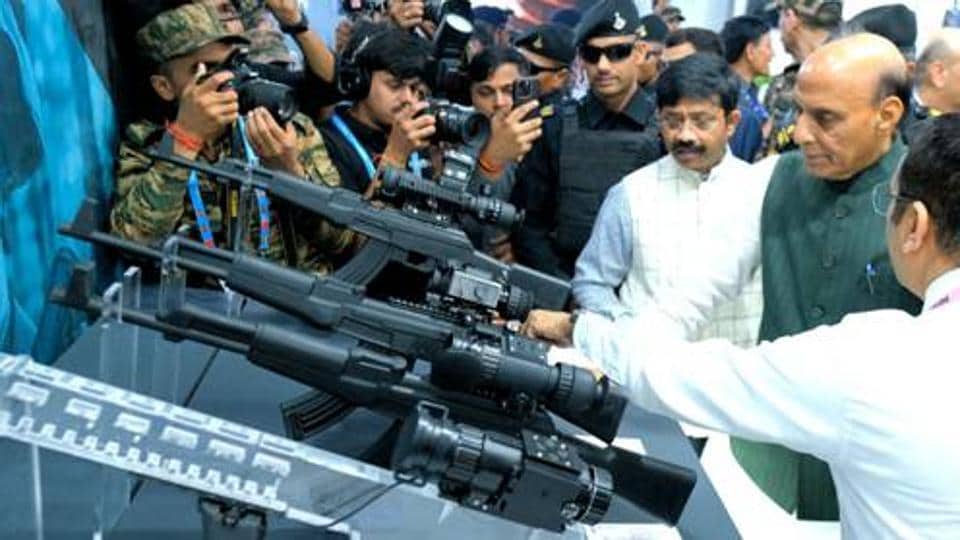
Singh was addressing defence personnel, industry leaders, innovators, start-ups and academia at the inaugural session of the three-day North Tech Symposium 2026 in Prayagraj.
“There is no substitute for research. The nature of future wars is being determined in laboratories today,” he said.
He also mentioned Operation Sindoor days ahead of its first anniversary and described it as a “unique” example of how the Indian military utilised advanced technology to deliver a decisive blow to terror groups and their “patrons”.
In addition, he referred to Israel’s ‘Operation Grim Beepers’ pager blasts to warn that “everything can be weaponised”, as he underlined the rapidly changing nature of modern warfare.
The symposium is being organised by the Indian Army’s Northern and Central Commands in collaboration with the Society of Indian Defence Manufacturers (SIDM).
Singh emphasised that while the armed forces “showed patience”, they were clinical in destroying terrorist infrastructure during Operation Sindoor. He added that the operation served as a global reminder of the Indian military’s capabilities.
India launched Operation Sindoor on May 7 last year in response to the April 22 Pahalgam terror attack. The operation targeted terror infrastructure in territories controlled by Pakistan.
The strikes triggered four days of intense clashes that ended with an understanding on stopping the military actions on May 10.
“The decisive response our soldiers gave to the terrorists and their patrons made the entire nation proud. It was a good thing that we showed patience and destroyed only the terrorists; otherwise, the whole world knows what our armed forces are capable of,” Singh said.
“The operation showcased the valour and capability of our forces. Indigenous systems such as Akashteer, the Akash missile system and BrahMos were deployed,” he said.
Singh highlighted how recent conflicts have demonstrated the speed at which warfare is changing.
“In the Russia-Ukraine conflict, warfare shifted from tanks and missiles to game-changing drones and sensors within just three to four years,” he said.
Referring to the pager blasts in Lebanon and Syria in September 2024, Singh added, “Could anyone have imagined that a seemingly ordinary pager would become a bomb? The pager attacks in Lebanon and Syria have forced the entire world to rethink warfare. No one can predict what could become a weapon these days... Everything can be weaponised. Now, in such a situation, when this dire form of change is before us, the preparedness of a country like India becomes even more important...”
“Operation Grim Beepers” refers to a covert, coordinated Israeli intelligence operation where thousands of pagers used by Hezbollah operatives in Lebanon and Syria were turned into explosives and detonated simultaneously.
The defence minister said India must develop capabilities that allow it to deliver unexpected responses when required.
“History shows that the decisive edge in war belongs to the side that possesses the element of surprise. While our armed forces are moving in that direction, we must accelerate our efforts,” he added.
He said defence research has been placed at the core of national priorities, with the Defence Research and Development Organisation (DRDO) working closely with industry partners. “DRDO is no longer working in isolation.
He noted that 25% of the defence R&D budget has been allocated to industry, academia and start-ups, with over ₹4,500 crore already utilised. A new Transfer of Technology policy has waived the earlier 20% fee for development and production partners, leading to the transfer of over 2,200 technologies to industry so far.
Singh also announced that Indian industries now have free access to DRDO patents. Additionally, DRDO’s testing facilities have been opened to industry on a payment basis, benefiting hundreds of firms annually.
Calling on industry to step up efforts, he identified priority areas including directed energy weapons, hypersonic systems, underwater domain awareness, space situational awareness, quantum technologies, artificial intelligence and machine learning.
He also highlighted initiatives such as Innovations for Defence Excellence (iDEX), ADITI and the Technology Development Fund as key drivers of innovation and private sector participation. Infrastructure development, including the Defence Industrial Corridor in Uttar Pradesh, is further strengthening the ecosystem, he added.
According to Singh, India’s defence production reached a record ₹1.54 lakh crore in FY 2025–26, while exports touched an all-time high of ₹38,424 crore. He noted growing global interest in partnerships with Indian firms, citing his recent visit to Germany.
Describing the symposium— themed ‘Raksha Triveni Sangam: Where Technology, Industry & Soldiering Converge’—as a significant step towards strengthening defence preparedness, Singh called for actionable outcomes. He proposed the creation of a “Knowledge Corridor” to facilitate collaboration across stakeholders.
“It must be our collective endeavour to establish India as one of the most formidable military powers in the years to come,” he said.
Lt Gen Anindya Sengupta, General Officer Commanding-in-Chief, Central Command, said the symposium provides a platform for developing indigenous solutions to operational challenges, guided by the principles of Jointness, Aatmanirbharta and Innovation.
Lt Gen Pratik Sharma, GOC-in-C Northern Command, emphasised the need to convert ideas into deployable capabilities. He noted that systems such as unmanned aerial platforms, counter-UAS technologies, AI-enabled decision tools and precision strike capabilities are becoming indispensable in modern warfare.
Among those present were Uttar Pradesh cabinet minister Nand Gopal Gupta Nandi; Chief of the Army Staff General Upendra Dwivedi; Air Marshal Balakrishnan Manikantan; Surgeon Vice Admiral Arti Sarin; SIDM president Arun T Ramchandani; and Prof Ramakrishnan S of IIT Madras.