Good parenting is a leading factor in children being good at general mental ability and thus having a better aptitude for learning, a study conducted by a wing of the State Council of Educational Research and Training (SCERT), Uttar Pradesh, suggests.
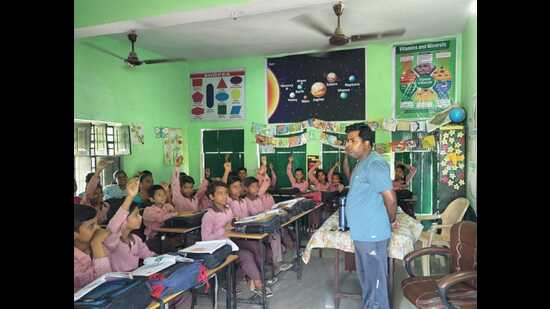
“Children with greater parental involvement in their overall development scored better in a test conducted to determine their general mental ability,” an official associated with the study said.
The study, in which 1,826 students of classes 4 to 8 enrolled in government primary and upper primary schools across the state took part, has been released in the form of a book that was published by the SCERT in July.
The study, which is based on a test with multiple-choice questions that totalled to a score of 100, found that 61% of the candidates scored ‘above average’ to ‘high’ in the test, experts who analysed the findings said and suggested that these students received better parenting than other candidates who scored lower in the test.
As part of the study, teachers and parents of these students were also interviewed.
{{/usCountry}}As part of the study, teachers and parents of these students were also interviewed.
{{/usCountry}}Students from districts in Prayagraj, Meerut, Ayodhya, Agra, Gorakhpur, Bareilly, Lucknow, Varanasi, Moradabad, Jhansi and Kanpur divisions were the subjects of the study. For the study, the researchers used a standard and popular test developed by noted Indian psychologists RP Srivastava and Kiran Saxena.
One of the questions asked the candidates to pick the odd one out between “chair, almirah, table, computer, Sunday, January, 21 and banana”. Others quizzed them on their numerical, verbal and logical reasoning abilities.
“Parents and teachers play important roles in the mental development of children. Children with greater parental involvement were found to have above average or higher scores. This result is very natural because parents are the first teachers of children,” Usha Chandra, the director of Bureau of Psychology, reasoned.
“Parameters on which the assessment was carried out included analogy, classification, number series, reasoning ability and absurdities,” she added.