
 E-Paper



Industry bodies hail budget as progressive, growth-oriented
According to experts, the budget shows vision towards long-term goals. Major announcements included new schemes for semiconductors, biopharma, rare earth corridors, and increased capital expenditure.

 Prefer HTon Google


Industry bodies hailed the Union Budget-2026 as progressive with a long-term vision for India, focusing on infrastructure, youth, agriculture, women, export promotion and making the country ready to tackle AI with focus on data centres. They opined that the budget focuses on increasing capex to boost the economy.
According to experts, the budget shows vision towards long-term goals. Major announcements included new schemes for semiconductors, biopharma, rare earth corridors, and increased capital expenditure.
The government aims to lower the fiscal deficit further, a stated target of around 4.3% of the GDP for FY-27, continuing the medium-term consolidation path and reducing borrowing pressure on the economy. The fiscal discipline signal combined with capex support is designed to maintain mid-to-long-term growth momentum and keep debt dynamics manageable.
A record infrastructure outlay of around ₹12.2 trillion is projected, intended to sustain investment demand and stimulate private sector participation.
Expert voices:
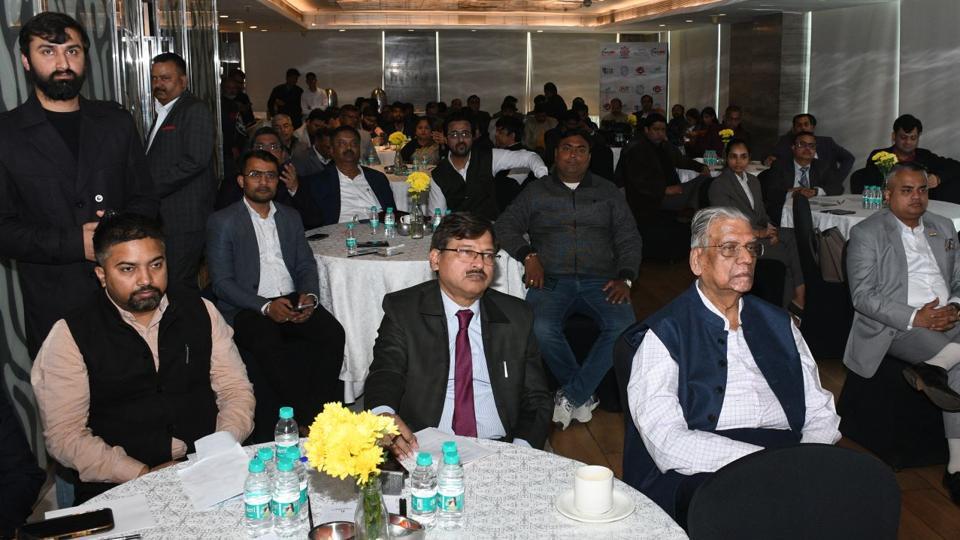
LK Jhunjhunwala from sugar industry, Sarvesh Goyal from hospitality, Dharmendra Kumar and Arpit Gupta (CAs) , Arvind Mohan (economist), DP Singh from agriculture, Manish Agarwal from Adani Group, and Vinayak Nath (FICCI) attended FICCI’s live viewing session on budget.
Mukesh Singh, chairman, UP Coordination Committee, Indo-American Chamber of Commerce:
Union Budget 2026 focuses on overall Industrial growth, inclusivity, women and ‘yuva shakti’.
In an era of unprecedented global change and turmoil, India has emerged as a stable macroeconomic force. This budget reinforces the view that signifies continuity and stability.
Vishwas Swarup, Co-chairman, FICCI UP State Council:
The budget proposals will re-energise the economy by lifting sentiments of the middle class and nudging the private sector to advance its investment plans as demand improves across sectors.
The proposals will scale up manufacturing across seven strategic and frontier sectors, including bio-pharma, critical minerals, electronics and capital goods. They will strengthen India’s manufacturing ecosystem, reduce import dependence and create large-scale employment opportunities for the youth.
Abhishek Saraff, vice-chairman, CII, UP:
The budget is clearly growth-focused, with a strong emphasis on strengthening manufacturing and enabling MSME-led expansion. The proposed SME Growth Fund, through improved access to equity and liquidity support, will help enterprises scale up, drive innovation, and integrate more deeply into India’s manufacturing and export ecosystem. Investments in high-speed rail corridors will enhance connectivity, reduce logistics costs, and improve productivity across industrial regions.
Upasana Arora, chairperson, CII, UP:
The budget takes an important step towards strengthening the healthcare sector. The Bio-Pharma Shakti initiative will boost manufacturing, R&D, and exports, while the enhanced focus on mental health, trauma care, and assistive technologies will improve access to quality healthcare. The budget reflects a clear and deliberate focus on job creation and preparing India’s workforce for emerging opportunities. With a large number of young people entering the labour market every year, initiatives aimed at skill development in future-oriented sectors demonstrate a forward-looking approach to enhancing India’s share in global services exports and fully leveraging its demographic dividend.
Rajesh Nigam, co-chair, UP, PHDCCI:
The budget is growth-oriented, forward-looking, and balanced for industries. Record capital expenditure on infrastructure, strengthening of the manufacturing sector, improved financial support for MSMEs, and a special focus on logistics and connectivity will give a new impetus to industrial development.
The focus on semiconductors, electronics, pharmaceuticals, textiles, and strategic sectors will empower ‘Make in India’ and ‘Atmanirbhar Bharat’. The growth fund, credit guarantee, and working capital facilities for MSMEs will boost employment generation and exports.
Dinesh Goel, national president, IIA:
The budget announcements reflect a strong commitment to the growth of the Indian economy and MSMEs across all sectors, and that the budget is “forward-looking and growth-oriented.”
Significant allocations for biopharma, semiconductor manufacturing, and high-speed rail infrastructure, along with the proposed growth fund for micro-enterprises will collectively strengthen India’s manufacturing ecosystem and directly benefit the MSME sector.
Mayur Tandon, vice-chairman, IIA, CII:
The budget’s ₹12.2-lakh crore capex will boost infrastructure for sustainable supply chains. Investments like ₹4,000-crore Self-Reliance Fund and ₹10,000 crore for champion SMEs will enhance credit access via TReDS mandates. Five medical tourism/educational hubs will create ancillary opportunities.
Khalid Masood, director, Shalimar Corp:
The budget outlines a progressive roadmap for strengthening the real estate sector. The introduction of the Infrastructure Risk Guarantee Fund will improve access to financing and mitigate project risks. The emphasis on Tier-2 and Tier-3 cities will catalyse infrastructure growth and generate long-term opportunities for real estate development nationwide.


