
 E-Paper



Janjati Bhagidari Utsav commences: Tribal artists call for government endorsement
This program celebrates Janjati Gaurav Diwas, commemorating the birth anniversary of Indian tribal independence activist Birsa Munda.


The Janjati Bhagidari Utsav kicked off at Sangeet Natak Akademi today, with tribal performing artists from Uttar Pradesh (UP) and across the country participating in the week-long festival. This program celebrates Janjati Gaurav Diwas, commemorating the birth anniversary of Indian tribal independence activist Birsa Munda.
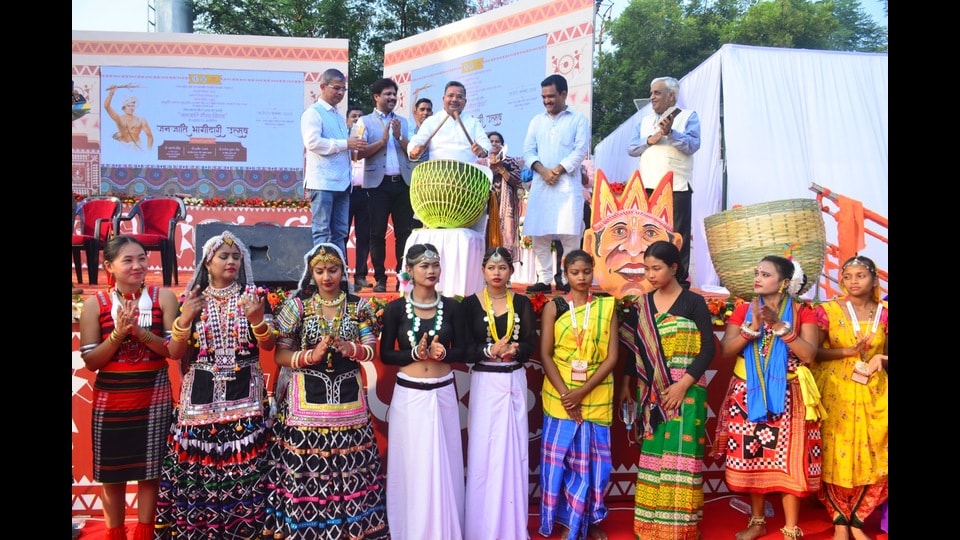
The program commenced with a march from 1090 crossing to Sangeet Natak Akademi, with all the artists who have traveled from various parts of the state and the country to perform at this event. Nearly 20 groups of tribal performers have gathered here to showcase 30 different kinds of music and dance forms over the next seven days, representing 17 states, including Odisha, Rajasthan, Jammu and Kashmir, Chhattisgarh, Assam, Nagaland, among others.
The inauguration event was graced by state minister for tourism and culture Jaiveer Singh, principal secretary of the department Mukesh Meshram, and state minister and principal secretary of the Social Welfare Department, Aseem Arun and Dr Hari Om, respectively, among others. They each emphasised the importance of preserving these art forms and platforms like this event. According to Singh, tribal cultures have always contributed greatly to the integrity of natural resources and their habitats, and it is time for state governments to pay it forward by uplifting them.
Shamshaad Baharupia from Rajasthan, with pink glitter paint on his face, a pagdi, fake mustache, and lensless spectacle frames perched on his nose, traveled to showcase his art at this event. “My father and grandfather were also bahurupias, but my children won’t be,” he said. “Local performing arts like these are disappearing into oblivion,” he elaborated. ‘If our governments do not support our art and help keep it relevant, we have no hopes of earning a living through our performances,” added Shamshaad.
Deepak Jal from Odisha, here with his 15-member group to perform Dhalkai nritya, also echoed these views. He said that for each of the artists in his group, this dance form was their only avenue for income. “Not only ours but almost all folk styles and tribal dance and music forms are close to extinction. Most people in UP will not have heard of Dhalkai dance, whereas everyone back home knows what this is,” he said.
“Getting involved in arts is a great way of keeping young minds occupied and active,” said Saneer Rajput from Jammu and Kashmir, who is here to showcase Gojari nritya, popular in their part of Kashmir. “We perform this dance at every happy occasion, be it a family function or the first harvest,” he explained. Raazi Taheed, the manager of this troupe, pitched in, “national-level events like these are one of the biggest ways we can keep our folk art forms alive.”
Apart from stage shows, the ground where the open-air stage has been set up is also lined with merchandise stalls selling local handicrafts like items and showpieces made of terracotta, wrought iron, and bamboo. This event, with new dance forms lighting up the stage every day, will continue until 8 PM every night for the next seven days. Artists and the audience alike filled up the grounds by evening, entranced by performances many were seeing for the first time.


