
 E-Paper



Passenger convenience hallmark of Lucknow airport’s new terminal
PM virtually inaugurates it, defence minister Rajnath Singh says the Modi govt faced challenges but turned them into chances

 Prefer HTon Google


Prime Minister Narendra Modi virtually inaugurated the integrated Terminal 3 (T3) of the Chaudhary Charan Singh International Airport (CCSIA) aka Lucknow airport at a public rally in Azamgarh on Sunday.
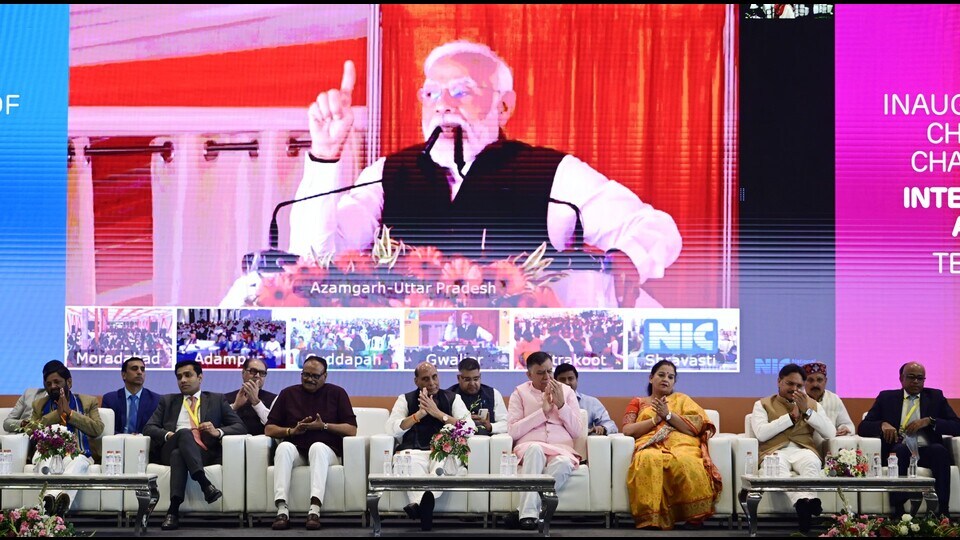
Built at a cost of ₹2,400 crore, T3 will cater to domestic and international flights, with capacity to handle 4,000 passengers during peak hours.
Phase I of the world-class terminal can cater to 8 million passengers per annum, with elevated pathways separating the arrival and departure flows. Phase 2 will enhance the handling capacity to 13 million passengers per annum.
Addressing the gathering after the inauguration of the new terminal at Lucknow airport, defence minister Rajnath Singh said there had been a lot of challenges but under PM Modi’s leadership, they were transformed into opportunities.
“Earlier, air travel was considered for elite class only but PM Modi bridged the gap between the poor and the rich by enhancing the regional connectivity, through ‘Ude Desh ka Aam Nagarik (UDAN) scheme,” Singh added.
“I am fortunate that I am the MP from Lucknow, which was once represented by former MP Atal Bihari Vajpayee. It makes me feel proud that our city and India are continuously developing under the leadership of PM Modi,” he said.
In 2014, we had 74 airports but now we have 149 airports in our country, Singh added. “Our government has moved forward from class banking to mass banking. We have connected the poor to the banking system through Jan Dhan Yojana. You can see the same thing in internet connectivity also. Earlier, only the rich had access to it. It is the result of the work done by our government that today everyone has internet connectivity,” he said.
Speaking on the occasion, Karan Adani, managing director, Adani Ports & Special Economic Zone Ltd, said, “Our vision for CCSIA is big and far reaching. The master plan aims to expand the airport’s capacity to ultimately serve 38 million passengers annually by 2047-48. This exponential growth is the cornerstone of our strategy to support Uttar Pradesh’s aspiration to become a one-trillion-dollar economy. We are not just building infrastructure, we are creating over 13,000 direct and indirect job opportunities, thus contributing significantly to the economic advancement of the region and the state.”
The new terminal buildings at Kanpur, Rajkot and Maharishi Valmiki international airport, Ayodhya Dham, were also inaugurated by the PM on Sunday. The projects are aimed at augmenting passenger amenities and giving a fillip to local economy. The 12 new terminal buildings are being developed at a total cost of ₹8,903 crore, having a combined capacity to serve 61.5 million (615 lakh) passengers annually.
However, the elegant terminal of Lucknow has state-of-the-art amenities and features for passenger convenience. While 72 check-in counters (including 17 for self-baggage drop) and 62 immigration counters will ensure swift and smooth transit of passengers, modern lounges will elevate their comfort.
The newly constructed apron will increase the passenger boarding gates from 7 to 13 and passenger boarding bridges from 2 to 7. At present, the airport connects 24 domestic and 8 international destinations. The capacity augmentation will help in improving its operational efficiency substantially. T3 will also simplify travel with technologies such as DigiYatra, common use self-service kiosks, automated tray retrieval systems, and advanced baggage screening machines.
An out-of-this-world audio-visual experience has been brought to life at the airport with the art and architecture of Uttar Pradesh, starting from entry gates to the skylight. The check-in counters will mesmerise passengers with illuminated motifs of ‘chikankari’ and ‘mukaish’ (metal) embroidery. Graphics on the frosting depict stories from the epics such as the Ramayana and the Mahabharata.
The airport has several sustainability features and adequate deployment of recyclable materials. It will be a multi-modal travel hub with metro connectivity, intercity electric bus service and app-based taxi services.


