At least 10 Gangetic dolphins, the national aquatic animal of India, got stranded in the shallow water of the Sharda irrigation canal in Uttar Pradesh’s Lakhimpur district. Locals, irrigation and forest staff spotted them during routine pre-monsoon maintenance work on Saturday.
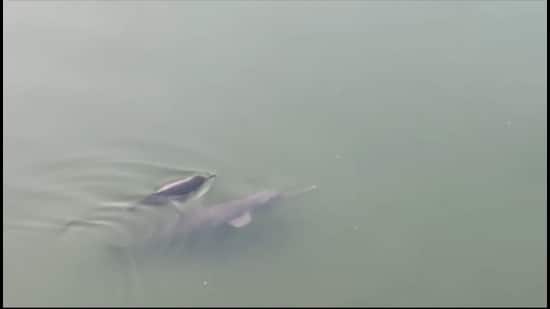
“The dolphins are stuck at two places. We are making efforts with the irrigation department to get more water at the place where they (dolphins) are stuck,” said Lakhimpur divisional forest officer Sanjay Biswal.
Late in the evening, officials said water level had become adequate for the dolphins. Dr Vipul Maurya, wildlife biologist working with the Wildlife Institute of India, said, “Water level has increased and dolphins have started to move out of canal.” Dr Maurya personally monitored the movement of two adult dolphins and a calf.
“Water was released into the canal to ensure adequate water level following which the dolphins’ group swam back to the Ghaghra river,” Biswal said over the phone, claiming no dolphin was in trouble now.
The stranded dolphins were around 12 km from the Ghaghra river. Their exact location is in the vicinity of Chakai Gaon, Bel and Jhamnagar villages, 145 km from the state capital.
{{/usCountry}}The stranded dolphins were around 12 km from the Ghaghra river. Their exact location is in the vicinity of Chakai Gaon, Bel and Jhamnagar villages, 145 km from the state capital.
{{/usCountry}}Earlier, principal chief conservator forest (wildlife) Sanjay Srivastava said, “We are making all efforts to rescue dolphins in a safe manner. Different departments are coordinating in the effort and hopefully the dolphins will come out safe. We have spotted five dolphins and there could be more in the canal.”
At one spot, the water is about five-feet deep and at the other spot, it is just over three feet in depth. The shallow water level makes it stagnant. With the temperature around 40 degrees Celsius, the stagnant water heats up fast and the evaporation will be fast.
Experts said water level needed to be brought quickly to 9 feet depth for safety and survival of the dolphins. At this level, water will not get hot during the day and more time will be there to conduct rescue operation.
“Raising the water level at the place (where the dolphins are stranded) is a must for their survival until rescued. The first and the safest way to rescue them is to bring the water level in canal and river at par so that dolphins swim back. This will require the least human intervention,” said Arunima Singh, biologist and representative of “Turtle Survival Alliance (TSA)”, a global conservation organisation.
Among those stranded, two mother dolphins were seen swimming with their calves in a video. The news brought a lot of locals to the spot where they started making videos of the spot and developments.
Representatives from WWF, Wildlife Institute of India, biodiversity conservation and Ganga rejuvenation teams are also at the site to help the forest and irrigation departments.
“This will be the biggest rescue operation in recent times,” says an expert. There are two ways of making the rescue successful. First, to make them swim back and the other way needs more human intervention. Experts say the second option will be the last.
“We have manually translocated dolphins in previous years but their number was less, may be one or two at a time. This year, the issue is also of number. Hence, we would take the least risk when rescuing them (dolphins),” Singh said.
In 2023, a few dolphins were rescued in Lakhimpur but then water was not so shallow.
Shailendra Singh, scientist, Turtle Service Alliance, said, “A pre-monsoon mandatory maintenance exercise over the gates leading to canal is in progress which led to scarcity of water in the canal and subsequently leading to this crisis.”
The Wildlife Institute of India estimates presence of around 4,000 dolphins in the Ganga and its tributaries currently. In Uttar Pradesh alone, the number is nearly 2,000.
(With inputs from Deokant Pandey in Lakhimpur)