
 E-Paper



Ring road to offload 1.60 lakh vehicles from Lucknow roads
Equipped with 157 entries and exits across the stretch, the ORR looks to significantly bring down traffic load on multiple national and state highways that pass through the state capital.

 Prefer HTon Google


Nearing completion, the sprawling 105-km-long outer ring road (ORR) encircling the state capital is projected to divert around 1.60 lakh vehicles every day.
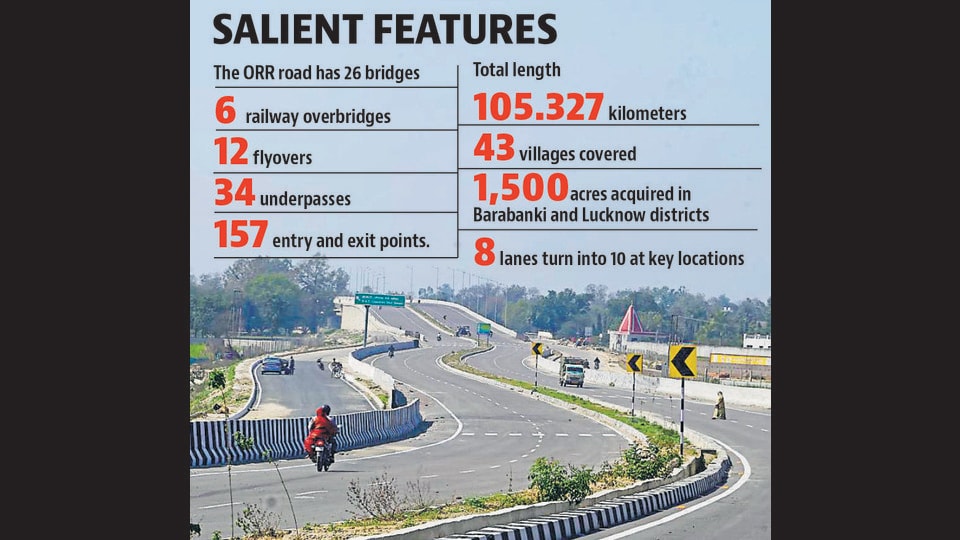
Equipped with 157 entries and exits across the stretch, the ORR looks to significantly bring down traffic load on multiple national and state highways that pass through the state capital.
Better traffic management is likely on Faizabad Road (NH-28), Sultanpur Road (NH-56), Rae Bareli Road (NH-24B), Kanpur Road (NH-25), Mohan Road (SH-40), Hardoi Road (SH-25), Sitapur Road (NH-24) and Dewa Road (Major District Road 88C) after its launch.
Spearheading the project is Saurabh Chaurasia, the National Highways Authority of India (NHAI) project director. “When we started its construction, around 1.05 lakh vehicles (of varied sizes) passed through the state capital daily. Considering the growth in vehicular traffic at 5% every year, the number would be around 1.60 lakh today,” Chaurasia said.
According to an Annual Average Daily Traffic (AADT) analysis by Consulting Engineering Services (India), a private firm, 5,553 buses, 35,133 trucks and 64,142 four-wheelers passed through Lucknow daily in 2015, around a year before the ORR’s construction was taken up.
Citing the study, Chaurasia added: “The outer ring road will be able to handle four times more traffic than this. Its eight lanes transform into 10 lanes at key highway crossings. Designed with the primary objective of alleviating Lucknow from the burden of heavy vehicular traffic, especially during night hours, the outer ring road is all set to become a vital component in the city’s transportation landscape.”
“The road also holds strategic importance as it intersects five national and six state highways. Sultanpur Road, Rae Bareli Road, Harodi Road, Kanpur Road, Ayodhya Road and Sitapur Road are some of the key routes that the ring road connects to. This connectivity not only facilitates efficient transportation within Lucknow but also positions the city as a key hub for economic activities and regional integration.”
Chaurasia added: “The construction of the ORR, which started in 2016, was meticulously executed through five distinct packages. The first section from Sultanpur to Behta was completed at a cost of ₹1,062 crore. The second section, from Behta to Sitapur Road, was completed at ₹981 crore. The third section, which is 14.618 km long from Sitapur Road to Kursi Road, was finished at ₹292 crore. The fourth, spanning 14.707 km, was executed at ₹388 crore. Meanwhile, the 11.362-km-long Ayodhya Road to Sultanpur Road stretch is around 97% complete.”
Diwakar Tripathi, a representative of Lucknow MP and defence minister Rajnath Singh, said: “The ORR boasts of 26 bridges, six railway overbridges, 12 flyovers, 34 underpasses, and a network of 157 entry and exit points.”
He added: “The ORR will not only offload Lucknow’s vehicular traffic but also act as a catalyst for trade, employment, tourism, and real estate growth. Covering 105.327 kilometers and 43 villages, it required the acquisition of approximately 1,500 acres of land from Barabanki and Lucknow districts.”


