
 E-Paper



Tree translocation policy set to take root in Uttar Pradesh as committee finalises report
Entire tree translocation shifting of big/old trees that are ecologically important and are not less than 10 feet in height. The committee has recommended the shifting of such trees be done 100% for big commercial projects


Residents of Uttar Pradesh would soon be able to help save old trees by getting them translocated (shifted) instead of felling them for construction work as the state is in the process of making a policy for the same.
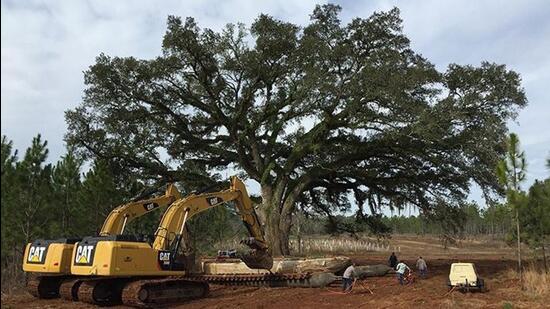
Tree translocation is a process in which the entire tree is uprooted instead of being cut and then replanted at a different location, where it can grow further.
A state-level committee has finalised a report on ETT (entire tree translocation) following trials in five districts of the state. It includes provision for both big commercial projects and individual residents.
“Trials were done in Lucknow, Rae Bareli, Varanasi and Agra where big and old trees were shifted to a different location under the ETT. Now, a report on the same has been submitted to the state government for consideration and a policy on it (ETT),” said Ravi K Singh, member of the committee and divisional forest officer (DFO), Lucknow.
Apart from Singh, the committee members included DFO (Unnao) Esha Tiwari, DFO (Obra) Prakhar Mishra, Anupam Gupta, a senior forest official and the then nodal officer for the committee. The secretary of the department was the chairperson of the committee.
The ETT enables shifting of big/old trees that are ecologically important and are not less than 10 feet in height. The committee has recommended the shifting of such trees be done 100% for big commercial projects. For smaller ones or individual residents, there can be some relaxation.
In Lucknow, five trees were shifted in 2020-21 and all have survived.
“Trials showed an over 80% survival rate will be there after shifting of trees,” said Singh.
The procedure to obtain permission for the shifting of each tree is the same as for felling. Such permission is obtained from the forest department.
The shifting would involve evaluation by a committee/panel and the task of shifting will be carried out by an experienced agency, according to the procedure laid down by the committee.
Once permission is obtained and the spot for shifting is identified, the tree will be uprooted by the agency with the help of specialised equipment.
Experts say saving trees by shifting them is important for human life.
“Just as human blood cannot be manufactured anywhere but in the human body, similarly the level of oxygen in the air can be maintained only if we have big trees around us. So, shifting trees, instead of felling them, is good for our health and existence,” said Dr Abhishek Shukla, secretary general, Association of International Doctors.
“After it is planted, a sapling takes at least two and up to 10 years to produce a considerable quantity of oxygen. Hence saving old trees is the option. Also, when the state is making an effort to increase green cover from the present 9.23% to 15%, translocating trees, instead of cutting them, would be a wise choice,” said a senior forest official.
Once the policy is framed, a formal shape will be given to the ETT project with shifting agencies and the office where the permission will be granted.
“The agency that shifts the tree has to give an assurance of its survival and (for) up to three years the trees shifted will be physically verified for their survival. If there is failure, the security deposit will be seized,” said Singh.
THE COST
Shifting trees may cost between ₹5,000 and ₹50,000, depending on the size of the tree, the number to be shifted and the distance between site of uprooting and translocation.
“The ecological value of the tree will always be much more than the shifting cost. We assessed that if shifting a big tree costs ₹55,000, the ecological value will be more than ₹1 lakh,” said Ravi K Singh.


