
 E-Paper



U.P.: Ways for better implementation of Juvenile Justice, POCSO Acts discussed
A daylong zonal conference covering 14 districts was on Sunday held to discuss the ways to ensure effective implementation of the Juvenile Justice (Care and Protection of Children) Act, 2015 and the Protection of Children from Sexual Offences (POCSO) Act, 2012


A daylong zonal conference covering 14 districts was on Sunday held to discuss the ways to ensure effective implementation of the Juvenile Justice (Care and Protection of Children) Act, 2015 and the Protection of Children from Sexual Offences (POCSO) Act, 2012.
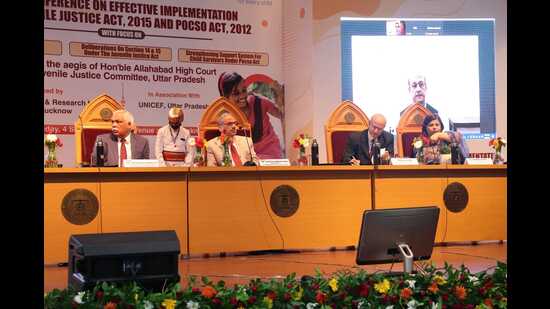
The Judicial Training and Research Institute (JTRI), in association with UNICEF, Lucknow, under the aegis of the High Court Juvenile Justice Committee (HCJJC), Lucknow, organised the conference on JTRI campus.
In his keynote address, Chief Justice, Allahabad high court, Justice Rajesh Bindal said, “This conference was overdue and it was important to discuss the issues related to Juvenile Justice Act and POCSO Act at a platform where all the concerned stakeholders meet. Therefore, zonal conferences have been organised.”
“It is important to see what kind of environment is being provided to a child as it has an effect on the child’s psychology and actions in many ways. As children are vulnerable, a balance should be kept for exposing them to television and internet. It is very important also to sensitise children as they should know about the consequences of the offences which might affect their life,” he said.
Justice Bindal also spoke about the cases related to sexual abuse of children and their safe custody. “Counselling of children as well as their parents is also a very important aspect while dealing with such cases of sexual abuse,” he added.
Justice Ramesh Sinha, senior judge, Allahabad high court at Lucknow said, “Children are a very important part of our society. Expeditious justice delivery system should be administered for them and the laws provided are to safeguard their interests and provide them a suitable environment. “
Justice DK Upadhyay, chairman, JTRI Lucknow, said, “For matters related to juveniles, I still feel that there are many aspects of Juvenile Justice Act, 2015 and POCSO Act, 2012 related to their implementation which need to be looked at closely. As judges when we come across any child and we are facing any problem in dealing with the case, the key idea should be to take decision in the best interest of the child.”
Justice Kaushal J Thaker, judge and chairperson, Juvenile Justice Monitoring Committee, Allahabad high court, spoke about the concept of victimology and about the conditions of the juveniles in the child care institutions. He said, “We need to focus more on the plight of the victims of child sexual abuse and award appropriate compensation under the victim compensation scheme or Rani Laxmi Bai scheme as the case may be.”
Justice Abdul Moin, judge, Allahabad high court at Lucknow and member, Juvenile Justice Committee, Allahabad high court said, “It is overwhelming to see the commitment of the participants who have come from their respective districts for contributing to the conference.”
This was the first of the six consultations planned jointly by JTRI and UNICEF at six locations in Uttar Pradesh. The initiative is based on the directions from the chief justice, Allahabad high court, to sensitise all key stakeholders for effective coordination and convergence in ensuring timely justice to children. The remaining zonal consultations would now be held in Allahabad, Gorakhpur, Bareilly, Gautam Buddh Nagar and Kanpur in the upcoming weeks.
“The aim is to sensitise the officers and functionaries on different nuances and the dynamics surrounding issues of protection of children from harm, abuse, and any form of exploitation-- be it the case of survivors of sexual abuse or case of a juvenile in conflict with law,” said Dr Amit Mehrotra, programme manager, UNICEF Uttar Pradesh.
Anamika Singh, secretary, department of women and child Development, U.P., said, “Around 40% population of India consists of children who need our attention.” She said under the guidance of the High Court Juvenile Justice Committee, the department of women and child development took various steps to take care of the children during the Covid pandemic.


