
 E-Paper



‘Wandering’ bullet removed from 3-year-old girl’s brain in complex surgery at KGMU
A CT scan conducted about four-and-a-half hours later at a private hospital showed the bullet lodged superficially in the left frontal lobe. After nearly 20 hours of observation, she was shifted to KGMU, where fresh imaging revealed that the bullet had migrated deeper towards the basal region of the brain, according to an official statement.

 Prefer HTon Google


Doctors at King George’s Medical University (KGMU) have removed a “wandering “ bullet from the brain of a three-year-old girl in what experts described as an “extremely rare” and complex neurosurgical case, officials said on Thursday.
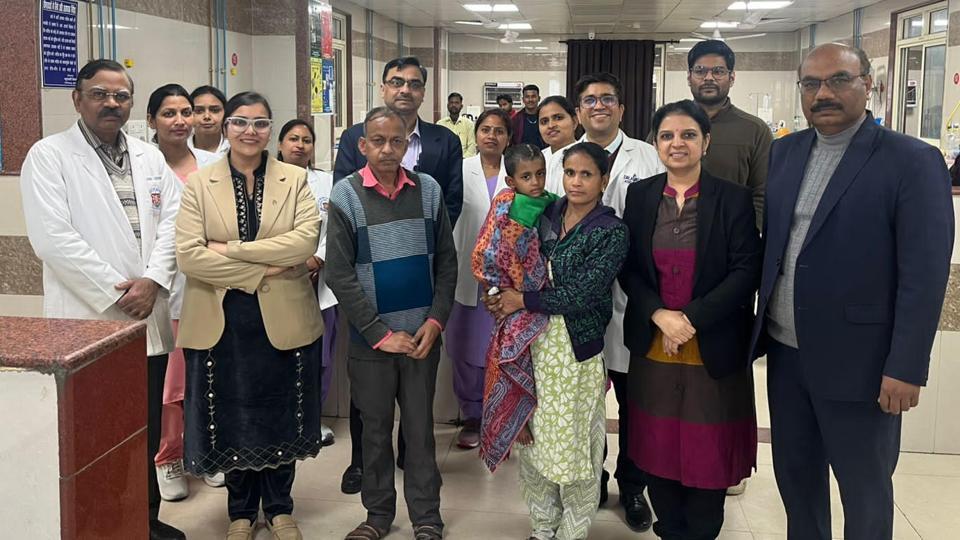
The child, a resident of Indira Nagar, sustained a gunshot injury to the left frontal region of her head around 4 pm on December 16, 2025. According to police, it was still not clear under what circumstances the child suffered the bullet wound.
A CT scan conducted about four-and-a-half hours later at a private hospital showed the bullet lodged superficially in the left frontal lobe. After nearly 20 hours of observation, she was shifted to KGMU, where fresh imaging revealed that the bullet had migrated deeper towards the basal region of the brain, according to an official statement.
Dr Ankur Bajaj of the department of neurosurgery said the case was critical as the bullet kept changing position inside the brain, posing a serious risk to vital blood vessels. A CT angiography conducted about 25 hours after the injury showed the bullet had moved again — this time to the occipital region — confirming a rare instance of a “wandering” intracranial bullet.
Given the unpredictable movement, surgeons used intraoperative fluoroscopy to track the bullet in real time during surgery, enabling its removal while minimising damage to surrounding brain tissue, the statement said.
Following the surgery, the child experienced temporary difficulties with movement and speech and developed a fever, for which she was kept under close observation in the paediatric ICU. Doctors said her condition had improved significantly and she was now able to move her limbs and hold objects. She was likely to be discharged soon, they added.
KGMU vice-chancellor Dr Soniya Nityanand and spokesperson Dr KK Singh congratulated the medical team led by head of neurosurgery Dr BK Ojha, and also comprising Drs Ankur Bajaj, Anup K Singh, Ankan Basu, and Shraddha. The anesthesia team included Dr Monika Kohli and Dr Neelkamal.


