
 E-Paper



Women students outnumber men in Uttar Pradesh colleges, univs, says higher education directorate report
Higher education directorate report says 62.95% students were women, 37% men in 27 state universities and 7,391 degree colleges of Uttar Pradesh in the 2020-21 session


The constant efforts made over the past few decades to promote education among women and girls in Uttar Pradesh are finally starting to show results, officials have said.
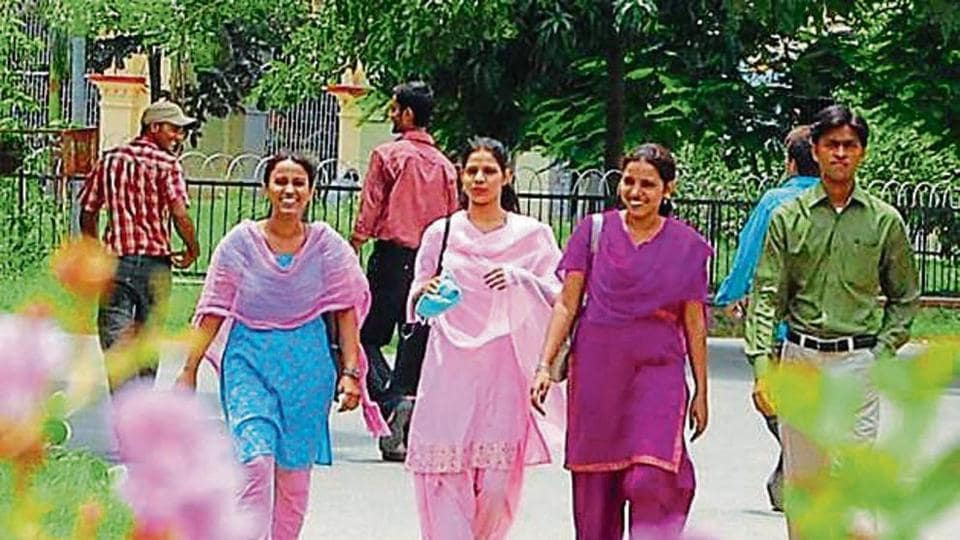
The latest data of the state’s higher education department shows that the girls and women enrolled in state universities and colleges affiliated to them in Uttar Pradesh far outnumber the men and boys, the officials said.
In the past four years, the number of girls enrolling for higher education increased by 13%, they added.
The latest report of the UP Higher Education Directorate sent to the state government said 27 state universities and 7,391 degree colleges of UP in 2020-21 session have a total of 50,21,277 students enrolled in them, out of which 62.95% are women. The count of men 18,60,220 (37%), they added. Four years ago, in the academic session 2017-18, there were a total of 55,74,638 registered students in UP’s higher educational institutions and the number included 27,77,137 women amounting to 49.81% as compared to 27,97,501 (50.18%) men, officials said.
Director (higher education) Amit Bharadwaj said that a change in the social perception finally led to girls being encouraged to go for academics, making use of the various government schemes that allow free of cost education to girls right from schools to the college and university level.
“Earlier, many parents were prompted to invest in boys’ education believing that they would support the home and be a pillar of strength during old age but with time and awareness, the realisation has finally sunk in that educated girls can not only be good professionals and support homes, but also lead a confident life of self-respect,” he added.
Government data shows that this trend of rising number of girls in educational institutions in the state is also visible at the school level. The number of girls registering for UP Board’s class 10 exams has doubled in the past three decades.
In 1991, UP Board had a total of 17,75,602 registered students for high school exams that included 14,04,519 boys (79.10%) and 3,71,083 girls (20.89%). However, in 2021, there were a total of 29,94,312 students registered for the class 10 exams that included 16,74,022 boys (55.90%) and 13,20,290 girls (44.09%). Psychologists also credit this situation to the change in the outlook of parents. “The change in the perception and outlook of parents is the main factor responsible for this welcome change over the years. Better social security being provided to girls is another reason for it. Earlier, parents residing in rural areas were especially reluctant in terms of educating girls, especially allowing them to pursue higher education. However, as the importance of education sunk in, and the various government initiatives, including free education, scholarships, systematic counselling as well as campaigns on radio, TV, all played their vital roles in bringing about this change,” said Dr Usha Chandra, director of the Bureau of Psychology, UP.
This trend in UP is along the lines of the pattern being witnessed at the national level, said Prof Badri Narayan, noted social scientist and director of GB Pant Social Science Institute.
He said the All India Survey on Higher Education (AISHE) 2019-20 released in June 2021 showed that apart from more females being enrolled in MPhil, postgraduate and certificate level courses in universities and colleges, they were also continuing to dominate in medical sciences, BA and BSc programmes.
“However, the share of female students is the lowest in institutes of national importance where there has been an overall increase of over 18% in female enrolment in higher education between 2015-16 and 2019-20 as per the report,” he said.
The Gross Enrolment Ratio of females stands at 27.3%, which is better in comparison to that of males at 26.9%. The survey also found a very high and sharp increase of female participation at MA, MSc and MCom courses during the last five years, he added.


