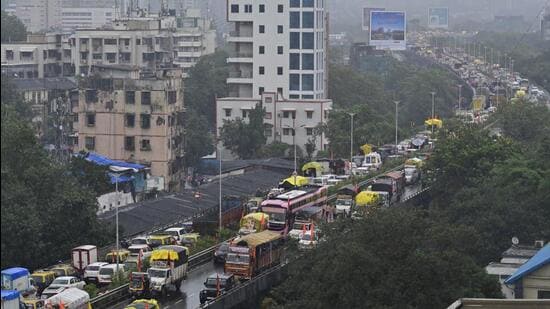
MUMBAI: The civic administration is putting the finishing touches to a draft policy to improve traffic management and address other key issues along the Western and Eastern Express Highways. Each of these arterial corridors is around 25km long and runs north-south across the length of this linear city.
The aim is to create uniformity and consistency in the management of the two highways, and includes enhancing infrastructure to improve traffic flow, and reworking regulations that govern other aspects. The draft policy will be forwarded to the municipal commissioner for approval.
Addressing the top-most priority – traffic congestion – a civic official from the bridges department said there is a disconnect between service roads and the main highways. To mitigate this, the Brihanmumbai Municipal Corporation (BMC) had earlier proposed the implementation of an access control system to ease traffic flow. The new draft policy has taken note of this suggestion.
“To ensure smooth traffic movement at intersections and avoid cross-directional congestion, underpasses will be built as a grade separation mechanism,” the official said. “These are being strategically planned at bottleneck points, to allow uninterrupted traffic flow from arterial roads onto the highways.”
Another key issue is the maintenance of the central medians along the two highways. “Different agencies have been appointed to maintain the plants on the medians. As a result, there is no uniformity in the species grown along these stretches,” said the official.
{{/usCountry}}Another key issue is the maintenance of the central medians along the two highways. “Different agencies have been appointed to maintain the plants on the medians. As a result, there is no uniformity in the species grown along these stretches,” said the official.
{{/usCountry}}Along the Eastern Express Highway (EEH), for instance, the central median is currently managed by four entities. “The BMC aims to use the new policy to clearly designate responsibilities and bring clarity to the management of such assets,” he said.
The official said that highways cannot be treated like internal roads. “Trenching and reinstatement work differs due to load patterns and traffic volumes. For instance, if a public utility undertakes a major trenching project on a highway, the reinstatement charges will be significantly higher than those for internal roads. Our policy will reflect these differences and enhance the trenching regulations for highways,” the official said.
The draft policy also addresses advertising rights along the highways. Currently, different portions of the highways are under the jurisdiction of different authorities, such as the Maharashtra State Road Development Corporation (MSRDC) and Mumbai Metropolitan Region Development Authority (MMRDA), which complicates management. The new policy aims to bring clarity and consistency to advertising permissions and formats, the official said.
“The policy is expected to offer a long-term, sustainable framework for highway governance in Mumbai,” added the civic official.
Stay updated with all the Breaking News and Latest News from Mumbai. Click here for comprehensive coverage of top Cities including Bengaluru, Delhi, Hyderabad, and more across India along with Stay informed on the latest happenings in World News.
Stay updated with all the Breaking News and Latest News from Mumbai. Click here for comprehensive coverage of top Cities including Bengaluru, Delhi, Hyderabad, and more across India along with Stay informed on the latest happenings in World News.