
 E-Paper



Land hiccups delay deep-sea pipeline to carry industrial effluents
While most of the required infrastructure has been ready for a year, around 800 metres of the pipeline is passing through private lands in Navapur village, Palghar. Various claimants to these lands have been embroiled in a prolonged negotiation with the MIDC over the compensation they will receive


Mumbai: An under-construction deep-sea pipeline to carry treated industrial effluents from Tarapur MIDC has been inordinately delayed on account of land acquisition hurdles.
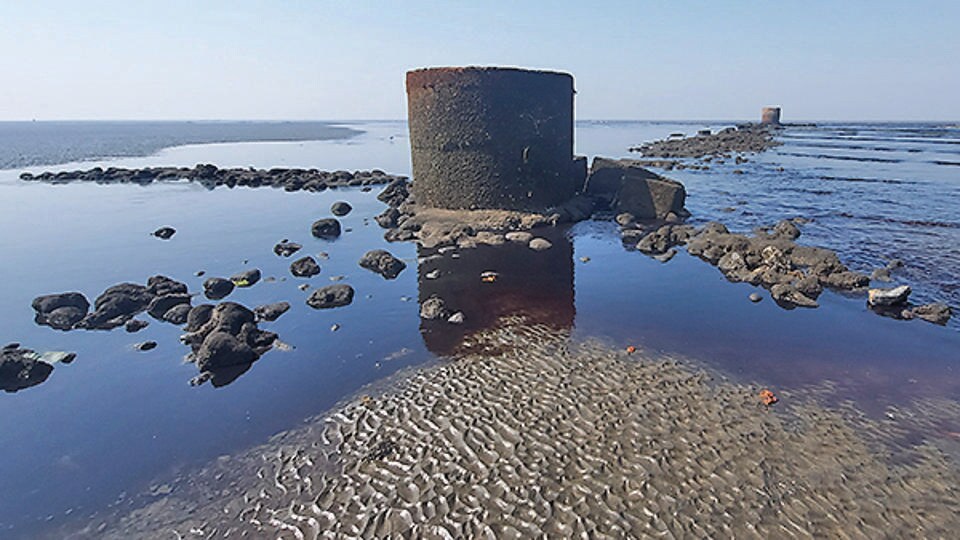
The pipeline will carry treated effluents from two common effluent treatment plants (CETPs) run by the Tarapur Environment Protection Society (TEPS) deep into the Arabian Sea, 7-kms off the Palghar coast.
While most of the required infrastructure has been ready for a year, around 800 metres of the pipeline is passing through private lands in Navapur village, Palghar. Various claimants to these lands have been embroiled in a prolonged negotiation with the MIDC over the compensation they will receive. Around 2.5 acres of land needs to be acquired for the remaining portion of the pipeline.
Mukesh Lanjewar, deputy engineer, MIDC Tarapur, clarified that they are taking urgent measures to commission the pipeline within this year. “A 7.1-km-long high-density polyethylene pipe has been laid from Navapur Beach into the Arabian Sea. A 3.4-km-long pipeline has also been laid on the landward side, connecting the central effluent treatment plants. Only 800-metre of the pipeline needs to be laid and we are still negotiating with the landowners.”
The pipeline, which was in the proposal stage works as early as 2015 and slated for completion by May 2018, has also divided local communities over its potential impact on marine ecology, and the livelihoods of fishers operating along the Satpati-Dahanu coast. While the project-affected landowners emphasised that the pipeline will prevent further pollution along the Navapur coast, others (mainly fishermen) expressed a strong distrust in the MIDC.
Rohit Bari, one of the landowners who is currently negotiating with the MIDC, said, “We want at least ₹8 lakh per guntha, which is much lesser when compared to the ready reckoner rate, which is around ₹16 lakh per guntha. Until the MIDC agrees to this, we will not give up an inch.”
Lanjewar confirmed to HT that a proposal recommending the demanded amount of compensation is awaiting approval from the MIDC’s head office in Andheri.
Fishers, on the other hand, cited their prior experiences of ecological degradation and remained staunch in their opposition to the new pipeline. “For decades, Tarapur industries have polluted our beaches, creeks and farmlands. Now, they want to pollute the deep-sea where we conduct what little we can of our trade,” Ashish Paghdhare, a Navapur resident and taluka president of Akhil Maharashtra Machhimar Kruti Samiti (AMMKS), said.
Currently, an old pipeline is discharging effluents from Tarapur—which is regarded as the country’s most polluted industrial cluster by the Centre’s Comprehensive Environmental Pollution Index (CEPI)—only 500-metre away from the high-tide line at Navapur beach, which is about 8 kms away from the industrial complex. This line has been operational since the 1970s, when the industrial area was established, and suffers from frequent leakage and maintenance issues.
To be sure, the pipeline is not the only route that effluents take to the sea. Hindustan Times has observed multiple outfall points discharging effluents onto mudflats and intertidal water bodies, which are part of a network of creeks—Kharekhuran-Murbe, Saravalli Creek and Dandi-Navapur creeks—that crisscross the region. Over the years, these pollutants have severely impacted artisan fishing, agriculture and salt-making, which were once the dominant occupation in surrounding villages.
Sadanand Bari, another project-affected landowner, pointed out that MIDC’s older pipeline has also been running through his family’s property since its establishment in 70s.
“Over the years, constant leakages have poisoned my fields and made them uncultivable. Forget ₹8 lakh per guntha. First, I want to be compensated for the damage my family has incurred over decades of pollution. MIDC has not paid us a rupee in compensation for this,” Bari said.
The Akhil Bhartiya Mangela Samaj Parishad, an organisation representing local fisherfolk, approached the NGT in 2016 with the grievance that water resources were being subjected to “grave degradation” at the hands of industries through the discharge of untreated effluents.
“As per data available with local fisherfolk societies, there has been a huge reduction in the number of families dependent on fishing in these villages surrounding the industrial complex. We have presented the numbers to the NGT. From 21,742 fisherfolk families in 1975, the number fell to 9,182 in 2016 and is likely to be even lower today. It is all due to the pollution by the industries,” Narendra Naik, an ABMSP representative, said.
The impact of industrial pollution in the area was comprehensively detailed in a judgement of the National Green Tribunal (NGT) on January 21, 2022. The Tribunal fined 103 industries to the tune of ₹260 crore as environmental compensation, but locals allege that industrial units are continuing to dump untreated or partially treated effluents into the creeks.
Previous court proceedings revealed that a CETP operated by TEPS was found to be operating at a max capacity of 25 MLD, as against the required 37-40 MLD, with the remaining effluents being discharged into the water bodies. A court-appointed expert committee had previously found the presence of heavy metals (mercury, lead, chromium, and cadmium) at the outfall points, and highlighted the “general failure in maintenance of standards” of effluent treatment plants.
These violations have also harmed public health. As per information placed on record by the medical superintendent, Rural Hospital, Boisar, the establishment reported a high incidence of 4,000 cases of skin diseases between January 2015 and January 2016.
Dhwani Shah, an independent environment researcher who studies critically polluted areas and their impact on communities, said, “TEPS has a proven history of failing to maintain discharge standards of Tarapur’s industrial effluents. Dumping the pollutants 7 km out at sea will make it harder to ascertain whether the effluent is meeting prescribed discharge standards. The pollutants may be sufficiently diluted to mask their presence, but they will remain in the environment for a very long time,” she said.
A more sustainable approach, Shah suggested, would be to ensure zero liquid waste discharge and mandatory recycling of wastewater by industries. This will also ensure efficient use of fresh water from the Surya River, from where Tarapur MIDC draws water for operations.


