
 E-Paper



How Ranjit Madhavji chronicled Mumbai
The cloth merchant and freedom fighter, who eventually became shutter happy, leaves behind a legacy in Hamilton Studios

 Prefer HTon Google


MUMBAI: One’s entry into Hamilton Studios, in Ballard Estate, is heralded by the tinkle of a string of bells hanging above its doorway. The photography studio, a rare wonder of 20th century India, is a temple that has drawn photographers from across the world.
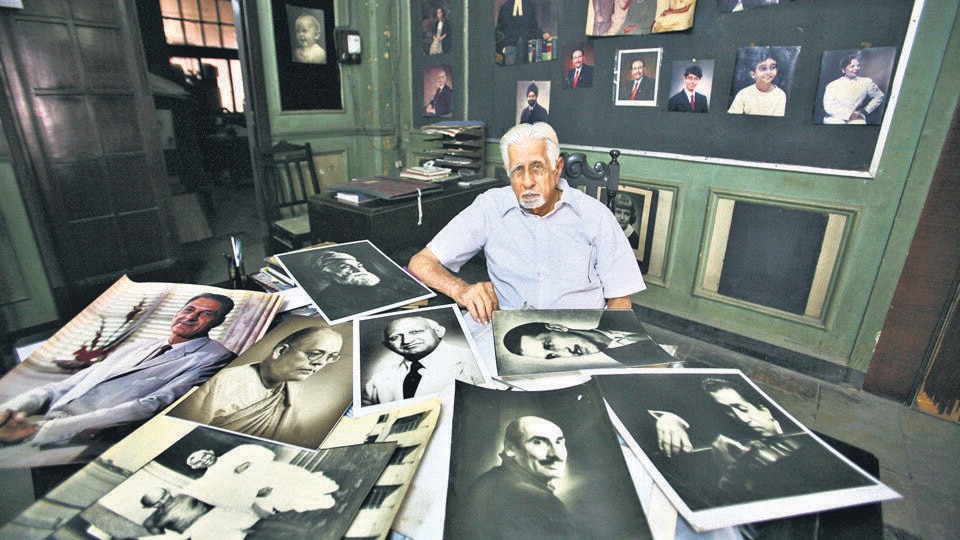
The studio, founded by Sir Victor Sassoon in 1928 and modelled after a London studio, has photographed nearly everyone, from royalty to governors, army generals, including Maharajas and Nawabs from Udaipur and Jodhpur, and powerful industrialists such as the Tatas. Sassoon established the studio in his house to explore his interest in photography and provide studio photographs to Bombay’s elite. However, it was Ranjit Madhavji who gave the studio a new lease of life in 1957, after it was left unattended and languishing by Sassoon post-Independence.
The pride of the place stemmed from the fact that prominent people from across the world would visit the studio only to be photographed by the ace and veteran photographer Ranjit Madhavji who has won a PSI Lifetime Achievement Award, is a five-time winner of Rahimtula Shield, five-time winner of Combizone Trophy and two-time winner of Unwalla Trophy.
Then a 31-year-old cloth merchant and freedom fighter, Madhavji, bought over Hamilton Studios during Diwali. A master of both black and white and colour photography, Madhavji would personally shoot every picture himself, checking every light and camera, taking a good 50 minutes before he blocked a shot – a forbearance that might befuddle today’s selfie-takers. The celebrated photographer passed away last week at 98.
His daughter Ajita Madhavji, who inherited the studio in the 1980s and now manages it, remembers her father starting out as an “amateur with no training, who eventually mastered everything from portrait to industrial to architectural to nature to fine art photography”.
Madhavji’s mother gifted him a Leica in 1956 when he was running the family business of textile imports. A few years on, he was selected as the official photographer for the Government of Bombay, Gujarat and Kathiawad State. Following this stint, he stepped into Hamilton Studios which was conferred an award at the hands of the then President of India, Zakir Husain.
The century-old establishment boasts of notable clientele such as BR Ambedkar, JRD Tata, Vinod Khanna, Zeenat Aman, Madhubala, Nadia Hunterwali, Vijaya Raje Scindia, Mohammad Reza Shah, HH Dalai Lama and Rimponchoo, HH Dr Syedna, Neville Wadia, Shapoorji Pallonji Mistry, Azim Premji, Mehli Mehta, Saira Banu, Maharani Gayatri Devi, Homi Bhabha, Bhulabhai Desai, Jehangir Sabawala, Persis Khambatta, among many others.
In a past interview with this newspaper, Madhavji had offered glimpses into the minds of some of the celebrities he had photographed. Madhubala, for instance, was so shy that it took him almost an entire day to shoot her. Of Maharani Gayatri Devi he had noted that women of those days were stunning and used minimal make-up as they believed that beauty lay in simplicity – it was therefore easy for him to capture the regality of Gayatri Devi. An early frame of Vinod Khanna taken by Madhavji became almost iconic – the picture tells the story of an ambitious young man with dreams up his sleeve, he had noted.
Ajita recalled, “There have been times when he has taken all of his 20 unwieldy old cameras, which include a Kodak 1926 Studio, a 1930 Field Camera, a Speed Graphic, a Graphlex, a Mamiaflex Professional, a Hilba and a Windsor out of the studio to shoot some of these famous personalities.”
A house of memories
The studio is house to a number of plates and prints that have been taken by such cameras. “A lot of our work was damaged when the drains nearby flooded,” said Ajita, recounting the hardships faced by her while managing the studio.
The studio specializes in restoration and rejuvenation of old mutilated portraits and oil paintings as well as portraiture for individuals, families, corporate houses, pets and celebrations.
“‘Digital cameras are blasphemous to the profession. And with a little effort, even a curmudgeon can be made to crack a smile,’ he would say,” she recalled.
However, to adapt to changing times, Ajita, who also manages the studio’s Instagram handle, admitted to have tried her hands at digital photography. “A friend brought in an acquaintance once, and all I had at hand was a digital camera at the time,” she recounted. “I started discussing the composition of the picture with them. When I asked him how he wanted his picture, he pointed at a picture of Lord Willingdon which had an emblem in its background. I took the photographs, but before delivering them, I asked my friend who he had brought in. I was then told that it was the Grand Duke of Russia. I then called for his emblem to be included with the photo.”
She lamented the lack of funds and the challenge to preserve the studio’s heritage, given the humidity of Mumbai. Archival boxes and regulation of temperature are required, apart from a specialist staff that is trained in archival work, which is hard to come by, she said.
For many years, the studio chose to remain analog. However, in 2018 it was awarded a grant by the British Council to clean, scan and digitize 25,000 glass-plate negatives, celluloid prints and memorabilia from the studio’s archives, dating between 1928-47. This digital collection is now a part of their Endangered Archive Programme, which can be accessed online.
Looking ahead
The studio now aims to digitize records from 1947 to 1967. The digitization project, which is a collaboration between Coventry University and Hamilton Studios has received support from Photo Miners CIC, that works with the public and institutions to repurpose photographic collections, and National Institute of Design (NID). The project will also add digital copying to Hamilton staff’s skillset.
The partnership with the English University was inked in August, 2024.
NID has provided four master’s level students of photography on two, six-month internships to help with the work of digitizing the records at the studio. Coventry University and Photo Archive Miners CIC will oversee the conservation and digitization.
The first batch of digitized material covers the period between 1947 and 1951, focusing on Indians who migrated to the UK under the British Nationality Act 1948. The second batch is from the period 1963 to 1967, which captures a surge in migration. According to the 1971 UK census, the British-Indian population had burgeoned tenfold since Partition. The third batch for the period 1951 to 1963 will be looked into after completion of the other two batches.


