
 E-Paper



Artist Atul Dodiya: I got to read faces closely in packed local coaches
Introducing a series on Mumbai’s trailblazers who dip into memory to share what anchors them in a changing city

 Prefer HTon Google


MUMBAI: An unnamed hill which can be seen beyond a network of high rises from artist Atul Dodiya’s spacious seventh floor studio in Ghatkopar, it is believed, formed the backdrop of Raja Ravi Varma’s ‘Shakuntala’. The hill at that time was not covered with slum colonies as it is now. Dodiya, 66, grew up in this north-eastern suburb of Mumbai at a time when he and his friends would play hide-and-seek criss-crossing its east and west. It is in a chawl here, which housed 18 Gujarati and Maharashtrian families, that the idea of community was imbued in him.
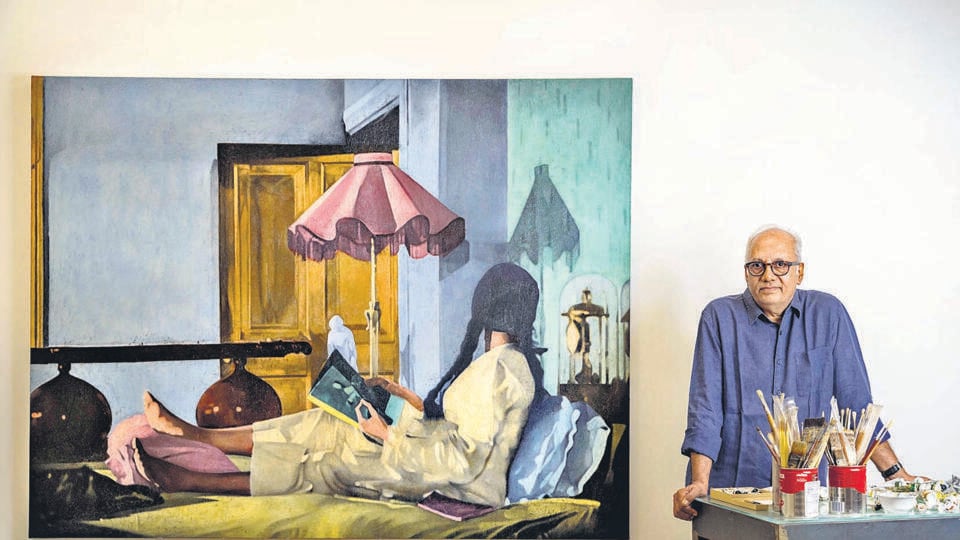
Over six decades later, the well-travelled artist, who by his own admission “can afford to live anywhere today”, chooses to live in the same neighbourhood, which has since metamorphosed into one of the city’s thriving suburbs.
In the midst of a busy afternoon, the artist took a pause to dwell on the changing colours of the city.
Excerpts from an interview:
What are your early memories of Bombay (as it was called then)?
Simple – travelling by local trains and occasionally in the double decker buses, sitting right in the front.
Growing up in this suburb, a trip to the city by train was a Sunday treat. We went to the museums, the Marine Drive, Taraporewala aquarium, Chowpatty and the zoo. My father was a civil contractor who often took many assignments around the Kala Ghoda area. Later when he bought a car – a Baby Hindustan – he would take me along, and let me be by myself at the Jehangir Art Gallery. I decided at 10 that I wanted to paint.
The same joyous train rides became a challenge later when I joined the Sir J J School of Art, when I had to navigate cramped spaces with my art material, portfolios etc; but it wasn’t oppressive. We were young and enthusiastic, with much to look forward to.
Travelling in packed coaches resolved many painterly problems. One, it gave me the time to rethink specific themes and colours I may have imagined for certain pieces of work, and secondly, as I was bombarded with images of people around me I could look at faces closely and observe human mannerisms, which helped a figurative painter like me.
What have been your favourite Mumbai hangouts in your youth and now in your mature years?
The Jehangir Art Gallery was a great place to hang out, as was Chemould, which was above Jehangir. We could not afford to eat at the Samovar café of course at the time.
Since it is a public space, we met many artists there, and saw works of people such as Tyeb Mehta and Bhupen Khakhar displayed there. I don’t get the chance to go there anymore.
The zoo remained a favourite space through my adult years. As a boy, I was drawn to the animals, but as time passed by, I was drawn to the big old trees and people who visited the zoo. I liked observing crowds at Juhu Chowpatty as well.
Another big draw was watching English films – a special treat for us at the time – for which we had to go to Regal, Eros, Liberty, Strand Cinema and Metro. We watched the early Hollywood films, including ‘The ten commandments’, ‘Ben Hur’ and ‘Mackenna’s Gold’.
The city is one of the big hubs of Indian art. It is home to many artists; do you get to meet them often?
Not anymore. However, as I was a very active student, I would often gather friends and go to meet people such as Gieve Patel, Akbar Padamsee, Tyeb Mehta, Prabhakar Barwe and Sudhir Patwardhan. Patwardhan was a radiologist, who used to work in the afternoons, same as Barwe who used to work at the weavers centre near Roxy Cinema and used his free time on Sundays to work on his paintings. They were all very generous with their time.
Later, when I passed out from art school in 1982, I became closer to them. Then we would meet in the Kala Ghoda area at Chemould or Pundole.
You don’t get to meet fellow artists as frequently as you did back then, anymore?
Everyone is too busy right now and some have passed on.
I was also very interested in theatre, particularly Marathi theatre in the mid-’70s. I used to go to Chhabildas School, in Dadar, which used to stage both popular and experimental theatre. They would host plays by Vijay Tendulkar, Amol Palekar, Arvind Pandey and Sulabha Deshpande. Sometimes we also saw plays by Satyadev Dubey, Amrish Puri and Govind Nihalani. They made time to interact with us as well.
What drew you to theatre?
It was an extension of my ambition to become an artist. However, by the ‘70s, the arrival of Doordarshan opened yet another vista for me and people with similar disposition as me. Good films came right in the private spaces of our homes. I was equally drawn to a show called Pratibha ani Pratima, where interviews of people from the performing arts and musicians were shown. They would also show good Marathi films.
In fact, one of the first (Satyajit) Ray films I watched on TV was ‘Nayak’. I knew about Ray’s work, particularly ‘Pather Panchali’, but never had the opportunity to watch his films. I was stunned by the realism and performances in the film.
By the time I was in SSC, I toyed with the idea of going to FTII, Pune, to study film direction. But I set aside the thought as cinema is an expensive medium which involves teamwork. I turned my attention back to painting – all needed was a small notebook and a place in the corner of my house to create my own universe.
Can you dwell on your life in a Ghatkopar chawl in your childhood?
I spent the first 30 years of my life in a chawl, which had a mix of Gujarati and Marathi families. All of us spoke both languages fluently. The Maharashtrians were curious about the arts. Prabha Atre and Veena Sahasrabuddhe were regulars at people’s homes. I remember sitting right at the back of a crowded living room and listening to them.
In those evenings I realised whether you paint, draw or write, the creative germ is common to all disciplines.
There was an ease of communication those days; artists and filmmakers would meet us effortlessly. I remember meeting Mani Kaul, Kumar Sahani and cinematographer KK Mahajan, psychoanalyst Udayan Patel, Gieve Patel, Nissim Ezekiel and Adil Jussawala very casually. We made time for one another.
Is it simplistic to say that those were simpler times?
Times have certainly changed in a big way. There was no access to things immediately in pre-internet days. Unlike today, we waited and looked forward to occasions such as the annual 30% discount fest from Strand Book Stall when I would be able to buy expensive art books. Friends would gather at someone or the other’s home and spend long hours discussing art and philosophy over simple chai and biscuits.
By today’s metric, it may seem as if we were deprived. When Gabriel Garcia Marquez got the Nobel for ‘One hundred years of solitude’ we had to wait for the book to arrive at Strand; just as we had to wait to watch retrospectives of Ritwik Ghatak and Andrei Tarkovsky. Our approach to consumption was different. There was a tremendous amount of craving in our quest to seek out the masters.
Now, everything is available on the laptop – if you search for Ray, you will be prompted with links to Ghatak. It provokes you to flit from one purpose to another. It creates chaos, as opposed to clarity.
Why has there been no movement in Mumbai after the Progressive Art Movement?
The Progressives grew influenced by French aesthetics. The art world is like a big joint family, which holds within many schools of thought – the Bengal School whose proponent was Abanindranath Tagore, Baroda School driven by figurative painters Ghulammohammad Sheikh and Bhupen Khakhar, and Mumbai had Gieve Patel and Sudhir Patwardhan. Three important artists came out of Kolkata subsequently -- Ganesh Pyne, Jogen Chowdhury and Bikash Bhattarcharjee.
My generation was curious and driven by a need for Indianness in art, even though we felt we belonged everywhere.
There may not have been a movement but everyone was doing their own thing. This is how the progressives were taken forward. I remember being fuelled by a similar stroke of individualism, out of which came 200 canvases of Gandhi, which was displayed at Chemould in a show titled ‘An artist of non-violence.’
The same was reflected in the socio-political roller-shutter series, drawing from the urban landscape.
There was a time when you were on the verge of losing your vision. In that phase, driving down Kemps Corner you could register a blurry image of the Kanchanjunga Apartments, which you subsequently painted as you saw. Although that building remains Charles Correa’s iconic piece of architecture, many highrises have come up since then holding some of the most expensive residences in the country. How do you view this change?
It has been a long journey since the 1980s. The city has a major influence on me. You are bombarded by sounds and images as soon as you step out of your home. Each time I drive to town in a train or cab, I watch how dramatically the city has changed. You could see Chembur and Deonar from here till around 15 years ago. Back in the day, my sisters would get red soil from the hill to create rangoli in our home during Diwali.
Chawls have given way to 13- 14-storey highrises.
Do you mourn the loss of that Bombay?
Yes, it does make me bitter. I mourn the poor infrastructure. Construction work goes on for a long time, which is disturbing. There is no space for the youth to hang out and everything is so expensive.
But this chaotic world shows up in different ways on my canvases. I am able to work on diverse things at the same time. I spent six months on Gandhi and immediately moved to a series on Rajesh Khanna – a commissioned work for his house Aashirwad, by its new owner in 2021.
And then I moved to painting cabinets titled ‘Broken branches’ showing the violence and conflict between communities inspired by Gujarat 2002.
Where is the Kanchanjunga painting?
It is a part of Harsh Goenka’s collection of art.
You moved to a highrise yourself 20 years ago, in the same neighbourhood of your childhood.
One needed a bigger house. I could never leave Ghatkopar, and I used the old chawl as my studio for a long time. I can live anywhere today, but I choose to live here as I know every corner of this neighbourhood.
If you had the opportunity to ask chief minister Devendra Fadnavis to change one thing in the city, what would that be?
I would request him to get 10 top architects to control the city’s design and explain aesthetics to the governing bodies. The task to beautify the city has been given to contractors who are splattering gaudiness all around. I recently came across a 15-ft high wall at P D’Mello Road with garish paintings of aircraft and ships.
The rich are becoming richer and living in their own world. The rest are living in kitsch.
You’re one of the most celebrated artists in the country. Has wealth made it easier for you to live in this city?
Well, it has helped me buy more books, having a big studio where I can work and I can easily buy material. I remember a time when I had asked a friend to get me a tube of marine blue paint from Dubai, and how stingily I used that colour. It was that kind of a time. Now, I can buy the best colour from anywhere I want. Success and money has given me the freedom to do anything I wish.
Two years ago, after a gap of three years, you exhibited ‘Dr Banerjee at Dr Kulkarni’s nursing home and other paintings’. Popular cinema, particularly Rajesh Khanna continues to be an inspiration. You have reportedly done over 100 canvases inspired by Bollywood film posters. But you always choose to dwell on a particular time. Why is that?
I have always been more interested in the cinema of the ’60s and ’70s. I grew up in the golden era of music through Binaca Geetmala. My mother was a huge film buff, and a fan of films starring Dilip Kumar, Raj Kapoor and Dev Anand.
Those films showed a gentler time. The film sets were painted but people were real. All that changed with the arrival of Amitabh Bachchan’s glamorous angry young man.
Do you watch contemporary Bollywood fare? Will you be inspired one day from a film such as ‘Rocky aur Rani ki prem kahani’?
I do watch these films but they don’t inspire me.
You had departed from tradition in 2022 and presented a line of water colours at the Kiran Nadar Museum of Art in New Delhi. Those paintings were done during the pandemic. How did the pandemic impact you and your work?
We were not meeting people. We were at home watching movies; I would paint all day. Although one was cautious given the serious threat to humanity, I enjoyed the peaceful time.
But you managed to do some work at that time, not necessarily being inspired by Mumbai.
I did solitary figures in nature – trees, forests and interaction with elements of nature. I did a painting a day – so there were 365 paintings in that time. I think the government should announce a three-month lockdown every year for all of us to retreat and have a quiet time. (Laughs)

Stay updated with all the Breaking News and Latest News from Mumbai. Click here for comprehensive coverage of top Cities including Bengaluru, Delhi, Hyderabad, and more across India along with Stay informed on the latest happenings in World News.


