
 E-Paper



The film historian and scholar’s new Gujarati book gets a posthumous release
At Asiatic Society of Mumbai (ASM), where he was a member since 1966, he had made his second home. On April 6 this year, 88-year-old Dharamsey passed away.


MUMBAI: Books were the late Virchand Dharamsey’s closest friends. Bookworms were a close second.
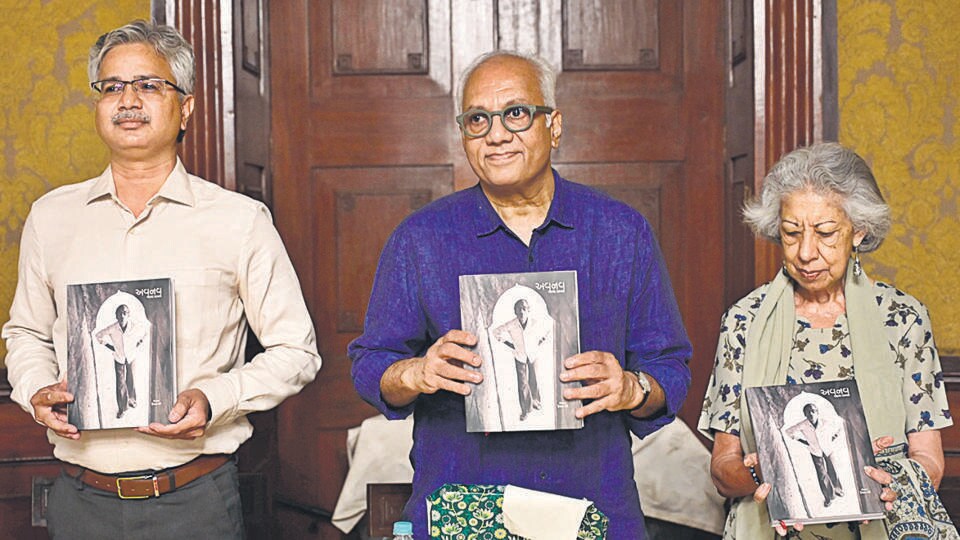
At Asiatic Society of Mumbai (ASM), where he was a member since 1966, he had made his second home. On April 6 this year, 88-year-old Dharamsey passed away. On Thursday, ASM released his book, ‘Avanav’, a compilation of his articles in Gujarati, edited by Dr Hemant Dave. “We had planned it like a lifetime achievement, but destiny had other plans,” said Prof Vispi Balaporia, president, ASM. “We miss seeing him in the library, poring over bound, voluminous newspapers from 20, 30 years ago, looking for research material. He was a constant presence. Today is a sorrowful remembrance, but also a celebration.”
The book was launched by eminent artist Atul Dodiya, his friend of close to 40 years.
A leading authority on silent cinema, who “advised two generations of film researchers”, Dharamsey is tough to classify. Dave said, “His articles in the book cover archaeology, Parsi theatre, contribution of Gujaratis to silent cinema, and art history focusing on Gujaratis, from the 11th century to contemporary artists such as Atul Dodiya. He knew many Gujarati painters personally. He truly deserves to be in the Gujarati pantheon of scholars. At the same time, he was Gujarati, but not Gujarati; Kutchi, but not Kutchi; Jain, but not Jain. He was above such parochial boxes.”
Dodiya added, “When you are at exhibition openings, many people visit from different backgrounds. The big question at the time was how to introduce him. How do you introduce Dharamseybhai? I would say, ‘He’s a reader.’ He was a living encyclopaedia.”
The Gujarati polymath
Dodiya was 16 when he met Dharamsey for the first time, at the house of a mutual friend. “He used to visit Ghatkopar often, where I live and paint. We forged a great friendship. We met almost every Sunday over the last 25-30 years. He was a remarkable man. He was interested in art, cinema, literature, philosophy, photography, anthropology, archaeology, architecture, music, theatre. I have learnt all the -isms from him. The input I received from him in my formative period was immense. My oeuvre stems from learning from him,” said Dodiya.
A no-nonsense man with strong likes and dislikes, Dharamsey was both temperamental and generous. “At parties, we would pray that he keep his cool,” said Dodiya. “He would not tolerate airy-fairy topics.” When his artist wife, Anju Dodiya, had her first show – a collection of watercolour on paper -- in 1991, “Dharamseybhai saw her works and gave her a book on Japanese prints”.
Dodiya added: “Till today, the Japanese influence in Anju’s works is so visible. He was not just knowledgeable, but had a deep understanding of many disciplines. His WhatsApp DP was of Joseph Beuys, one of the greatest post-war German artists. What person would have that as a DP?”
In 2012, ASM had awarded Dharamsey a silver medal for his book on Bhagwanlal Indraji, the first Indian archaeologist. At a seminar on Indology, he had presented a paper on it, where Dave met him for the first time. “As a student of archaeology, I realised that all my knowledge of Indraji up till then had been superfluous and faulty. He was much into empirical data.” It would be surprising, then, to learn that Dharamsey was a school dropout, who studied only till the seventh standard. Dave said, “He grew up at a time when the intellectual climate was not encouraging. But, by stepping out of formal education, he could see the pitfalls in it. He was saved in a way.”
A relentless walker, who read voraciously on Orientalism, who collected scripts of silent films and interviewed stars from the silent era at length, Dharamsey led an ‘avanav’ (atypical in Gujarati) life. His son Tatsubhai narrated an incident to underline this. “When he met my mother for the first time to discuss marriage, he told her, ‘My books are my first wife. You will be my second. But, I will not leave you till the end.’ It is a promise he fulfilled.”


