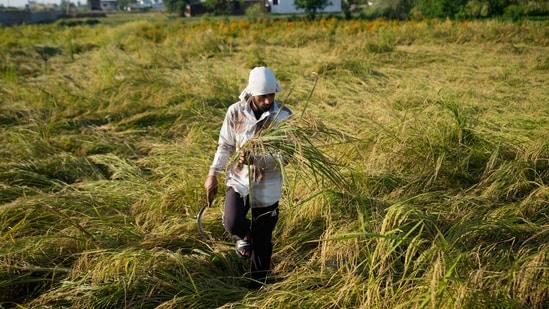
The Maharashtra government is set to return over 3,000 acres of land spread across nine villages in Shrirampur tehsil, Ahilyanagar district, to more than 1,000 farmers or their legal heirs, after settling a dispute that lasted over a century. The British administration acquired the land in 1918 but never used it for agriculture, the purpose for which it was acquired.
According to revenue department officers, the proposal has been under consideration since 1995. It was put on cold storage once, rejected once, and approved twice—most recently on September 15. The state government’s initial approval in 2024 stalled because then-Governor CP Radhakrishnan held the draft ordinance for a year before finally seeking the President’s opinion. “This created a new legal tangle as there was no provision for obtaining the President’s opinion in such cases,” a revenue official said.
Also Read | Weak monsoon, crop failures, force farmers to cut spending
Meanwhile, as the government delayed its decision, the Bombay High Court’s (HC) Aurangabad bench ordered a resolution in three separate rulings over thirty years.
Also Read | Haryana: 13,000 paddy farmers’ produce yet to reach mandis, verification ordered
Final call
{{/usCountry}}Also Read | Haryana: 13,000 paddy farmers’ produce yet to reach mandis, verification ordered
Final call
{{/usCountry}}Now, more than 45 days after the Maharashtra cabinet approved a change to the 1961 Agricultural Lands Act, Governor Jishnu Dev Varma has yet to give his official approval. Revenue officials explained that once the Governor signs this ordinance, a new legal process will open, allowing original landowners or their families to get their land back for farming.
Officials said that a new sub-section -- 3-1B -- would be inserted under Section 28-1AA (3) of the 1961 Act, empowering the government to grant land to the eligible.
“The land would be granted under Occupancy Class II (partial ownership), subject to the statutory ceiling limit or the actual area originally taken from the applicant, whichever is lower. An ordinance will be promulgated to amend the law following the governor’s approval,” the government decision stated.
After the land was acquired for irrigation in 1918, it was leased to Belapur Company Limited and incorporated in 1919. After the Maharashtra Agricultural Lands (Ceiling on Holdings) Act came into force in 1961, 6,425.17 acres of the company’s 7,377-acre Haregaon Estate in the then Ahmednagar district were declared surplus and transferred to the Maharashtra State Farming Corporation (MSFC), a state-owned company managing surplus agricultural land.
A fight across generations
The state government’s decision is a shot in the arm for farmers who have struggled to reclaim their lost land, following decades of protests, court cases and unfulfilled promises.
Sharad Asne, 51, said 40 acres belonging to his great-grandfather Yadu Asne were acquired. His family has preserved land records, including 7/12 extracts, mutation entries tracing ownership across generations and death certificates, to support their claim. “I have 10 acres today, but not every farmer is as fortunate. Many families have lost their land and are struggling to make ends meet. They have waited years for the government to return what they believe rightfully belongs to them,” he said.
The wait has lasted three generations for Babasaheb Vetal, 52. His great-grandfather Rabaji Sayaji Vetal’s 20.38-acre land parcel was acquired under a 30-year agreement; it was not returned after the agreement expired, nor was the family compensated. “I have the agreement. We first filed a petition in 1961 and have been fighting for justice ever since. Today, I own just one acre, making me virtually a landless farmer,” he said.
Vetal said his family had hoped the government would return the land following the HC’s 2024 ruling, but the wait continued. “Our family has been fighting for generations, but we are yet to get justice. We are still waiting. Let’s see what fate has in store for us,” he said.
Also Read | Don’t attend last rites of farmers who die by suicide: Sena MLA Sanjay Gaikwad
Gaps in records and litigations
While the state awaits the final nod from the Governor, the central question before the state government was whether the original acquisition was legally completed as there were no records available.
The cabinet proposal approved last month indicates that a declaration under section 6 of the Land Acquisition Act, 1894, was issued, but it does not conclusively establish whether all required procedures were followed, including determining compensation, issuing a final award and taking possession of the land.
Meanwhile, the fight to reclaim the land has involved decades of litigation and protests.
In 1995, freedom fighter and CPI leader Madhavrao Bayaji Gaikwad approached the HC, urging it to restore the lost lands to their owners. The government later formed a committee headed by Ramraje Naik-Nimbalkar, but deferred a decision in 2001.
In 2015, farmer Girdhar Asane and others filed another petition at the Aurangabad bench, which directed the government to decide their claim within eight months. The government rejected it in 2016, citing a Supreme Court ruling that land acquired for a public purpose could not simply be returned to its original owners merely because it remained unused.
Fresh petitions followed in 2020, and in 2024, the government told the court it was considering amending the Maharashtra Agricultural Lands (Ceiling on Holdings) Act, 1961, to enable restoration of the lands. The HC disposed of the petitions, directing the government to introduce the amendment within two months.
Advocate Ajit Kale, who represented the farmers, said the case exposed gaps in acquisition records. “The government could not produce documents confirming the 1918 acquisition or the final award showing how compensation was determined for each farmer,” he told HT. He said the government announced its decision to return the land only after the court pressed it to produce the records.
Kale’s involvement began with his father Babanrao, who resigned as general manager of the State Bank of India’s Shrirampur branch in 2003 to join Sharad Joshi’s Shetkari Sangathana and fight for the land’s restoration. Hailing from the same tehsil, Ajit Kale has since taken up the mantle to resolve the dispute.
The ball is now in the governor’s court, as farmers wait to reclaim their inheritance.
Stay updated with all the Breaking News and Latest News from Mumbai. Click here for comprehensive coverage of top Cities including Bengaluru, Delhi, Hyderabad, and more across India along with Stay informed on the latest happenings in World News.
Stay updated with all the Breaking News and Latest News from Mumbai. Click here for comprehensive coverage of top Cities including Bengaluru, Delhi, Hyderabad, and more across India along with Stay informed on the latest happenings in World News.