E-Paper


Weak monsoon, crop failures, force farmers to cut spending
India’s weakest monsoon in over a decade raises concerns about farm output, winter sowing and rural spending

 Prefer HTon Google


Farmer Ramesh Valvi, 34, hoped to buy a ₹4.5 lakh tractor for his three-hectare farm in Maharashtra’s Mandvi village. He saved ₹60,000 and hoped to earn another ₹50,000 for the ₹2 lakh down payment. Valvi planned to arrange the remaining amount from his brother, a construction contractor.
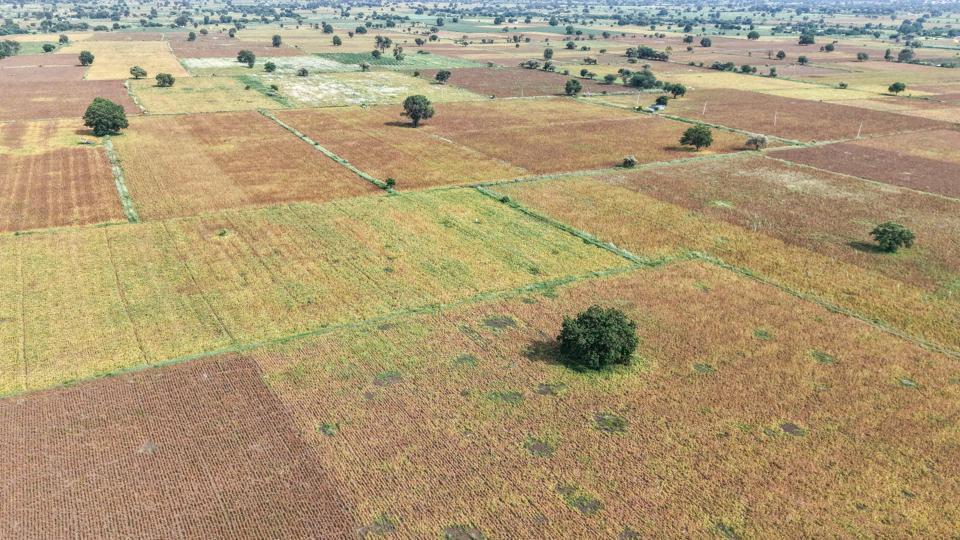
The plan is now on hold as Valvi’s maize and tur crops failed after rains stopped. ₹40,000 he invested in his land is also lost. Valvi expects to only break even, leaving little room for the tractor purchase. There is not enough water even to drink, and he sees little chance of sowing a rabi crop in the winter, unless water becomes available.
With no income expected from another harvest, he expects to use his savings to feed his family. His remaining hope is compensation through crop insurance. Valvi’s predicament echoes many as India’s weakest monsoon in more than a decade raises concerns about farm output, winter sowing and rural spending.
The effects are beginning to show in fertiliser and farm machinery sales, while low reservoir levels threaten to extend the damage beyond the monsoon crop.
The weak monsoon
The southwest monsoon, which delivers 70% of Indian rains, started weak. The country registered its fifth-driest June since national statistics began in 1901. There was a 39.8% fall from the long-period average. Rains picked up briefly bringing some relief in July but plunged again in August, recording a 16.3% deficit and the hottest August since 1901 as El Nino conditions strengthened.
The monsoon ended with a 12.6% downfall, the fourth-lowest since 2001. There were also sharp regional variations. East and northeast India received 25% less rainfall than normal. Southern peninsular India had 24% less and northwest India 6% less rain. Key agricultural states also recorded poor rains. Bihar had a deficit of 32%, Punjab 41%, Marathwada 39% and Kerala 28%. Overall, 17 meteorological subdivisions, covering 42% of the country’s area, recorded deficient rainfall during the season.
The decadal weak monsoon has left parts of the country with inadequate soil moisture just as farmers prepare for the rabi season. The weak monsoon has also left reservoir storages down. Despite higher storages recorded at the beginning of the season due to above-average rains last year, reservoir levels depleted to 68.6% of capacity on October 15, against 90.8% a year earlier and against the 10-year average of 82.1%.
According to a Barclays report, over 37% of districts had severe or extreme soil-moisture deficits. Rain-fed areas are particularly vulnerable because they have less access to irrigation. For farmers who have lost their kharif crops, a failure to sow rabi crops could mean another season with little or no farm income.
Fertiliser sales slide
The lack of rain affected not just Valvi’s crop but also how much fertiliser he could apply. He usually applies it four times during the crop cycle, but managed only two rounds this year because there was not enough water. The fertiliser he did apply failed to spread into the soil properly, he said, and pests attacked the crop.
National fertiliser sales have also weakened. Industry estimates suggest sales of complex fertilisers fell by more than 20% in April-September from a year earlier. Urea sales also declined, despite higher domestic production and imports.
Poor rainfall may have discouraged farmers from spending on inputs, though supply constraints and higher raw-material costs have also affected some fertiliser categories. With little water available even for drinking, Valvi does not expect to sow a rabi crop. His savings, which he had set aside to buy a tractor, will now go towards feeding his family. He is hoping for compensation through crop insurance to help him tide over the losses.
Muted tractor demand
India, still being a largely agrarian economy, has a significant percentage of the population dependent on agriculture for a healthy income. Prospects for that have turned sour this year owing to the bad monsoon.
Tractor retail sales fell 12.58% month-on-month to 76,906 units in September, according to the Federation of Automobile Dealers Associations, but were still 13.75% higher than a year earlier. On a year-on-year basis, sales were down 18%. A Barclays report said the effect of crop losses on tractor purchases could become clearer in early 2027, as lower farm earnings prompt some farmers to delay expensive purchases.
For Valvi, that decision has already been made. With his kharif crop gone and the next sowing uncertain, the money he set aside for a tractor will instead go towards food.