
 E-Paper



Maharashtra readies policy to compensate fishers affected by development projects
The Maharashtra government has prepared a draft policy for compensation of fishers affected by development projects with six broad recommendations including directing project proponents


Mumbai: The state government has prepared a draft policy for compensation of fisherfolk affected by development projects with six broad recommendations including directing project proponents (state or private organisations in charge of a project) to pay 2% of their total project cost toward compensation to fishers affected by the project.
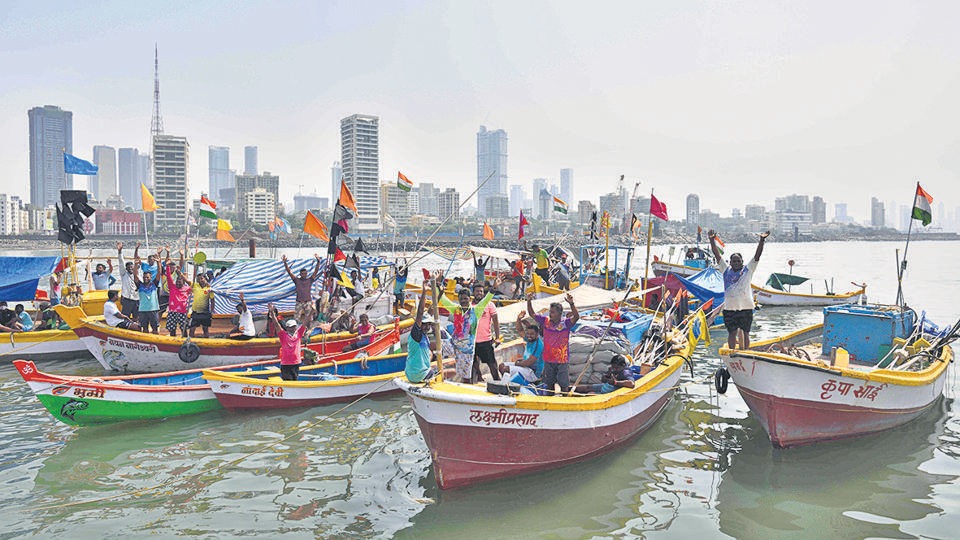
This comes in response to a petition filed in the Bombay high court (HC) by the Mariaayi Machhimaar Sahakari Sanstha Maryadit – a registered fishworkers cooperative based in Vashi – on behalf of the fishing community from Vashi, Juhu, Koparkhairane, Ghansoli and Diva villages.
The petitioner had claimed compensation for the fishermen, contending that they were inhabitants of the Thane creek area and their customary right to fish in the creek was adversely affected by the construction of the third Thane Creek bridge (TCB-3), a proposed six-lane bridge on the Sion-Panvel highway which will connect Mumbai with the mainland at Navi Mumbai.
The policy document prepared by a committee under the department of fisheries includes providing “unique smart identification cards” renewable every three years (in addition to the already existing IDs provided by the fisheries department) and creating a fresh database of subsistence fishers in the state. Hindustan Times has seen a copy of the draft policy.
“The state has a database of commercial fishers to some extent and traditional fishers to certain extent, however there is complete lack of data on subsistence fishers who are poor and unorganised fishers who need more care due to their fragility,” the document stated and recommended that all the proponents of infrastructure projects deposit a sum equal to 2% of the total project cost with the fisheries department for rehabilitation of fisherfolk. Details around this proposed regulation are presently unclear and “will be decided later”, the draft policy stated.
A division bench of justices SJ Kathawalla and Milind Jadhav of the Bombay HC on August 12 directed the Maharashtra government to frame a general policy for compensation “not only for fishermen, but for compensating any community whose customary rights to carry out an activity for their livelihood is impacted by government infrastructure projects.”
Subsequently, on October 11 the state constituted a 23-member committee to look into the matter.
In the preface of the policy document, dated November 29, the committee wrote, “There are a lot of projects going on in Maharashtra state being implemented by the government or other agencies like MMRDA, MSRDC, MCGM, CIDCO, MMRC, JNPT, NHAI, Railways, MMB, ONGC etc… All these projects demand to mitigate the risk of affecting fishing activities, therefore affecting the livelihood of the fishers.”
The draft policy also recommended including a fresh census of shipping vessels, mandatory prior social and technical impact assessment exercises before commencement of development projects, setting up a standard operation procedure (SOP) to mitigate its impact and setting up grievance redressal committees (at the regional, district and state level) for fishers, and mandatory baseline surveys on quality and quantity of fishing catch in a project affected area prior to construction work.
Fisherfolk said that stressing on a provision of compensation instead of safeguarding their intergenerational right to carry out a traditional livelihood is disappointing. Devendra Tandel, president of the Akhil Maharashtra Machhimaar Kruti Samiti (AMMKS), said such a move would not adequately address the community’s concerns.
“This policy is not acceptable to us, because it does not consult us. There is not even a single member of the fishing community who has been taken into the deliberations, let alone members who represent a good cross section of the community. There are also several aspects of this policy which are contrary to what it sets out to do. For example, social impact studies have been mandated by the project proponents themselves, which is a huge conflict of interest. Second, the method to calculate compensation for project affected fisherfolk assumes that only one member of each family earns an income, which is not true,” Tandel said.
“In Palghar district’s Kopran and Akkarpatti villages, fishers have been displaced by the Tarapur power station and in Raigad’s Uran, people have been displaced by the JNPT port. Whole generations have been kept from practicing their traditional livelihoods, on the backs of promises of modernity and better living which were never received. If the committee is unwilling to learn from the state’s past mistakes, where does that leave us?” Tandel asked.
A senior officer in the fisheries department seeking anonymity, however, said, “The High Court will decide whether or not the draft policy is suitable. Besides, this is only a draft and will be further revised based on Cabinet discussions. The draft policy has not yet been cleared by the state government. As far as consulting the community goes, we have invited, received and considered all the comments we have received from fishing societies and fisherfolk.”
The Maharashtra State Road Development Corporation began constructing the new TCB-3 in December 2020, with a deadline of three years. It will help ease traffic volume on the existing TCB-2, built in 1997.


