E-Paper



US ambassador calls J&K ‘important part of India’, Pak summons top diplomat to register protest
Sergio Gor, the first US ambassador to travel to Jammu and Kashmir in six years, made the remarks after a meeting with chief minister Omar Abdullah.

 Prefer HTon Google


US ambassador Sergio Gor on Wednesday described Jammu and Kashmir as an “important part of India” during a visit to Srinagar, prompting Pakistan to summon the senior-most American diplomat in Islamabad to register a protest.
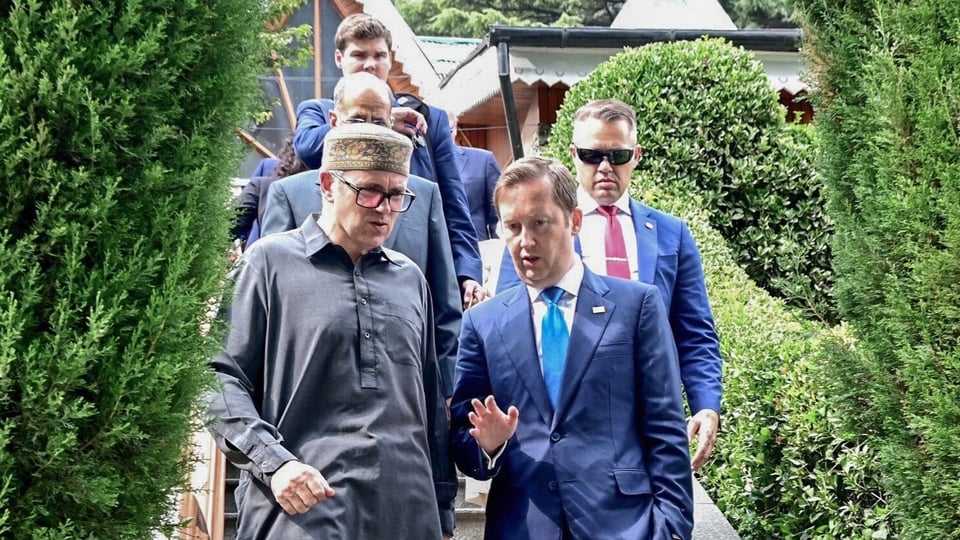
Gor, the first US ambassador to travel to Jammu and Kashmir in six years, made the remarks after a meeting with chief minister Omar Abdullah. He also indicated that the US could look into downgrading a travel advisory for Kashmir in view of the improvement in the situation in the region.
Gor hints on lowering US travel advisory risk for J&K
“This is an important part of India and so I am here visiting for the first time. It is an incredibly beautiful place and I’m thrilled to be here, thrilled to see this place,” Gor said while speaking to the local media along with Abdullah.
Gor, who is also the US special envoy for South and Central Asia, noted that the US has a practice of reviewing travel warnings that it issues for its citizens and said: “I cannot make any big announcements here today but it is something we are going to look at.”
Both the Central and Jammu and Kashmir governments “have made some incredible steps in keeping this area safer”, he said. “We will be looking at if the travel warning that is recommended by the US is something that should be downgraded because as I said earlier this is a beautiful area. I think a lot of Americans would enjoy coming here and seeing the beauty,” Gor said.
If the US state department downgrades the threat level, it could turn out to be a major boost for the tourism sector in Kashmir. Tourism accounts for 7% of the state GDP.
Also Read I US envoy Sergio Gor calls J&K ‘important part of India’, says travel advisories will be reconsidered
Islamabad issues demarche
Hours later, Pakistan’s foreign ministry summoned the US charge d’affaires in Islamabad, Natalie Baker, and served her a “strong demarche” on Gor’s visit to Kashmir and his “incorrect statement regarding the status of the disputed territory”.
A statement from Pakistan’s foreign ministry described Gor’s remarks on the status of Jammu and Kashmir as “factually incorrect”.
“Pakistan strongly condemned and categorically rejected the characterisation of Jammu and Kashmir as a ‘part of India’,” the statement said. The foreign ministry contended that Gor’s “irresponsible statement…negated the long-standing and well-documented position of the United States” on the Kashmir issue and “ran contrary to the United States’ commitment to supremacy of international law and the UN Charter”.
The statement added: “While appreciating President Donald Trump’s offer to mediate between India and Pakistan to resolve the Jammu and Kashmir dispute in the aftermath of Marka-e-Haq, the US side was urged to ensure that its public statements remain consistent with the disputed status of Jammu and Kashmir.”
Also Read I Pakistan summons US charge d'affaires over Sergio Gor's remarks during J&K visit
It is rare for US diplomats to publicly comment on the Kashmir issue. The US has traditionally maintained that India and Pakistan should handle all bilateral issues, while New Delhi has consistently ruled out any third party mediation, especially on issues such as Kashmir.
Several Kashmiri politicians, including opposition leader Mehbooba Mufti, had raised the US travel advisory for Kashmir amid Gor’s first visit to the region. Mufti said on social media that Gor should “review and withdraw the highest level travel advisory against visiting Kashmir” as thousands of families in the region depend on tourism. The US travel advisory, she said, acts as “a wall between Kashmir and the world”.
Also Read I After Trump, US envoy cites India's 660 million voters to push voter ID
Following his meeting with Gor, Abdullah told the media: “We had an opportunity to discuss the relations between our two countries, but with specific focus on what the US can do with Jammu and Kashmir.”
He added: “There are obviously certain legacy issues that, over time, we will be working to resolve but we look forward to taking this conversation further.”