MUMBAI: The Mangrove Foundation - an autonomous society under the Maharashtra forest department’s mangrove cell - on Tuesday launched a mobile application named M-Turtle to help streamline collection of data on the nesting patterns of Olive Ridley turtles in Ratnagiri, Sindhudurg and Raigad districts where they are known to lay eggs between December and March.
The app was created in collaboration with Chiplun-based NGO, Sahyadri Nisarga Mitra, which has been working with the Mangrove Foundation on sea turtle conservation in Maharashtra, and which is the first organisation in the state to start a sea turtle conservancy programme in Ratnagiri’s Velas village.
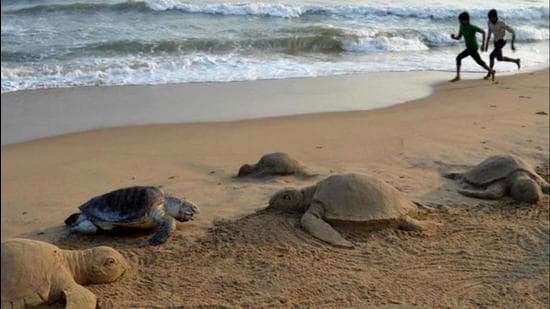
The application will be used by about 55 qualified nest managers, who conduct regular patrols along the coast to identify Olive Ridley turtle nests and transport the eggs to hatcheries where they are kept safely until the hatching season in April-May, after which the hatchlings are released into the ocean.
“During this process, we collect a lot of data ranging from the number of nesting sites, nests and eggs; to measuring turtle track marks on the beach; to the hatchling success rate; to the survival rate of the hatchlings. Doing this manually is a lot of effort, and there have been issues in the past due to the data not being uniform. The M-Turtle app eliminates any extra work, and all the information that we need as researchers becomes available to us on the cloud,” said Harshal Karve, a marine biologist with the Mangrove Foundation.
M-Turtle was first commissioned by the Mangrove Foundation in early 2020 and has been in testing over the past one month to remove bugs and respond to queries from nest managers. “Our nest managers in Raigad and Ratnagiri are already using the app, and have given positive feedback. We are conduting a training workshop in Sindhudurg on Wednesday. The nest managers deal with a large amount of data so it can get very tedious for them to note down everything manually and then input it on a computer,” Karve added.
{{/usCountry}}M-Turtle was first commissioned by the Mangrove Foundation in early 2020 and has been in testing over the past one month to remove bugs and respond to queries from nest managers. “Our nest managers in Raigad and Ratnagiri are already using the app, and have given positive feedback. We are conduting a training workshop in Sindhudurg on Wednesday. The nest managers deal with a large amount of data so it can get very tedious for them to note down everything manually and then input it on a computer,” Karve added.
{{/usCountry}}The Mangrove Foundation is planning to add more functionality to the M-Turtle app in future. For example, the foundation is considering equipping all nest managers with thermometers and asking them to log the temperatures of Olive Ridley turtle nests, along with the sand around the nesting site. “This plays an important role in determining the sex of the hatchlings. The data won’t be perfect but it will give us a rough baseline for future studies, and it can be reflected on the app in real time,” Karve explained.
This nesting season, nest managers have so far identified only 10 Olive Ridley turtle nests in Maharashtra including one at Araavi beach in Sindhudurg district, a hitherto unknown nesting location. Officials from the Mangrove Foundation said that they have conducted awareness drives among the locals and are currently keeping a watch out for other Olive Ridley turtle nests in the area. While there are four species of sea turtles recorded in Maharashtra, Olive Ridley turtles are the only species that nest in the state and have the widest population distribution. Globally, their populations have been declining, and they have been listed as ‘vulnerable’ in the IUCN Red list of threatened species.
In 2021, the number of turtle nesting sites along Maharashtra’s coastline had doubled as compared to 2020. During nesting season, a total of 451 nesting sites were recorded through field observations, up from 288 during the corresponding period last year. In fact, data shows a significant increase in the number of nesting sites over the past six years. In 2017, for example, only 75 nests were recorded across these three districts. That figure has shown steady improvements, year on year.
Stay updated with all the Breaking News and Latest News from Mumbai. Click here for comprehensive coverage of top Cities including Bengaluru, Delhi, Hyderabad, and more across India along with Stay informed on the latest happenings in World News.
Stay updated with all the Breaking News and Latest News from Mumbai. Click here for comprehensive coverage of top Cities including Bengaluru, Delhi, Hyderabad, and more across India along with Stay informed on the latest happenings in World News.