Mumbai: A total of 10,000 infrastructure and private construction projects are underway in the Mumbai Metropolitan Region (MMR) at present, including the Coastal Road, the Navi Mumbai international airport, the bullet train, seven metro lines, and concretisation of 400 kilometres of road in Mumbai.
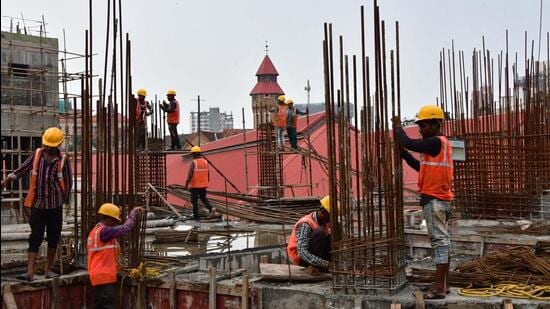
While these portend the emergence of a glittering new city, the weight of building it rests squarely on the shoulders of migrants from within and outside Maharashtra, who comprise the bulk of the labour force in the construction sector. Most migrants arrive in the city seeking escape from extreme poverty and the lack of opportunities. But once here, they encounter precarious working and living conditions, and often, the cost of fuelling the dreams of a new city by paying with their lives due to lack of safety measures.
Several laws are in place to protect the rights and interests of workers in the construction industry. These include laws such as Building and Other Construction Workers’ (Regulation of Employment and Conditions of Service) Act, 1996 which contains detailed guidelines for workers’ safety as well as provisions for financial compensation due to accidental injury and death. But these laws hardly make a difference to workers due to lack of awareness, unwieldy eligibility criteria and systemic apathy, say activists. Officials in charge of implementing these laws, meanwhile, claim they are making all efforts, but the bottleneck lies elsewhere.
Infra boom, poverty, migration
{{/usCountry}}Infra boom, poverty, migration
{{/usCountry}}A recent Knight Frank report estimates that the infrastructure sector is the second largest employment generator in the country, with an estimated 71 million workers in 2023. Around 80% of them are engaged in unskilled work, says the report.
Though Mumbai has attracted migrants in large numbers for decades, the boom in construction and infrastructure projects in the MMR in recent years has also fuelled the influx of migrant workers from within Maharashtra and states like Uttar Pradesh, Bihar, West Bengal, Andhra Pradesh, Telangana and Karnataka.
Most migrants are compelled by poverty and lack of employment opportunities back home. “Working as farm labourers doesn’t even cover the cost of one meal for my family. So, we and some other families come to work in Mumbai for a few months every year to ensure we can have two meals a day,” said Arjun Gawane from Maharashtra’s Beed district.
When migrants arrive in the city alone, they usually go to highways where contractors are on the lookout for daily wage labourers, said Suresh Shyamlal Gupta, Mumbai president of the youth wing of Indian National Trade Union Congress (INTUC). “But when they come in a group from the same village, they seek help from a fellow villager who has been working in the city. If they reach a construction site before a base is built or if accommodation is not provided by employers, the contractors get them very cheap accommodation in slum areas,” said Gupta.
A majority of migrants are aged 18-20 years when they enter the construction sector, though there are some who start in their teenage years, either due to an untenable family situation or the absence of a breadwinner in the family. Most are unaware of the safety measures or precautions that must be adopted while building roads, highways, bridges, flyovers, metro rail tracks, corporate offices, malls, hotels, IT hubs, and multi-storeyed apartments.
Employment in the construction sector, on the other hand, is tenuous and exploitative, say experts. “The industry is characterised by instability, short duration, wide range of skills, management of complex interactions and uniqueness of projects, leading to circumstances where blatant exploitation of construction workers takes place,” said Vaijayanta Anand, associate professor, College of Social Work, Nirmala Niketan.
Tenuous living, working conditions
The Maharashtra Building and Other Construction Workers’ (Regulation of Employment and Conditions of Service) Rules, 2007 lay down detailed guidelines and compliances related to worker safety that must be followed for all construction projects. The rules mandate that new public and private construction projects employing manual labourers must pay 1% of the total project cost as cess to the state government, which is directed to the Maharashtra Building and Other Construction Workers’ Welfare Board. The board is tasked with ensuring workers’ access to safety equipment, health and welfare schemes, scholarship for children and a one-time retirement amount. In case of accidental deaths, it provides a financial assistance of ₹5 lakh to the next of kin of the deceased, ₹10,000 towards final rites, and ₹24,000 every year for a period of five years to the deceased family. The board also provides financial help in case of natural deaths, but workers must be 51 years or above.
But activists say that the lack of proper deterrents, either in terms of enforcement or having a specific policy to ensure safety of workers, has enabled developers and contractors to flout the law at will.
“A majority of employers who engage daily wage workers including in construction and factories do not have the mandated group insurance that protects them in case of accidents. Workers who handle dangerous equipment are also not trained on safety aspects,” said Abhijeet Rane, founder of the Dhadak Kamgaar Union that represents more than seven lakh blue-collar workers.
“Workers at construction sites with a height of 10 feet or more need to be provided harnesses and safety helmets. But no construction site in the city has these safety precautions in place for all its workers,” said Rane, adding that the government needs to be more prudent, not just in terms of having rules addressing workers’ safety but also implementing them.
In similar vein, Gupta from INTUC drew attention to the precarious working and living conditions at construction sites. “Some sites have just one portable toilet for more than 50 labourers, forcing many to relieve themselves in the open. One corner in such sites is usually reserved for cooking and related activities, while another corner is used as an open lavatory. Mosquitoes and flies buzz all around the site, constantly spreading diseases,” said Gupta.
Moreover, most workers are employed at half the ₹7,000-8,000 minimum wage prescribed by the state, said the trade unionist. “This practice is rampant as 80% of the labourers are not on official records,” said Gupta. He said not adding workers’ names to official records helps developers and contractors escape from the clutches of law in cases of accidental death.
Gawane, who migrated with his family from Beed to Mumbai, discovered this the hard way on June 6, 2023, when his wife Lakshmibai, 40, and sister Saubai, 45, died after a part of the compound wall of an under-construction building in Virar east collapsed. Though Virar police filed a 400-page chargesheet against builder Chirag Doshi and contractor Bharat Patel, both were granted bail by the court.
Struggle for compensation
Mahendra Yadav, 26, from Bishanpura village of Uttar Pradesh’s Kushinagar district – the only earning member in a family of seven – died of electrocution in Mumbai on September 19, 2023. The incident occurred on the sets of a television show titled ‘Imlie’ as he was not provided with rubber gloves or gumboots while handling the electrical equipment.
The intervention of Dhadak Kamgaar Union saw the family being compensated with ₹16 lakh by the producers of the show. “Though there can be no consolation or replacement for the loss of our biggest support system, the money will certainly help my younger sister and me complete our studies and become capable of supporting our family,” said the deceased worker’s younger brother Dilip, 23, a second year BPharm student.
But such cases are more the exception than the rule owing to tedious bureaucratic procedures around compensation.
For instance, the families of 13 labourers who died on August 1, 2023 due to the collapse of a 700-metric tonne girder launcher on the Samruddhi Expressway near Shahapur in Thane were promised a compensation of ₹5 lakh by the state government and ₹2 lakh by the central government. But when the families of nine out of 13 labourers submitted the legal heir’s certificate and other relevant documents to claim compensation, authorities in Shahapur tehsil told them that it would be released only after all the families submitted the documents and they were verified by officials. The families were eventually compensated in December, more than four months after the incident.
But even such cases are rare, and most families of deceased workers do not get any compensation despite the efforts of activists. For instance, Sudhir Das, 30, and Ramkrishna, 25, died by electrocution while testing a new sewer line in Govandi on June 24, 2023. Though social activists held protests demanding compensation for the families of two deceased workers, they did not receive any help from the government.
On the contrary, when construction workers die due to accidents on-site, contractors tell their family that they can help with transportation of the dead body to the village and nothing more, said a contractor with over a decade’s experience in the construction sector in Mumbai. “That is the maximum we offer to the deceased’s family on an immediate basis. Other people working on the site are kept quiet by warning them of consequences. Only if the family persists, the builder provides a small compensation,” he said.
Steep criteria, apathy
Currently, 13.31 lakh workers are registered with the Maharashtra Building and Other Construction Workers’ Welfare Board, compared with 7 lakh last year. The board has linked 20.28 lakh workers with various welfare schemes till date, disbursing a total of ₹598.09 crore.
While these numbers comprise a miniscule proportion of the total number of construction workers in the MMR, benefits under the BOCW Act are available only to those workers who are voluntarily registered with the board. The criterion for registration includes employment for at least 90 days within the preceding year, and applicants are required to furnish relevant certificates or documents. They must also renew their membership with the board every year.
Migrant workers often find it difficult to adhere to these requirements, denying them access to the protective ambit of the law, said officials. “The issue with construction workers is that most of them are migrants who do not stay at a place for a long time. Therefore, they do not turn up for registrations,” said Vivek Kumbhar, secretary cum chief executive officer, Maharashtra Building and Other Construction Workers’ Welfare Board.
He said that since April 2023, the board has been issuing booklets at nakas where construction workers gather every morning in a bid to increase registrations. “Workers are asked to fill in details of the work they have undertaken in the booklet, even if they have been working at households independently. So far, we have distributed 4,000 booklets,” he said.
The board has also partnered with CREDAI-MCHI, the apex body with 1,800 real estate developers in the MMR, to arrange labour registration drives. Till date, 4,300 labourers have been registered under their joint efforts, said officials.
Keval Valambhia, chief operating officer, Maharashtra Chamber of Housing Industry, said that while developers deposit the 1% labour cess prior to commencement of a construction project, the state must do more for labour welfare instead of holding them accountable for accidents or mishaps.
“Considering that the average cost of projects in Mumbai is ₹450-500 crore, the labour cess makes up a huge amount. We have written to the government with our suggestions, asking them to work with us on labour welfare. We can take care of the skilled and unskilled labour force on our own, but unless there is a government push, our efforts will only be a drop in the ocean,” he said.
Sonvi Khanna, who leads Social Compact – a multi-stakeholder platform for the wellbeing of vulnerable workers – said that while policy documents related to occupational safety and health including the BOCW Act are exhaustive, developers are often at a loss regarding how to implement them.
As an example, she mentioned that many companies tweak occupational health check-ups as per their convenience due to lack of knowledge. “HR (human resources) and IR (industrial relations) personnel in any construction firm should understand that occupational health doesn’t only mean checking blood pressure of construction workers annually. Health check-ups must be specific to the hazards their job poses,” said Khanna. “If a worker is involved in scaffolding, his spine tests need to be done. If a worker in engaged in welding, his eyes must be tested periodically.”
(Inputs from Megha Sood, Manish Pathak, Anamika Gharat, Faisal Malik)
Stay updated with all the Breaking News and Latest News from Mumbai. Click here for comprehensive coverage of top Cities including Bengaluru, Delhi, Hyderabad, and more across India along with Stay informed on the latest happenings in World News.
Stay updated with all the Breaking News and Latest News from Mumbai. Click here for comprehensive coverage of top Cities including Bengaluru, Delhi, Hyderabad, and more across India along with Stay informed on the latest happenings in World News.