Mumbai: A team of researchers working at the Thackeray Wildlife Foundation have discovered and described a new species of scorpion from Maharashtra. The species has been named Compsobuthus satpuraensis after the locality where it was first seen in October 2020, in the foothills of the Satpura range in Jalgaon district.
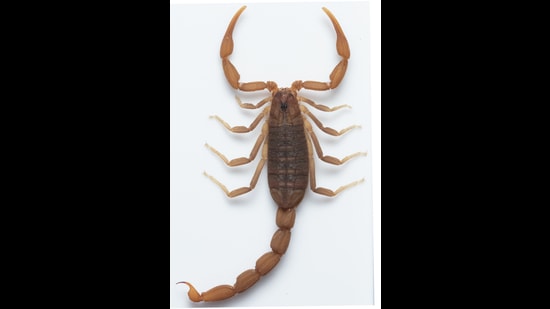
This is the fourth species of scorpion in India belonging to Compsobuthus, which is a genus of the larger family of buthid scorpions.
Details of the finding were published by authors -- Vivek Waghe, Satpal Gangalmale and Akshay Khandekar -- on Thursday in the international, peer-reviewed journal Euscorpious, which is dedicated to scorpiology (the study of scorpions).
“During the recent scorpion survey of non-protected areas in northern Maharashtra, we collected two scorpions of the genus Compsobuthus from two closely spaced localities in Jalgaon District. A detailed morphological examination revealed that the collected samples together differ from the congeners in several non-overlapping morphological characters,” the authors have noted.
According to Khandekar, there are some markers used to distinguish between species of scorpions like the number of pectinal teeth, the presence of carinae, the positioning of the trichobothria, which is a sensory organ, and the placement of the eyes.
“In our morphological examination, we compared the new species with morphological traits of its congeners by reviewing available literature on the subject, and our collected specimens were unique with respect to every distinguisher. That is why we have been able to classify it as an entirely new species,” Khandekar added.
{{/usCountry}}“In our morphological examination, we compared the new species with morphological traits of its congeners by reviewing available literature on the subject, and our collected specimens were unique with respect to every distinguisher. That is why we have been able to classify it as an entirely new species,” Khandekar added.
{{/usCountry}}This discovery also marks the first report of the genus Compsobuthus from Maharashtra and indicates that the genus could be more widely distributed in India than is previously known.
Previous congeners in India have been recorded in Madhya Pradesh, Gujarat and Rajasthan. This discovery extends the known distribution range of the Compsobuthus genus by approximately 600 km southwest in peninsular India.
The researchers said that additional dedicated field surveys, targeting suitable areas, especially in northern and central India, might further expand the known range of this genus in the country.
“It may also lead to uncovering a larger number of potentially undescribed species,” said Vivek Waghe, the study’s lead author.
Researchers also pointed out that this new species, along with its congeners, is typically found in habitats that are under immense anthropogenic stress.
“We have made this discovery by searching in a non-protected area, meaning it does not come under the legal definition of ‘forests’. But open scrublands and dry deciduous vegetation house several undiscovered species like these, so there is an urgent need to conserve these places. There is an immense wealth of biodiversity yet to be discovered in non-protected areas,” Khandekar said.
Stay updated with all the Breaking News and Latest News from Mumbai. Click here for comprehensive coverage of top Cities including Bengaluru, Delhi, Hyderabad, and more across India along with Stay informed on the latest happenings in World News.
Stay updated with all the Breaking News and Latest News from Mumbai. Click here for comprehensive coverage of top Cities including Bengaluru, Delhi, Hyderabad, and more across India along with Stay informed on the latest happenings in World News.