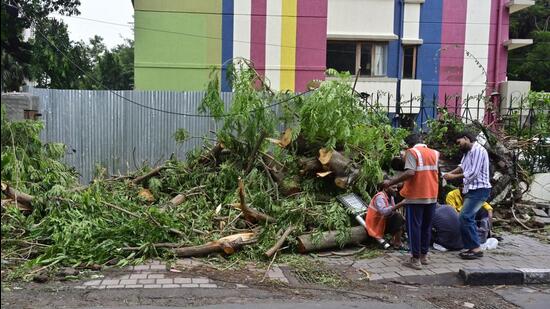
MUMBAI: Municipal commissioner Ashwini Bhide on Tuesday rejected claims that Mumbai’s ongoing road concretisation works were responsible for the recent spate of tree-fall incidents that claimed three lives in less than a week. However, her contention that there was no scientific evidence to support such a conclusion has been refuted by environmental activists.
Bhide on Tuesday announced that the BMC would ask botanists, arborists and technical institutions to assess the issue. The civic body has already approached experts from Mumbai University (MU), IIT and other institutions, and discussions have been instituted with Sanjay Deshmukh from MU’s department of life sciences and biodiversity to find long-term solutions. Additionally, internal meetings have already been held with assistant municipal commissioners and the garden department.
Bhide pointed out that concreting took place only on the carriageway whereas trees were located on footpaths. “Sometimes, underground utility works beneath footpaths may disturb root systems,” she said. “Roots will inevitably intersect with underground utilities—banyan and peepal trees have particularly complex root systems. The question is how those roots can be protected and whether there are better scientific methods of managing or pruning them without affecting the stability of the tree.”
According to the 2018 tree census, Mumbai has around 2.97 million trees, of which nearly 200,000 are roadside trees. “The challenge is to ensure that utilities and trees coexist without affecting the health of the latter,” Bhide said. “During footpath concretisation, we usually leave an open soil area around the trunk for rainwater. We are exploring whether additional permeable sections or openings can be created to improve water infiltration. Such measures have already been implemented at a few locations, including Malabar Hill, though on a limited scale.”
{{/usCountry}}According to the 2018 tree census, Mumbai has around 2.97 million trees, of which nearly 200,000 are roadside trees. “The challenge is to ensure that utilities and trees coexist without affecting the health of the latter,” Bhide said. “During footpath concretisation, we usually leave an open soil area around the trunk for rainwater. We are exploring whether additional permeable sections or openings can be created to improve water infiltration. Such measures have already been implemented at a few locations, including Malabar Hill, though on a limited scale.”
{{/usCountry}}The municipal commissioner said that many of Mumbai’s roadside trees were over five decades old. “Their roots extend deep underground, and it is difficult to determine whether anything has disturbed the roots below the surface,” she said. “Therefore, while carrying out road concretisation, we will seek expert opinions and prepare a Standard Operating Procedure on the precautions that need to be taken. We will also ensure that utility works are carried out safely. If there is clear evidence of negligence anywhere, strict action will certainly be taken.”
Bhide, however, reiterated that whether the reason was underground utilities, overall urbanisation or some other factor, evidence was needed that this was the factor responsible for tree falls. “We have completed nearly 1,700 km of road concretisation, and tree-fall incidents cannot be attributed to this,” she said.
The municipal commissioner’s assertion was disputed by environmental activist Rohit Joshi, who argued that if concretisation was not a factor, the BMC needed to explain whether strong winds alone caused the incidents. “Our surveys in 12 Mumbai and three Thane wards found several affected trees located on pavements and along nallahs,” he said. “We found that concretisation linked to utility works, religious structures and seven to eight categories in all had compromised tree health.”
Joshi added that the issue could be objectively verified using the LIDAR tree radar system, which detects internal cavities and structural weaknesses. According to him, a BMC project involving an arborist had used sample surveys and LIDAR scans, which showed that several trees had become vulnerable due to road concretisation and were subsequently classified as hazardous. The environmentalist has called for an urgent tree risk assessment on a war footing across the city.
Bhide said that an average of around 600 trees fell across Mumbai every year. The recent spell of heavy rain, accompanied by unusually strong winds, has upped the damage—so far, nearly 830 trees and 1,238 large branches have fallen so far, claiming three lives.
The municipal commissioner also reviewed the overall impact of the monsoon on the city, noting that Mumbai had already received nearly 40 per cent of its average annual rainfall this season. Mumbai’s long-term annual average rainfall is around 2,400 mm although the average over the past decade has increased to nearly 3,000 mm. Bhide pointed out that the rainfall received by Mumbai in early July alone is comparable to the annual rainfall of several major Indian cities, noting that Delhi receives around 800 mm annually, Pune about 720 mm and Bengaluru roughly 970 mm.
Stay updated with all the Breaking News and Latest News from Mumbai. Click here for comprehensive coverage of top Cities including Bengaluru, Delhi, Hyderabad, and more across India along with Stay informed on the latest happenings in World News.
Stay updated with all the Breaking News and Latest News from Mumbai. Click here for comprehensive coverage of top Cities including Bengaluru, Delhi, Hyderabad, and more across India along with Stay informed on the latest happenings in World News.