MUMBAI: On Tuesday, the Mithi River did what Mumbai had long feared – it pushed back.
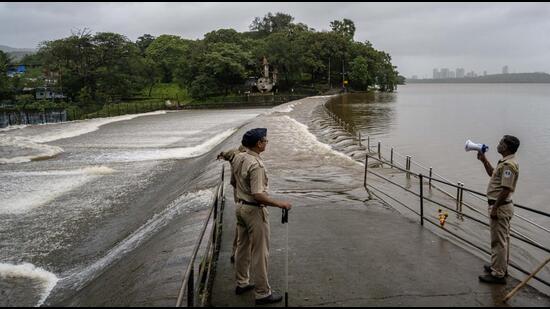
After five days of relentless rain, the river surged to 3.9 metres, breaching the Central Railway’s 2.7-metre danger mark, submerging tracks and paralysing train services for over eight hours. The timing couldn’t have been worse: a 9:16am high tide blocked the floodwaters from draining into the Arabian Sea, forcing the river to back up onto the streets. The overflow flooded parts of Kurla, BKC and Santacruz, with LBS Road, Taximen’s Colony and Kapadia Nagar among the worst hit.
For decades, the Mithi has been treated less like a river and more like a dumping ground. Today, it is choked with untreated sewage, industrial effluents, plastic waste and construction debris. According to Stalin Dayanand, director of the NGO Vanashakti, “Around 70% of the liquid in the Mithi is sewage, 30% garbage, and 10% industrial discharge.”
The warning signs have been there for years, ignored.
The Mithi, which originates in Vihar Lake in the Sanjay Gandhi National Park (SGNP) and flows 18km through Mumbai’s eastern suburbs, has steadily deteriorated. This crisis has been decades in the making. Around 50 years ago, two key developments set the stage: the unchecked expansion of the city led to excessive dumping into the river, and land reclamation for BKC narrowed the channel dangerously near its mouth.
Tuesday’s flood wasn’t a natural disaster. It was manmade, engineered by years of administrative apathy, unchecked encroachments, and the systematic dismantling of what was once a natural stormwater outlet.
{{/usCountry}}Tuesday’s flood wasn’t a natural disaster. It was manmade, engineered by years of administrative apathy, unchecked encroachments, and the systematic dismantling of what was once a natural stormwater outlet.
{{/usCountry}}Mumbai didn’t just face the river’s wrath. It faced the consequences of its own neglect.
Desilting the River
The Brihanmumbai Municipal Corporation (BMC), the official guardian of the Mithi, has spent more than ₹2,000 crore on dredging the Mithi, an exercise sabotaged by corruption and apathy.
“From 2013 to 2023, there was almost no desilting, even as the civic body was cheated of ₹65 crore,” said a police officer, referencing the massive Mithi River Desilting scam currently being investigated.
Civic officials, middleman and contractors had colluded to fudge log sheets, inflate costs, doctor figures relating to desilting, and manipulate contracts, to siphon crores of rupees for personal gain.
These murky dealings concealed a stark irony – no one had ever scientifically evaluated how much silt the Mithi held, or how much had actually been removed. As the scam unravelled, arrests were made and companies blacklisted – too little, too late.
‘Swimming in the Mithi’
Nostalgia and the Mithi don’t often go together and yet, for some, the river still holds a special place. “There was a time when I would swim in the Mithi,” says lawyer and activist Godfrey Pimenta, recalling summer vacations spent on the river’s banks at Marol. This was before the 1970s.
Raju Singh, a resident of Saki Naka, now one of the river’s most polluted stretches, shares an unusual memory. He recalls a time when people travelled from afar to collect drinking water from the Mithi. “Then, industries came in and the rest is history,” says Singh, who has been living here for 70 years.
“As the urban sprawl gained momentum, encroachments mushroomed on its banks, and garbage and untreated sewage from slums began to be discharged into the river,” says Rishi Aggarwal, founder of the Mithi River Sansad, which is pushing for the Mithi’s revival. “This is the root of the Mithi’s problems.”
While institutional inertia forced the river to recede from public gaze, it was back in focus during the torrential rains on July 26, 2005, and the floods that followed. Even though the rain subsided and the high tide receded, the Mithi remained swollen – choked by garbage, debris, plastic and other pollutants. Although the rainfall was unprecedented – 944mm in just 24 hours – it finally highlighted a deeper, systemic issue.
The Chitale Committee, set up in the aftermath, found that the course of the Mithi had been altered in many places due to encroachments on its banks. This, the committee pointed out, had compromised the river’s ability to drain rain water. It recommended removing encroachments, desilting the river and widening the channel.
In 2006, the Maharashtra government established the Mithi River Development and Protection Authority (MRDPA). Its mandate was clear: clean the river, rehabilitate encroachers and restore its natural flow. Nearly 20 years on, the results have been underwhelming.
As early as 2009, the Indian Institute of Technology, Bombay (IIT-B) released a study that identified at least 45 sources of contamination, both industrial and domestic. It didn’t help. “Pollution and encroachments have only increased along the banks,” rues Aggarwal, who claims to have walked from the Mithi’s source to the sea in 2009, to study the release of untreated effluents at multiple locations.
A Polluted Journey
The Mithi doesn’t flow far from its source before it begins to resemble a sewer at Bangoda Pada, an adivasi settlement along its banks. The settlement ahead, ironically named Filterpada, is located at Aarey Milk Colony. Here, untreated sewage from the slums flows into the river. Garbage too is dumped into its shallow depths, visible in piles every few metres during pre-monsoon cleaning.
“There are barely two garbage cans here, at the very end of the colony. So we throw our trash into the river, and it stays there until the river washes it away. Then we dump some more,” says Naseem Shaikh, a Filterpada resident.
Afroz Shah, who leads beach and river clean-ups and is working to clean up the Mithi in these parts, says, “Since waste is a socio-economic problem, we work on behavioural change among the citizens by setting up an efficient waste-management system, that is, door-to-door garbage collection and waste segregation.”
He adds, “We are working along the first 3km of the river, at Filterpada, Bhim Nagar and Gautam Nagar. That’s a population of 50,000. Last year, we removed 110,00 kg of garbage from the river and its banks.”
It’s a largely futile effort, for any citizens’ action must be backed by institutional support, which is lacking despite the BMC’s ambitious Mithi River Rejuvenation Project. The first phase focused on this stretch and included laying sewer lines and constructing a service road between Filterpada and Powai at a cost of ₹133 crore. An 8 MLD sewage treatment plant was also set up. The Mithi, though, continues to be polluted with all kinds of waste.
At Kalina, near Taximen’s Colony and at Kapadia Nagar – both badly flooded on Tuesday – vast slum colonies cling to the Mithi’s banks, choking it with debris, plastic waste, construction rubble and household garbage.
Remedial Measures
The proposed clean-up of the Mithi has seen many twists and turns, including a series of legal battles. Among the petitioners advocating for the river is Vanashakti director Stalin Dayanand. He has filed several applications in the National Green Tribunal (NGT) on the BMC’s plan to blast the river’s mouth to increase its carrying capacity, build protective walls along its banks, and on the massive quantities of sewage being released into the river.
In 2013, the NGT ordered the closure of over 200 polluting industries along the Mithi. By 2018, the Maharashtra Pollution Control Board (MPCB) disconnected utilities to these non-compliant units. Even small-scale units near the river were shut down. However, with no oversight from the authorities, they resumed operations.
Compounding the pollution, several small textile factories discharge industrial waste into the Vakola River, a tributary that meets the Mithi. The situation is particularly dire at the confluence, turning it into a serious environmental hazard.
In 2018, housing societies were encouraged to install on-site sewage treatment plants (STPs), to curb the flow of domestic waste into the Mithi. The effort failed. In 2019, a more comprehensive plan was unveiled, to lay new sewer lines and build STPs. But the STPs simply could not match the scale of domestic waste being generated by informal settlements.
Phase 2 of the BMC’s grand plan to clean up the Mithi focused on the stretch from Powai to CST Road in Kurla. It aimed to build retaining walls, interceptors and sewer lines. Although the BMC claims the work is 60% complete, it appears to have made little difference in the absence of a comprehensive plan and strict monitoring.
Worse, large parts of Phase 3 of the Mithi River Rejuvenation Project have been ignored, including the construction of 25 gate pumps along LBS Marg, flood-control structures near BKC, and a protective wall. A tender was floated in February 2025 after being cancelled several times since 2023, due to lack of interest and difficulties in relocating project-affected persons. The latest tender is being floated again.
Phase 4 of the rejuvenation plan involves building a tunnel from Bapat Nalla to Safed Pul Nalla in Kurla, ultimately linking to the Dharavi Waste Water Treatment Facility. The BMC claims 84% of this phase is complete.
Clearly, these efforts are not enough. In 2020, the NGT had directed the BMC to deposit a fine of ₹37 crore for discharging pollutants into the city’s creeks, rivers and drains. The case is pending in court. The BMC had also contested another NGT order, which required it to halt construction of walls alongside the mouth of the river. This case too is pending in the courts.
The MRDPA, without regular oversight or updated data on the river’s flow and encroachments, has been largely ineffective. Much of the work, especially pre-monsoon desilting, unravels with each year’s rains.
In light of Tuesday’s flooding, the BMC’s attention has shifted from pollution-control to flood-control – installing 25 floodgates with pumps. “Tenders will be invited in two weeks so that during high tide, sea water doesn’t enter the system,” says additional municipal commissioner Abhijeet Bangar (projects). The broader flood-management plan includes components such as interceptor drains, pumping stations, gate pumps and a sewage-treatment plant.
Circling back to the source of the Mithi’s problems, Stalin says the BMC must create a decentralised sewage system in slums, after which in-situ treatment can be done at the river bank. Other environmentalists say micro-tunnelling pipelines underneath slums would greatly help reduce domestic effluent discharge into the Mithi. Door-to-door garbage collection will significantly reduce solid-waste pollution in the river.
“The BMC does not understand water dynamics. Rivers have a pattern and it is being destroyed due to encroachments, pollution and land reclamation along the river,” says Jagdish Gandhi, an environmentalist.
Former state chief secretary UPS Madan notes that while several measures have been implemented over the years to prevent the Mithi from flooding, they’ve fallen short. “Although some widening and deepening (of the river) was done wherever possible, there was a lot more scope upstream. But because of construction, encroachments and slums on both sides, this has not happened. On the other hand, construction activity is increasing all the time. While the Mithi’s capacity is decreasing, the capacity of the area outside its banks to hold water is also falling,” said Madan.
The message is clear: unless the Mithi is revived and protected, Mumbai will keep sinking under the weight of its neglect.
Reported by: Sabah Virani, Linah Baliga, Niraj Pandit, Ateeq Shaikh, Shashank Rao, Shreya Jachak and Vinay Dalvi
Stay updated with all the Breaking News and Latest News from Mumbai. Click here for comprehensive coverage of top Cities including Bengaluru, Delhi, Hyderabad, and more across India along with Stay informed on the latest happenings in World News.
Stay updated with all the Breaking News and Latest News from Mumbai. Click here for comprehensive coverage of top Cities including Bengaluru, Delhi, Hyderabad, and more across India along with Stay informed on the latest happenings in World News.