Mumbai: The Mumbai Traffic Police (MTP) has recently identified 13 bottlenecks in the city and suburbs, as part of its routine study. These gridlocks are in five locations in the western suburbs and four each from the island city and eastern suburbs. Meanwhile, there are many more challenging spots that are not included in MTP’s data, but eagerly highlighted by citizens.
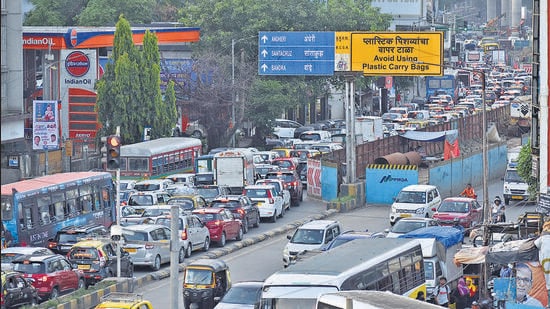
How does a traffic department identify a bottleneck? “It is when the number of vehicles on the road remain a constant but the width of the road reduces due to factors such as encroachments, construction and on-going infrastructure projects; and the number of lanes for a smooth flow of vehicular traffic are reduced,” said Ramkumar, additional commissioner of police (traffic).
One of the key bottlenecks on the Western Express Highway (WEH), listed by the department is at Akurli, in Kandivali. Three of the four north-bound lanes in Akurli have been shut down to facilitate the widening of the Akurli vehicular subway by the Mumbai Metropolitan Region Development Authority. The result – a 20-minute journey from Andheri to Akurli, which is around 10 kilometers, takes 80 minutes on most days during peak hours.
Reshma Doshi, co-convener, Mumbai North Central District Forum, lives in Bandra but her parents live by themselves in Kandivali. She lives in constant fear that at a time of any unforeseen event, it might take her a few hours to reach them. “It takes at least one or one-and-a-half hours in non-peak time to reach Kandivali from Bandra and two to two-and-a-half hours in peak time, just because of this bottleneck. Besides potholes, the patch is also very poorly planned – there are slopes on half the road, which create confusion and jams. How can there be potholes exactly at the bottleneck?”
{{/usCountry}}Reshma Doshi, co-convener, Mumbai North Central District Forum, lives in Bandra but her parents live by themselves in Kandivali. She lives in constant fear that at a time of any unforeseen event, it might take her a few hours to reach them. “It takes at least one or one-and-a-half hours in non-peak time to reach Kandivali from Bandra and two to two-and-a-half hours in peak time, just because of this bottleneck. Besides potholes, the patch is also very poorly planned – there are slopes on half the road, which create confusion and jams. How can there be potholes exactly at the bottleneck?”
{{/usCountry}}Although, tenders were floated in January 2018, the vehicular subway work is still underway; and traffic cops have said that it is likely to go on till December 2023.
While citizens have taken to social media platforms to highlight the Akurli bottleneck, similar challenges exist across the city due to on-going infrastructure projects like metro and the coastal road.
The traffic police said besides providing additional manpower and officials on these spots to ease the flow, they are also opening up side lanes at few places to ease the traffic. “As most bottlenecks are due to infra projects, not much can be done. We try to have the construction barricades moved as soon the respective patch is done,” said an official.
Apart from infra projects, some of the bottlenecks are perennial – the Lucky Junction on SV Road, Bandra West, is one. According to the traffic department, the clog at Lucky junction is caused as vehicular flow from six lanes merge into two lanes. They comprise four lanes from S V Road and two from the Bandra-Worli Sea Link. Additionally, officials pointed to a heavy footfall here due to Friday namaaz and shoppers headed for Hill Road, which add to the congestion. A few months ago, the traffic police made a suggestion to the Brihanmumbai Municipal Corporation that a pedestrian subway be constructed connecting this junction to Bandra railway station to ease pedestrian movement and vehicular traffic some months ago.
Apart from the traffic police’s data, citizens have identified various other challenging spots. The popular page @RoadsOfMumbai on the social media platform ‘X’ has highlighted this malaise. In an email response to HT’s query, a representative of the page said, “The authorities need to consult qualified urban planners and implement their plans to decongest roads and redesign the sections where bottlenecks occur. There should be zero tolerance against illegal parking and encroachment. Potholes and craters should be fixed as soon as they emerge. Potholes also lead to bottlenecks as drivers have to manoeuvre around it, thereby compromising the speed of the traffic flow.”
He added that as “the civic body and traffic police are not doing much” Mumbaikars are left on their own to bear the jams.
Dhawal Ashar, programme head of Urban Transport & Road Safety, Sustainable Cities & Transport, WRI India, said, “Traffic bottlenecks on the downstream are bound to cause snarls. In Mumbai, as in many other cities, there are different elements that lead to bottlenecks – a structure of a building could be jutting out, double or triple parking or halting and pedestrians using carriageways.” Ashar pointed to places such as Amar Mahal junction, in Chembur; Lucky junction, in Bandra; and Mith chowky junction, in Malad, as case-studies of such phenomena. He underscored the problems can be resolved with proper planning and design.
“We need to ensure contiguity – while it may increase the length of traffic queues, traffic dispersal will be much more efficient. Proper footpaths for pedestrians will automatically increase vehicular efficiency,” he added.
LIFE IN A METRO
Saki Naka Junction, Saki Naka
Issues: Motorists driving on the wrong side, menace of illegal parking, an illegal share auto stand and a crowd that gathers to drink on the road outside a wine shop.
Naraayan Kannan, communications consultant
Saki Naka is plagued by multiple issues on every side of the crossroad. On one side is a busy petrol pump, bus stop, poor roads, metal spikes, manhole covers jutting out near Mainland China and an illegal auto stand on the left when you turn to Saki Vihar Road. This leads to motorists driving on the wrong side regularly in the absence of consistent vehicular flow.
On the other hand, on the Asalpha and Jari Mari side, apart from driving on the wrong side, many motorists are known to jump signals and not slow down at the dividers – this leads to life threatening situations throughout the day. On the Asalpha side under the metro station and near the illegal auto stand, wine shops are known to operate as make-shift bars, with people eating and drinking on the streets, which leads to more traffic chaos.
Lucky Junction, Bandra West
Issues: The barricades for on-going metro work lead to the bottleneck. Pedestrians are forced to walk on the road and they have no alternative to cross over to the railway station.
Urich Kamath, event management professional
The main issue of this junction is the narrow road. There is no one to control pedestrians who cross the road ignoring the signals. This is also the main junction that leads to Bandra railway station. People spend between 30 and 45 minutes to travel less than a kilometre. It takes 30 minutes to travel from south Mumbai to Bandra, and then another 30-45 minutes to enter Bandra. What is the use of having Sea-links, bypasses and flyovers if one has to be stuck in traffic for so long?
Hiranandani Link Road, Powai
Issues: The encroachments here include illegal garages. Also, heavy vehicles arrive on this road from several narrow lanes.
Romaljit Kaur, insurance professional
The road goes towards RCity Mall and it is also a shortcut that connects Hiranandani Gardens to Vikhroli, LBS Marg and the mall. Most citizens living in Chandivali and Powai use this road for faster access to Ghatkopar and Vikhroli. Illegal garages and shops on the narrow road create hurdles for motorists. The road needs to be widened by removing the encroachers blocking it. This road is also the shortest route connecting various housing societies on LBS Marg and Hiranandani Hospital, and hence it is always jammed.
Prabhadevi flyover junction, Prabhadevi
Issues: Bottlenecks are created on both ends of Parel flyover because motorists have to travel through the old Parel bridge, which has only one lane on each side. The Delisle bridge is yet to be fully functional. Once open, it can ease the bottleneck.
Uday Mane, businessman
There are potholes at the end of the Prabhadevi flyover, where the bottleneck ends. I have complained to BMC many times, highlighting how bikers often skid and fall here but the civic body only does some bad patchwork every time which soon comes apart. The traffic on this flyover is also because of the delay in reopening Delisle bridge. This has led to heavy traffic movement on the old flyover. On September 17, BMC opened the second arm of Delisle bridge – now traffic can move towards Currey Road and South Mumbai from Lower Parel. The Bridge is yet to be opened fully.
Western Express Highway, Kandivali
Issues: Bottleneck due to widening of Akurli underpass. Potholes and an uneven stretch also slows down traffic.
Nishant Mody, finance professional
I stay in Thakur Complex, Kandivali East, which is just ahead of the Akurli bottleneck. It sometimes takes over an hour to travel approximately 3.5 kilometers from Oberoi Mall, Goregaon, to this bottleneck. The work on the underpass has been going on for a few years. The part completed on the south-bound lane has potholes as well, but the traffic is worst on the north-bound side.
Stay updated with all the Breaking News and Latest News from Mumbai. Click here for comprehensive coverage of top Cities including Bengaluru, Delhi, Hyderabad, and more across India along with Stay informed on the latest happenings in World News.
Stay updated with all the Breaking News and Latest News from Mumbai. Click here for comprehensive coverage of top Cities including Bengaluru, Delhi, Hyderabad, and more across India along with Stay informed on the latest happenings in World News.