
 E-Paper



Vocalist Prabha Atre’s death brings the curtain down on an era
Atre’s exit was unexpected in the sense that she was scheduled to perform the same evening at the Hridayesh Festival, the biggest open-air festival in Mumbai. A grand felicitation had been planned for her; Destiny, however, intervened cruelly to deprive music lovers of her performance yesterday and forever

 Prefer HTon Google


MUMBAI: Dr Prabha Atre, the last surviving towering figure of Hindustani vocal music passed into history on Saturday morning en route to a hospital in Pune, the city that was her home ground for years of her long and illustrious career. She was 92.
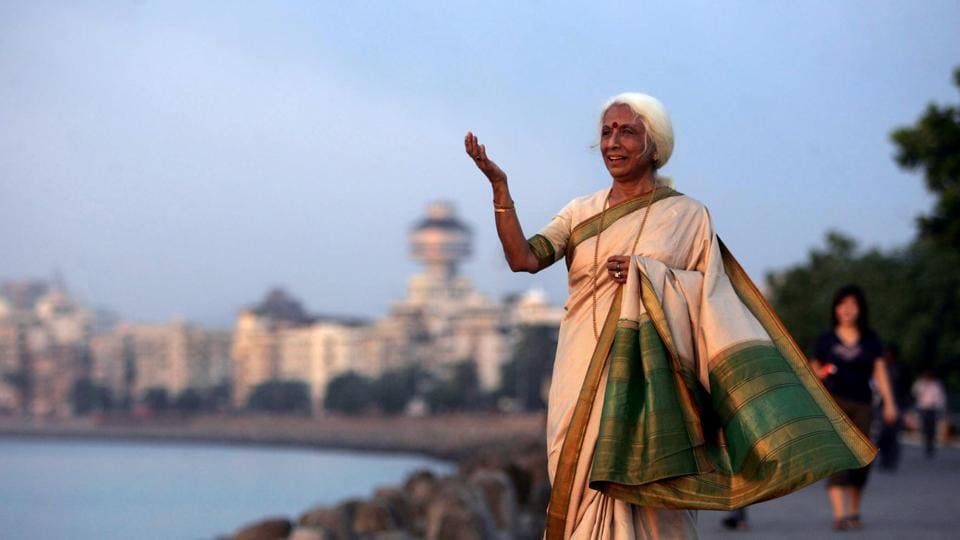
Atre’s exit was unexpected in the sense that she was scheduled to perform this evening at the Hridayesh Festival, the biggest open-air festival in Mumbai. A grand felicitation had been planned for her; Destiny, however, intervened cruelly to deprive music lovers of her performance yesterday and forever.
For the last 13 years, Atre reigned supreme over the music scene by virtue of her seniority and eminence. The concluding slot at the prestigious Sawai Gandharva music festival, where the audience strength touches 10,000, used to belong to Pt Bhimsen Joshi; after he passed away, the honour went to Atre, the rightful heir to the coveted seat. With her trademark grey locks, she quite literally symbolised the grey eminence of Hindustani music.
Atre was indeed a unique musician of her generation. Apart from being a front-ranking performing artiste, she was also an educator, a thinker, an author and an organiser. She worked as a programme executive and also a producer of music at All India Radio. Later, she became an academic as well, heading the department of music at SNDT University and writing many books.
Hailing from Pune, the Mecca of classical music in Maharashtra, Atre trained under classical singer and thumri maestro Sureshbabu Mane, the son and pupil of the great Ustad Abdul Karim Khan. Atre’s co-students under Mane were Vasantrao Deshpande and Manik Verma, who shot into prominence in later years. Atre herself mastered the sweet-sounding Kirana gharana style of singing under Mane. After Mane’s premature death, his sister and celebrated singer, Hirabai Barodekar moulded Atre into a perfect and proud product of the Kirana gharana.
Atre had a melodious voice and a stunning stage presence. Teenagers like me developed an instant crush on this singer with a darkish complexion and irresistible dimple on her left cheek. She would sing with her head delicately touching the tanpura. As the wah wahs were showered on her, she would respond with a coy smile, which would send many hearts aflutter. Her voice had unusual warmth and innocence, which added further appeal to her performances.
Around 1965, Atre cut an LP under the HMV banner with a Maru Bihag on Side A and Kalavati on Side B. This disc, which sold like hot cakes, permanently enthroned her in the hearts of music lovers. The raga Maru Bihag, with all its romance and sense of longing, became synonymous with Atre’s singing. Gangubai Hangal, another leading light of the Kirana gharana, had a deeply husky voice, which she herself would describe as “masculine”. In contrast, Atre ‘s voice was feminine, and the tender modulations she executed tugged at the heartstrings of music fans.
The vocalist had her own thoughts on music and its presentation. She stirred up a controversy of sorts by strongly underplaying the importance of lyrics in the khyal form. Her self-composed khyals were known for their economy of words. Gurucharan Nit Labho in Raag Yaman could linger on for well over an hour at a languorous pace, enveloping the listener in myriad, yet mesmerising, phrases of the raga. She also advocated scrapping the antara (the second half of the composition which accentuates the upper octave), which stirred a hornet’s nest. Undaunted, she stuck to her guns and kept singing, remaining true to her convictions.
Another notable feature of Atre’s perspective was that she was broad-minded enough to accord film music and other forms of popular music their legitimate place under the sun. This was rare accommodativeness, as most art musicians have a condescending and exclusionary attitude in this regard.
Atre, especially during the 1970s, ’80s and ’90s, was a role model for many aspiring female singers. “What a treat it was to listen to her raga elaboration in a mehfil; one could learn so much from her performance,” enthused Saniya Patankar, a leading performer of the current generation. “Her dedication to her art is worthy of emulation,” said Priyadarshini Kulkarni, another present-day singer. Several of her students are luminous names today, including Chetna Banawat, Aarti Kundalkar and Atrindra Sarawadikar.
Prabha Atre has made an exit, but her music will continue to regale regular music lovers as well as connoisseurs.
(Amarendra Dhaneshwar is a Hindustani classical vocalist and a music critic)


