Shimla: A joint committee of the Central Pollution Control Board and Himachal Pradesh Pollution Control Board will study the dumping of untreated waste into the Sirsa and Sutlej rivers by pharmaceutical companies at Baddi in Solan.
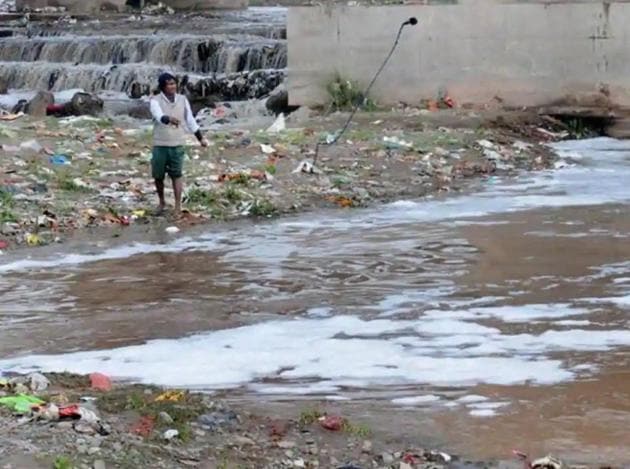
The National Green Tribunal (NGT) has asked the committee to submit an action taken report within three months. The state board will be the nodal agency for compliance and coordination.
The orders were passed by a bench, comprising chairman justice Adarsh Kumar Goel, justice SP Wangdi and expert member Nagin Nanda, on a petition by an NGO, Veterans Forum for Transparency in Public Life on July 22.
In its application, the petitioner urged the court to direct the authorities to take remedial action against the discharge of waste in the central effluent treatment plant (CETP) at Baddi by Acme Life Sciences, Nalagarh, and Helio Pharmaceuticals, Solan, to prevent the pollution of Sirsa and Sutlej rivers.
According to the applicant, the CETP is not connected to pharmaceutical units at Barotiwala and Nalagarh that are discharging effluents directly into the rivers.
Even after treatment in effluent and sewerage plants, pharmaceutical ingredients still come out from the industries unless the ETP/STPs are specialised.
{{/usCountry}}Even after treatment in effluent and sewerage plants, pharmaceutical ingredients still come out from the industries unless the ETP/STPs are specialised.
{{/usCountry}}At present, the CETP is not designed to neutralise active pharmaceutical ingrediencts (API).
NO DISPOSAL SYSTEM IN BBN FOR INDUSTRIAL EFFLUENTS
The treatment, storage, and disposal facility (TSDF) does not receive sludge generated from the industrial units at Nalagarh.
The industries in Baddi generate 20,779 kilo litres /day (KLD) of effluent of which 17,894 KLD is being treated at the CETP and the remaining 2,885 KLD is disposed of by occupiers directly into the Sirsa river.
There is no existing sewerage system for disposing the industrial effluents in the Baddi Barotiwala Nalagarh (BBN) industrial area and no demarcation in residential and industrial areas.
MULTI-RESISTANT PATHOGENS REACHING WATER BODIES
The presence of Ciprofloxacin in the concentration of 296.1 ug/l was found on chemical analysis. The concentration of Ciprofloxacin in the effluent discharge of M/s Acme Life Sciences works out to be 13,455 times of the prescribed limit.
Applicants said that the increasing occurrence of multi-resistant pathogens is a global threat to human health and it is finding its way into water bodies through industrial discharge and also due to the heavy use of antibiotics in human and veterinary medicine.
The next hearing is on January 4, 2021.