
 E-Paper



Local factors, stubble burning turn Ghaziabad, Noida air quality ‘poor’
The three cities of Ghaziabad, Greater Noida and Noida on Monday recorded an air quality index (AQI) of 220, 299 and 229, respectively

 Prefer HTon Google


On the eve of Dussehra and Vijaya Dashami, the air quality in Ghaziabad and Noida dipped to “poor” with officials of the state pollution control board blaming biomass burning in northern states and local factors for the current deterioration.
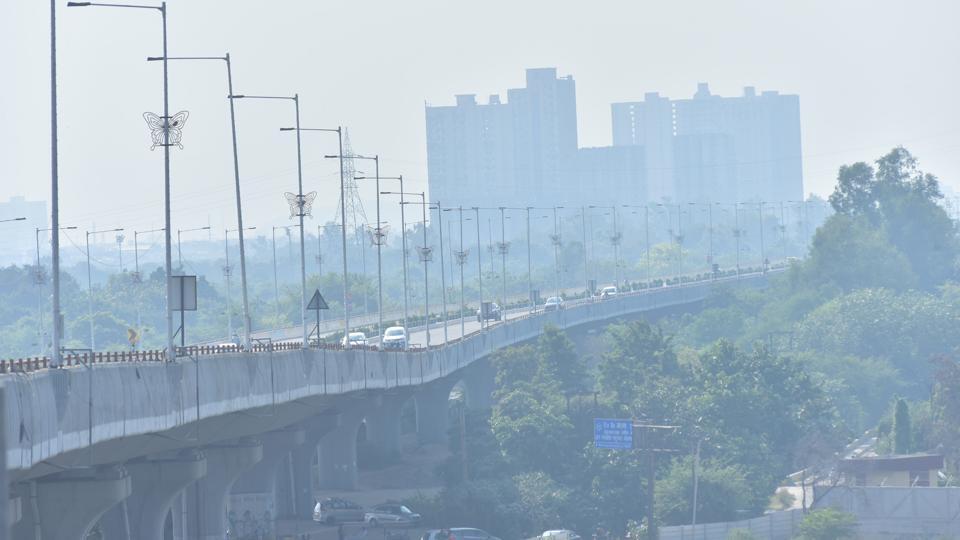
The three cities of Ghaziabad, Greater Noida and Noida on Monday recorded an air quality index (AQI) of 220, 299 and 229, respectively, all under the “poor” category, according to the daily bulletin of the Central Pollution Control Board (CPCB).
The AQI was even worse on Sunday, when Greater Noida and Noida recorded AQI of 354 and 304, respectively, on Sunday, both values in the “very poor” category, according to the CPCB bulletin.
According to the AQI scale, readings between 0 and 50 are considered “good”, 51 and 100 are “satisfactory”, 101 and 200 are “moderate”, 201 and 300 are “poor”, 301 and 400 are “very poor”, and 401 and 500 are “severe”.
“The ”poor” AQI is mainly owing to instances of biomass or crop stubble burning in states such as Punjab, Haryana and others and its effect , about 50%, is carried to Delhi and National Capital Region by the north-westerly winds. This impact will continue for a couple of days more. The slower wind speed has also led to a decrease in dispersal of pollutants,” said Utsav Sharma, regional officer of Uttar Pradesh Pollution Control Board (UPPCB), Noida.
In view of the deteriorating air quality in Delhi/NCR, on October 21, the Commission for Air Quality Management (CAQM)’s sub-committee invoked the 11-point action plan as per stage-2 of graded response action plan (Grap).
During the period from September 15 to October 22, Punjab recorded 1,794 instances of stubble burning, while Haryana recorded 714 instances, Uttar Pradesh 540, Delhi 2, Rajasthan 443, and Madhya Pradesh 881 instances of paddy residue burning, according to the data compiled by the Consortium for Research on Agroecosystem Monitoring and Modelling from Space (CREAMS) laboratory of the Indian Agricultural Research Institute, New Delhi.
Between October 19 and 23, 539 instances of stubble burning were reported from Punjab and 189 from Haryana, the CREAMS figures showed.
“Greater Noida also suffered the effects of crop residue burning while some local factors such as construction works near the Knowledge Park 5 monitoring station are also affecting the AQI,” said DK Gupta, regional officer of UPPCB, Greater Noida.
According to the forecast by the India Meteorological Department, Delhi’s air quality is likely to remain “very poor” from October 23 to October 25.
“The air quality is likely to be in the lower end of ”very poor” category on October 26. The outlook for subsequent six days is that the AQI is likely to remain in the ”poor” to ”very poor” categories,” the IMD forecast on Monday said.
It added that the present winds are coming from the north-east and these will change direction and is likely to come from the north-west on October 26 with a speed of about 12-16 kilometre per hour.
The officials of UPPCB, Ghaziabad, could not be reached for their comment.
Environmentalists said instances of residue burning have reduced this season when compared to past years.
“The local agencies should effectively take up issues of traffic congestion, road dust and also road repairs. These should have been taken up well before the start of the monsoon and the advent of the winter season. The ground level enforcement is still lacking,” said Akash Vashishtha, an environment lawyer.


