Children of 253 schools located in rural areas of Prayagraj still go to study walking on footpaths or dirt tracks. There are no paved roads within 1 kilometre radius of these schools. Also, there are 222 primary and upper primary schools in the district where there is just one teacher for over 100 students and only one toilet for more than 200 students in 302 schools.
These facts have come to light in a study undertaken to evaluate primary and upper primary schools of Prayagraj and their accessibility using Geographical Information System (GIS) techniques carried out by experts of GIS Cell as well as Electronics and Communication Engineering department of Motilal Nehru National Institute of Technology (MNNIT)-Allahabad using District Information System for Education (DISE) 2017-18 data.
The study by the team comprising Prof Rajeev Tripathi of Department of Electronics and Communication Engineering, Dr Sonam Agrawal, assistant professor, GIS Cell and Dr Dharmendera Kumar Meena, a research scholar of GIS Cell presently working in computer science and engineering department at Dr BR Ambedkar National Institute of Technology (NIT), Jalandhar, covered a total of 4,878 government and private primary and upper primary schools running in the district.
The team’s findings have been published in the August 2022 issue of the prestigious GeoJournal of Springer Nature.
{{/usCountry}}The team’s findings have been published in the August 2022 issue of the prestigious GeoJournal of Springer Nature.
{{/usCountry}}The study team obtained information related to 650 schools from GPS and 4,228 schools from Geoportal website (https:// schoolgis.nic.in/). Street and village related data was taken from open street map and census, informed Prof Rajeev Tripathi, a former director of MNNIT-Allahabad.
The GIS-based study, through DISE (2017-18) data analysis, also found that the number of girl students was more than the boys in 2,246 schools whereas in 2,302 schools it was vice-versa. The number of girl students is equal to that of boys in 171 schools of the district, he added.
These figures reflect growth in girl child education in the district. Awareness in the society towards girl child education, availability of resources and government efforts are the main reasons behind this, he shared.
The team shared that the spatial analysis (statistical analysis based on patterns and underlying processes) of primary schools is needed to ensure that they meet standards set by the Government of India. The spatial analysis of schools has been performed using various parameters that include: literacy rate, student gender ratio, teacher taught ratio, and students’ toilets ratio.
“The results identify the location of all those schools where there is a need to take corrective measures. Further, the route analysis between home and school also has been handled in this research work. Sometimes, commutation is the sole criteria in selection of a school. Therefore, optimal path analysis has been performed based on three parameters, ie, population density, travelling distance and travelling time,” informed Dr. Sonam Agrawal.
This work will help people to select the best possible path based upon their requirements. There is often a requirement to reach all the schools to distribute the goods or other physical monitoring activities. This work has given the optimal route to visit all schools. This will also help the government identify locations where new roads need to be constructed to have road connectivity for the schools, she added.
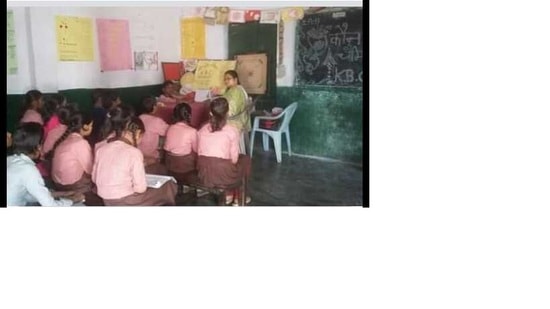
PHOTO: Students studying at a government-run primary school in Prayagraj (HT)