A former student of the Allahabad University (AU) claims to have developed a biosensor that can detect Covid-19 infection through sweat sample. Amit Dubey (34), who is working as a senior scientist at Quanta Calculus, Greater Noida, claims that he has developed the world’s first specific, reliable ultra-small gold nanoclusters for biomedical and biosensing applications to detect Covid.
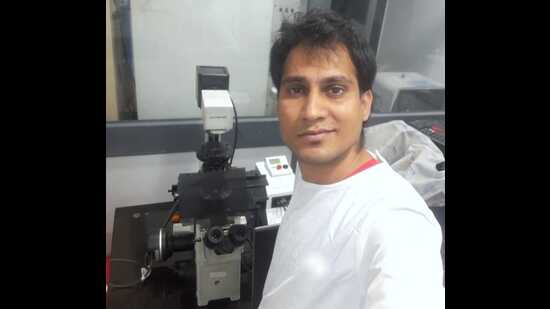
His work can lead to a new age effective and cheaper testing kits capable of detecting Covid-19 using just the sweat of an individual instead of nasal or throat swab that kits of today need. Sharing his research, findings of which have been recently published in “Luminescence: The Journal of Biological and Chemical Luminescence,” a peer-reviewed US journal published by Wiley, Dubey said the biosensors would be a one-step identification or sensing technique.
“In instances where traditional laboratory techniques are not readily available, biosensors have already shown that they can deliver affordable and accessible diagnoses,” he said. Ultra-small gold nanoclusters, with diameters less than 2 nm, are attracting increasing attention due to their unique size-dependent physiochemical properties which include strong luminescence and excellent biocompatibility.
“The main component of the biosensor is the ultra-small gold nanoclusters, as gold is unreactive, meaning that when it comes into contact with a substance the team wishes to measure—for example, a potential disease biomarker present in sweat—it does not chemically alter that substance. Instead, as the ultra-small gold nanoclusters are so fine, they can provide a surprisingly large surface for that biomarker to bind to and this is where the other components of the sensor come into play,” Dubey said.
{{/usCountry}}“The main component of the biosensor is the ultra-small gold nanoclusters, as gold is unreactive, meaning that when it comes into contact with a substance the team wishes to measure—for example, a potential disease biomarker present in sweat—it does not chemically alter that substance. Instead, as the ultra-small gold nanoclusters are so fine, they can provide a surprisingly large surface for that biomarker to bind to and this is where the other components of the sensor come into play,” Dubey said.
{{/usCountry}}As a low-power laser is pointed at the ultra-small gold nanoclusters, some of the laser light is absorbed and some is reflected. Of the light reflected, most has the same energy as the incoming light. However, some incoming light loses energy to the biomarker or other measurable substance and the discrepancy in energy between reflected and incident light is unique to the substance in question. A sensor called a spectrometer can use this unique energy fingerprint to identify the substance. This method of chemical identification is known as Raman spectroscopy.
“Currently, our ultra-small gold nanocluster-based biosensors need to be finely tuned to detect specific substances, and we wish to push both the sensitivity and specificity even further in the future,” said Dubey. “With this, we think applications like cancer target site monitoring, ideal for cancer drug delivery, or even virus detection might be possible in future,” he said.
“There is also potential for the ultra-small gold nanocluster biosensor to work with other methods of chemical analysis besides Raman spectroscopy, such as electrochemical analysis, but all these ideas require a lot further investigation,” said Dubey. “In any case, I hope this research can lead to a new generation of low-cost biosensors that can revolutionise health monitoring and reduce the financial burden of health care,” the scientist said.