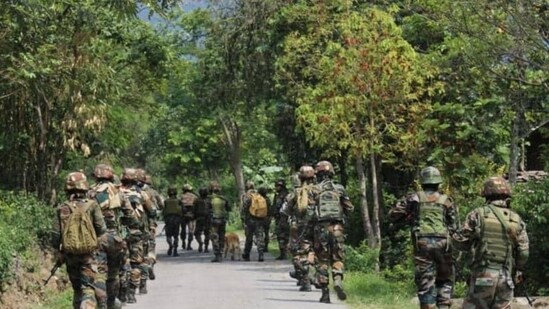
The Central Armed Police Forces (CAPFs) will be deployed in Siang district of Arunachal Pradesh to aid surveyors to conduct pre-feasibility report (PFR) of the 12,500 MW Siang Upper Multipurpose Project (SUMP), officials said- a move opposed by local residents over concerns displacement and environmental impact.
The hydropower project by NHPC (formerly National Hydroelectric Power Corporation) involves construction on the Siang River at three proposed sites- Dite Dime, Parong and Uggeng.
Last week, authorities in Siang district issued a letter to the circle officer of Rebo-Perging with a request to arrange accommodation for CAPFs who will be stationed in Riew village. It sought the help of village chiefs and the public for repair and maintenance of the government primary school at Riew for the same.
“I am directed to inform you that a team of CAPF is expected to be stationed Riew village in the purview of conduct of PFR regarding the Siang Upper Multipurpose Project (SUMP) in the succeeding week,” said the letter issued by Siang deputy commissioner PN Thungon, which HT has seen.
Locals have been protesting against the project over fears of threat to their lives, livelihoods and the environment. According to some estimates, nearly 100,000 residents will be affected by the project.
{{/usCountry}}Locals have been protesting against the project over fears of threat to their lives, livelihoods and the environment. According to some estimates, nearly 100,000 residents will be affected by the project.
{{/usCountry}}“We are against the move to militarise the area by deploying CAPF personnel. The project will be detrimental to the people and the ecology of the region,” said Bhanu Tatak, legal adviser of Siang Indigenous Farmer’s Forum, one of the groups opposing the project.
On Wednesday, local groups and residents held a meeting and decided to oppose the move to deploy CAPF. Village chiefs of the area said that they were not consulted by the district administration before deciding to deploy the central forces.
On Tuesday, the Northeast Human Rights (NEHR), an Itanagar-based rights group, wrote to the state chief secretary, raising concern about the deployment of CAPF and urged for their “immediate withdrawal”, besides initiation of dialogues with the local community and reevaluation of the project’s feasibility.
“The government’s role is not only to act as an administrator, but also as a steward of trust, justice and equity. We believe that prioritising peaceful negotiation and genuine community engagement can resolve this issue in a manner that respects the dignity and aspirations of all parties involved,” the letter said.
In recent months, there has been a push by the state government to ensure that work on studies related to the project gets completed. On November 29, chief minister Pema Khandu held a meeting with ministers and officials regarding the “strategically and environmentally significant project”.
“With the whole-hearted backing of the Government of India, we resolved to expedite the construction of the project,” Khandu said in a post on Facebook on November 29. The CM has been stressing that the project is of national importance and will counter threats from China, releasing large volumes of water from the 60000-MW dam being built on the upper reaches of Siang in Tibet.
“The damming of the Siang River, known as Yarlung Tsangpo in its upper reaches by our neighboring country poses significant threats, including flash floods and water scarcity. These risks could have devastating consequences for downstream areas in the Siang region and beyond,” Khandu said in Facebook post on November 30.
“To address these challenges, the Siang Upper Multipurpose Project has been conceived. The project will not only store water to mitigate shortages but also serve as a safeguard against sudden flash floods caused by upstream water releases. If we do not act now, we risk being at the mercy of external forces that could harm our people and our lands,” he added.