
 E-Paper



Civic apathy, rain amplify Gurugram’s sanitation crisis
City areas such as Sector 45, 56, 57, 48, 50, Golf Course Extension Road, Southern Peripheral Road (SPR) and many more parts of the city have turned into garbage hotspots, with residents complaining of no regular collection and zero accountability

 Prefer HTon Google


Gurugram: Beneath Gurugram’s gleaming skyscrapers and ‘smart city’ label lies a deepening garbage crisis that has not only overwhelmed residents but exposed glaring lapses in civic planning. From overflowing garbage bins and waterlogged roads to illegal dumping and open burning of electronic waste, the city is battling a sanitation breakdown — made worse by monsoon rains and civic apathy.
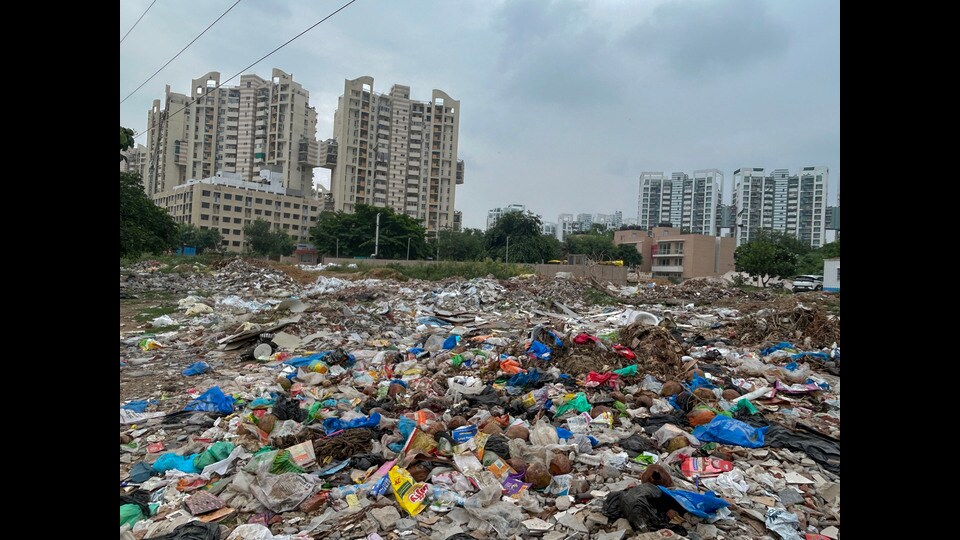
City areas such as Sector 45, 56, 57, 48, 50, Golf Course Extension Road, Southern Peripheral Road (SPR) and many more parts of the city have turned into garbage hotspots, with residents complaining of no regular collection and zero accountability. Despite the appointment of private agencies for e-waste collection, discarded appliances and toxic materials are being dumped in public places or burned near residential zones, creating a serious health hazard.
“The garbage is not confined to one corner anymore. It’s literally everywhere — from the gates of apartment complexes to school entrances and green belts,” said Amit Gupta, a resident of Sector 46. “We are now constantly sharing photos and videos on our society groups, tagging officials and councillors just to get a response.”
Voicing the frustration of thousands of citizens, businessman and columnist Suhel Seth launched a scathing attack on the administration and political leadership for allowing the situation to spiral out of control
“This is no longer just about garbage lying on the roads — this is about the complete collapse of civic governance in Gurugram. For the past five days, I have been raising this issue on every social media platform— and still, not one official has stepped out or taken charge,” Seth said.
“Let’s be clear — this is not a waste crisis, this is a crisis of bureaucratic failure, of indifference, and of sheer incompetence. Where are the civic officials? Where is the leadership? The situation is so inhuman that the courts should now step in and take suo motu cognizance of this neglect,” he said.
He also called out the ruling government, stating, “The chief minister of Haryana must take a stand. And I say this with all seriousness — if the Prime Minister himself launched the Swachh Bharat Mission, he should also take note that this city — under his party’s state government — is choking in filth. We are not just living with garbage, we are being asked to survive in it.”
“The bottom line is this — pure apathy. There is no will to serve the people anymore. Either sack the officers who have failed us or prepare for citizens to hit the streets. Enough is enough,” Seth said.
“The city is sinking under its own waste. Not only is legacy waste lying unattended, but fresh garbage continues to be dumped without any effective mechanism in place,” said Maj Gen (Retd) Yash Mor, a resident of Sector 50. “Where is this waste going? Where is the waste management system? Even the door-to-door collection has failed in many areas, especially in high-density sectors. There is no segregation at source, and even citizens are not supporting segregation efforts. We urgently need a comprehensive, accountable system with stronger community participation and enforcement.”
“It is a public health emergency. The city should take emergency measures like cracking down on single-use plastic, outlawing its use in government offices and public functions, writing to retailers and e-commerce players to take immediate steps to reduce waste generation, particularly of plastic waste. The civic agency should ideally identify land for 20 or more material recovery facilities or MRFs, all around the city, and work with CSR to make these MRFs operational in a modern way. Residents must help by segregating their waste. We need to reduce, reuse and recycle,” Manas Human, CEO of Nagarro.
MCG’s emergency intervention
In the face of mounting public pressure and visible civic decay, the Municipal Corporation of Gurugram (MCG) has announced a series of emergency measures to tackle the crisis. In a high-level meeting on July 28, MCG commissioner Pradeep Dahiya allowed councillors and contractors to directly arrange vehicles for door-to-door garbage collection within their wards.
The decision, taken under Section 49(C) of the Haryana Municipal Corporation Act, 1994, allows councillors, contractors, and even citizens to deploy private vehicles such as tractor-trolleys to support garbage pickup efforts. The move is intended to address immediate gaps in the sanitation chain, although officials clarified it is a temporary stopgap measure, not a permanent restructuring.
A high-powered committee, headed by additional commissioner Ravindra Yadav, has been formed to finalise vehicle rates and set transparent guidelines to monitor the initiative.
“This measure is aimed at restoring some degree of normalcy and relieving residents from the current sanitation backlog,” said a senior MCG official. “However, we are working simultaneously on a new, transparent tender process to create a more sustainable waste management system.”
Residents demand accountability
Despite MCG’s announcement, most residents remain sceptical. “This is classic damage control — a half-hearted effort to save face. We’ve seen too many promises, and too little action,” said Ritesh Ahuja, a resident from Sector 23A.
“A smart city isn’t defined by tech parks and malls — it’s defined by how it treats its waste and its people. And right now, Gurugram is failing on both counts,” said Ambika Yadav, a sustainability advocate who has been documenting waste black spots across the city on social media.
As the city grapples with toxic air, choked drains, and mounting mounds of waste, citizens continue to do what the system hasn’t — raise the alarm, demand answers, and push for action.


