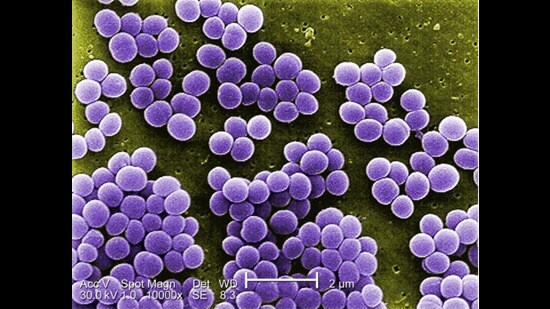
A widely used emulsifier— Tween 80— commonly added in cosmetics, pharmaceuticals and food products has the potential to kill staphylococcus aureus—a multidrug resistant (MDR) bacteria that causes many respiratory and skin diseases, says a study undertaken by a team of Allahabad University (AU) researchers.
The findings of the research have recently been published in the reputed journal ‘Applied Biochemistry and Biotechnology’ of Springer Publication.
The lab experiments conducted under lead researcher and assistant professor of department of Biotechnology of AU Awadh Bihari Yadav in association with research scholars Sarita Maurya and Manish Gaur have shown promising results and the same will now enter the second phase involving testing on animals.
“Staphylococcus aureus is a round-shaped bacterium found in the upper respiratory tract and skin and causes many respiratory and skin diseases like pneumonia and abscesses. The reason for it becoming MDR is the overuse of antibiotics and these superbugs cannot be treated with antibiotics in use or even the most advanced ones,” said Yadav.
He added one in five people and 20-30% of healthy people are carriers of this bacterium. He further said Methicillin-resistant Staphylococcus aureus (MRSA) is a group of microbes that form biofilms (a cover made by bacteria on which antibiotics are ineffective). These biofilms are found in hospitals on surgical instruments, scissors and catheters and have drug tolerance towards many broad-spectrum antibiotics.
{{/usCountry}}He added one in five people and 20-30% of healthy people are carriers of this bacterium. He further said Methicillin-resistant Staphylococcus aureus (MRSA) is a group of microbes that form biofilms (a cover made by bacteria on which antibiotics are ineffective). These biofilms are found in hospitals on surgical instruments, scissors and catheters and have drug tolerance towards many broad-spectrum antibiotics.
{{/usCountry}}“The bacterial biofilm is made up of lipids, and eDNA forms a network-like structure where bacteria remain safe. This can cause fatal infections. Bacteria can only be killed by breaking the biofilm,” he explained.
Yadav added that in the laboratory they have created biofilms by growing staphylococcus aureus bacteria and later exposed bacterial biofilm with Tween-80. “We found that bacterial biofilm can be broken using Tween-80. Tween-80 is already in use in the baking industry in a permissible amount. It can break bacterial biofilm and thereby fight these bacteria,” he added
He said that after success in the laboratory, scientists will now verify this by experimenting on animal models with the help of the Central Drug Research Institute (CDRI)-Lucknow.