Ethics matter
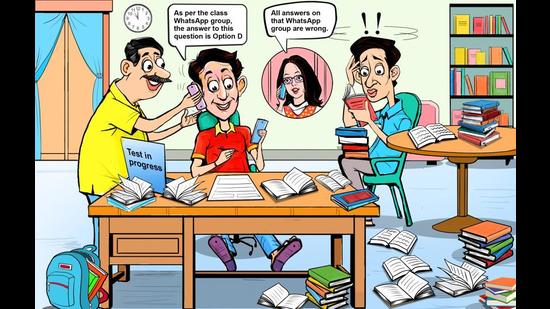
Fairness in online exams depends solely on the ethics that candidates carry in their lives. One’s true behaviour comes to fore when we think no one is watching. In these times, we have no option but to hold online exams. To ensure that students’ progress is properly assessed, questions should be framed in such a manner that their analytical and comprehension skills are put to use.
Anju Mohan, Panchkula
Students always find loopholes
There is almost no technological way to reduce or prevent cheating as students these days can always find loopholes to applications and programmes that are aimed at preventing cheating. The most straightforward and foolproof method of reducing or preventing cheating will be to include innovative questions, for which answers cannot be easily found anywhere.
Avi Khurana, Chandigarh
Encourage higher order thinking
The Covid crisis has had an unprecedented impact on the education systems. With educations institutes forced to switch to online mode of teaching and assessment, fair evaluation has taken a back seat. Educators must come up with questions that require higher-order thinking to fairly assess students in online exams.
Tanya Chadha, Ambala
Leave no time for cheating
{{/usCountry}}Leave no time for cheating
{{/usCountry}}For online assessment, students should be tested with multiple-choice questions. There should be a fixed time-limit in which students should be required to submit their answers. This won’t leave any time for cheating. Besides, the questions must be framed in a way that students will have to go through the entire syllabus and get their concepts clear to be able to answer these.
Amanpreet Kaur Bains, Kurali
Surveillance must
Online exams are fraught with scope for cheating as a student sitting at home will have multiple means to copy, consult and get guidance from parents, tutors and others. In foreign countries, online exam are carried out under strict surveillance that keep tabs on the response time, eye movements of students etc. This almost negates the possibility of malfeasance.
Raghunath Chhabra, Chandigarh
Institutes should care about students, not just image
For many institutions, online exam protocols to minimise cheating only make it to the sugarcoated speeches of the authorities. Some of them don’t want to put any efforts to explore the options for fair assessment of students. All they care about is the image of their institution and thus turn a blind eye to the unfair means adopted by students so that they can score high marks. However, for the benefit of students, some form of invigilation is a must. Besides, institutions should set multiple sets of question papers, and frame high-order thinking questions to test the students for their intelligence.
Prisha Gupta, Chandigarh
Unfair means unavoidable even offline
There is no denying the fact that online exams can hardly match the scrutiny that offline exams allow. But unscrupulous elements find a way to cheat be it online or offline. Many of them manage to cheat even in the presence of invigilators in examination halls. The only way out is to test the students in a way that their actual intelligence and progress is assessed.
SC Luthra, Chandigarh
No dearth of options
In the USA, many schools and universities take online exams through an app called Canvas which offers three main exam formats: essays, tests and online exams. When the exam is in process, the system automatically blocks internet search engines. In the UK, many colleges have been conducting the online exams for students by providing only 72 seconds to answer each question and therefore, it’s really hard for students to look up the answers on the internet within this time. Schools and colleges in India could hold open-book examinations instead of going ahead with normal online exams.
Samay Seth, Chandigarh
Pop quizzes, viva voce for assessment
The pandemic has forced us to explore new ways of solving our day-to-day problems. The same must be done in the arena of education. Classes have been shifted online since the pandemic outbreak last year. While there are many benefits of online classes, evaluations pose a challenge. To solve this, schools and colleges must adopt the secure browser technology so that students can’t open any other window when the exam is in process. Besides, teachers could hold pop quizzes and viva voce from time to time to assess the students.
Aashita Sood, Chandigarh
Proctoring best, most common solution
The most common solution to check cheating in online exams is to use proctoring software. It is specifically designed to enable students to take online exams securely with features such as automated monitoring, ID verification, and computer lockdown.
Vijay Malia, Chandigarh
Can’t give invigilation a go by
The only constant in life is change and we grow by adapting to them. Same way, this pandemic brought many changes in all the spheres of our daily lives, especially in the field of education. It has shifted from classroom teaching to online mode. Teachers have tried their best to adapt to new technology but the evaluation system is yet to get fool proof. In this virtual era, with invigilation given a go-by there is a question mark on the fairness of the exam.
Arti Sood, Chandigarh
Objective type questions for fair, quick assessment
Online exams should be of short duration instead of the usual three hours. Students should be asked objective-type questions and be told to answer it within the given time frame. Real-time videography of the candidate while answering questions is a must so that no help can be taken from outside. This will not just make evaluation fair and transparent but also quick.
Col TBS Bedi (Retd), Mohali
IIT Goa shows the way
Indian Institute of Technology (IIT), Goa, surprised everyone by asking the students to frame their own questions based on what they had grasped through the semester and then it. The method was so unique that the image of the question paper went viral on social media. Our educators just need to get their thinking hats on to solve the problem of cheating in online exams.
Khushboo Singla, Mohali
Consult all stakeholders
Panjab University and its affiliated institutions are set to start their semester exams soon. This time too, the varsity seems to have done nothing to check unfair means during online exams. After wide-range consultations, the varsity is going ahead with the same old tried and tested method. The irony is that students, who are the most important stakeholders, were not even consulted. Surely, PU could do better.
Usha Verma, Chandigarh
Students must self regulate, for their own good
Students need to regulate themselves and study well before exams. They are our future nation builders. They must not forget their moral values and attempt their online exams in a fair manner. They ought to understand that they are nor preparing for an exam but for the future challenges. They should study and prepare for the future and envision the fact that their career and profession will not excuse them if they cheat.
Karan Singh Vinayak, Chandigarh
Tech to the rescue
The Covid-19 pandemic has forced us to find new ways to run our education system. Many service providers have the know-how of holding online examinations but none can come up with a foolproof solution. So it is very difficult to ensure fairness in online examinations unless the student herself/himself behaves ethically in the process. There should be softwares which would log out the student once the camera detects any unfair activity. The integrity of the online examination can be further safeguarded by lockdown application, which prevents electronic corruption and a student obtaining an unfair advantage. So only advanced technology intervention can ensure a higher level of fairness in the online examinations.
Anil Kumar Yadav, Chandigarh
Online exams best option in these times
Cheating is everywhere, not only in online examination system. Online exam is the best option in these times of the pandemic. Determination is the key to success. Students should prepare well for their own good.
Sumesh Kumar Badhwar, Mohali
Strengthen the moral fibre
The main reason for cheating in exams is the non-serious attitude of students. Get them interested in learning, make them realise the value of education and they will themselves understand the need to put in hard work and not cheat. Apart from exploring various means of technology to check cheating, educators must work towards strengthening students’ moral fiber.
Prabhjot Nagpal, Zirakpur
Time each question
In order to ensure that there is no cheating in an online exam, one must ensure that each question has a timer. This way, if the student doesn’t know the answer, she or he will have to move on to the next question without wasting time on unfair means.
Gurnoor Grewal, Chandigarh
Teach students to remain true to themselves
Covid has taught humanity to the world. Along with that, it’s also time we learn how to remain true to ourselves. The exams are being held online to prevent the virus spread. If one does not study wholeheartedly and cheats, one is only cheating onself and one’s dreams and aspirations.
Priyam Aggarwal, Chandigarh
Online exams have put integrity at stake
The ongoing pandemic has badly affected the academic integrity of students. Many solutions can be offered to improve fairness in online tests. Some academic institutions give direct questions in tests, which makes cheating easy. However, in online tests, the questions given should require higher-order thinking. This practice could reduce cheating as answers to such questions are not easily available on the internet. Another great solution for this problem is using remote proctoring applications that have been specifically made to solve this problem and have been proven useful.
Saihibb Kaura, via email
Test students on integrity, not on cramming skills
There are many ways to assess a student. Merely testing them for their rote-learning abilities is not the way to go about it. Students should be examined for their sharpness, intelligence and also their character. They should be motivated to attempt the papers honestly without external help and made to sign a self-declaration, pledging to not use any unfair means.
Subhash Nagpal, Zirakpur
Upside to online evaluation
Authentication is at the core of an e-evaluation environment that includes allowing a student to secure access to his/her personal learning space while maintaining the confidentiality and rightful identification. Online portals ensure that a large question bank is compiled and these can be presented to students in a randomised manner. Additionally, it also saves time and effort to prevent paper leaks, as the logistics are automatically resolved due to the secure nature of online assessment.
Sanjay Chopra, Mohali
Address the gaps
The pandemic has brought to fore the multiple gaps in our education system. It has helped us realise the need for reforms for the benefit of students. It’s not difficult to find sources teaching ‘How to cheat in online exams’ online. Such sites should be banned. Students should understand that they will only be cheating themselves by cheating in these exams.
Abhishek Kumar, Chandigarh
Check duplicity, punish wrongdoers
Exams should be taken as a test of discerning and presentation rather than a test of memory. Students should be advised to adopt ABC (Accuracy, Brevity and Clarity) as a cardinal principle while writing their exams. There are different ways of ensure fair online exams. As per the strength of teachers in an institution, a group of students should be allotted to a teacher individually for the purpose of fair invigilation. Another method is to use softwares to check plagiarism-cum-duplicity. If the level of similarity exceeds the prescribed limit, then stringent action should be taken against wrongdoers.
Vaibhav Sharma, via email
Curbing cheating difficult, not impossible
The education sector has been badly hit by the pandemic. Universities and colleges across the country have been managing online teaching despite having limited resources and experiences. On the other hand, universities are grasping at a straw to control mass cheating during online examinations. It is a fact that bringing the cheating level to zero especially during online examinations is a tough row to hoe. However, a simple approach may improve the sanctity of online examinations system that includes. There are many open-source platforms available for the proctored examination which universities may customise to meet their requirements. Tejinderpal Singh, Chandigarh
Marks shouldn’t be the ultimate aim
A secure browser, remote proctoring such as audio or video capturing and IP-based audit logging, remote candidate authentication, data encryption during transit and an exam timer for each question must be incorporated in order to make online exams more secure and efficient in rooting out malpractices. Backtracking and retaking of the exam must be prohibited, score availability should be delayed and the test settings adjusted to end the exam when the student exits or if the time runs out. Varied types of questions that require higher order thinking must be created to allow them to authentically demonstrate their mastery of course content. Stress or fear of failure caused by a self-propelled desire to excel can lead to cheating. Getting a respectable grade or scoring magnificently high should not be the objective. We want our children to grow into adults who are vibrant, stable, creative, justly ambitious, can face life squarely, without inhibitions and complexes and can also celebrate the joys of life with zest.
Komal Singh, Chandigarh
Reader of the week
Make use of technology to check the menace
Educators must make use of technology to rein on cheating during online exams. There are a variety of options available. Remote proctoring, with the help of live video streaming or recorded video, can help examiners keep tabs on candidates. Image proctoring option can be useful where internet connectivity is limited. In this, a web camera can be used to capture images of candidates after periodic intervals. Besides, the option of multiple-choice questions (MCQs) can also be explored. Examiners must randomise the order of questions as well as answers so as to not leave any scope for mass cheating. Setting a tight deadline will also leave students with no time to indulge in unfair means. Besides, Concurrent Login Prevention systems can be used to prevent malicious logins in the exam from different IP addresses. Also, there are mechanisms which let the online test occupy the whole screen, barring candidates from switching screens to hunt for answers during the exam.
Utkarsh Khandelwal, Chandigarh
What experts feel
Better planning
PU should have either gone ahead with offline exams, as was done by GNDU, or have properly brainstormed the various options available to make the online exams foolproof.
Mritunjay Kumar, President PUTA
Continuous assessment
The faculty of engineering carries out continuous assessment of students throughout the semester. All other faculty members can be advised to do the same and give timely feedback to students.
Professor JK Goswamy, director, UIET.
Innovative models
I think universities should work on innovative questions which don’t have readily available answers on internet or in standard text books. It is imperative that the teaching fraternity comes out of the comfort zone of the traditional examination system and look for new innovative models.
Parvinder Singh, former controller of examination, PU
Test intelligence
During exams, real time answers need to be uploaded as is done in case of TOEFL, GRE or CAT. 30% of the question paper must include very difficult questions which require analysis and thorough knowledge of the subject.
Nisha Aggarwal, principal, Post Graduate Government College for Girls, Sector 42
Invigilation must
Invigilation is an integral part of the examination process and must be done regardless of whether it is an online or offline exam. Besides, educators should go for continuous academic assessment of students through assignments, quizzes etc rather than holding one exam at the end of year or semester.
Satnam Singh Sandhu Chancellor Chandigarh University, Gharuan