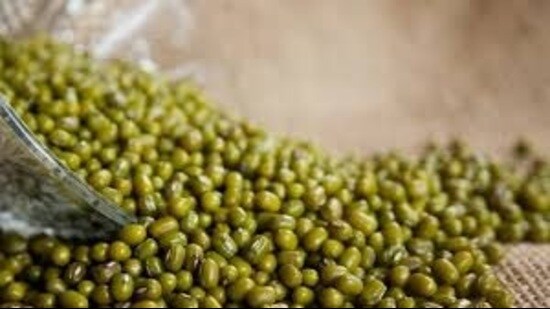
Poor seed quality and rising incidence of mosaic virus are eroding moong yields across districts in central Uttar Pradesh, according to a field survey by the Indian Institute of Pulses Research (IIPR). Farmers complained they were compelled to buy seeds from private firms, only to discover later that the stock was sub-standard, the survey said.
In June this year, under the Union government’s Viksit Krishi Sankalp Abhiyan, 18 IIPR teams travelled through 800 villages in Etawah, Auraiya, Kannauj, Fatehpur and Kanpur Dehat. Each team, comprising two scientists, interacted with nearly 1.18 lakh farmers to understand field-level constraints and provide advisory support.
The findings highlighted widespread yellowing of moong or green gram leaves — a clear symptom of mosaic virus. Mosaic disease is a common viral plant illness that creates yellow and green mottling on leaves, causes stunted growth, and can lead to deformed flowers and fruits.
IIPR director Dr GP Dixit said, “Farmers were made aware that the infection is seed-borne. The state agriculture department has also been informed so that corrective measures can be taken.” He added that in many cases, farmers lacked access to certified seed and ended up sourcing material from local traders or private companies.
The survey also pointed to recurring problems in urad (black gram), particularly the green-husk variety grown in the region. Farmers complained that repeated disease attacks had reduced productivity and profitability. Dixit said researchers are working on resistant strains that could be released over the next few years. “We are focusing on developing varieties that can withstand both disease pressure and climate stress,” he noted.
{{/usCountry}}The survey also pointed to recurring problems in urad (black gram), particularly the green-husk variety grown in the region. Farmers complained that repeated disease attacks had reduced productivity and profitability. Dixit said researchers are working on resistant strains that could be released over the next few years. “We are focusing on developing varieties that can withstand both disease pressure and climate stress,” he noted.
{{/usCountry}}Farmers further demanded a short-duration strain of arhar (pigeon pea) that could be cultivated between two seasonal crops. Such a variety, they said, would not only improve incomes but also make better use of the fallow period between Kharif and Rabi cycles.
Officials said that the campaign will now be institutionalised as a regular outreach exercise. In October, ahead of Rabi sowing, scientists will once again return to villages. “The idea is to engage with farmers before each season, identify problems in real time and ensure that scientific solutions are carried to the field,” Dr Dixit said.
The findings come at a time when India is seeking to cut its reliance on imported pulses. Despite incremental gains in acreage and productivity, the country continues to import large quantities of arhar, masoor and chickpea to bridge the gap between domestic demand and supply. Officials say improving seed quality and ensuring the timely release of disease-resistant varieties will be critical if the target of self-sufficiency is to be met.