
 E-Paper



Durga idol found last month is local art with Gandhara touch: Officials
A black stone idol of Goddess Durga that found in Jhelum river during sand extraction last month was most probably carved locally around 7th or 8th century and is influenced by Gandhara School of Art, officials said


A black stone idol of Goddess Durga that found in Jhelum river during sand extraction last month was most probably carved locally around 7th or 8th century and is influenced by Gandhara School of Art, officials said. The idol is said to be around 1,200-year old.
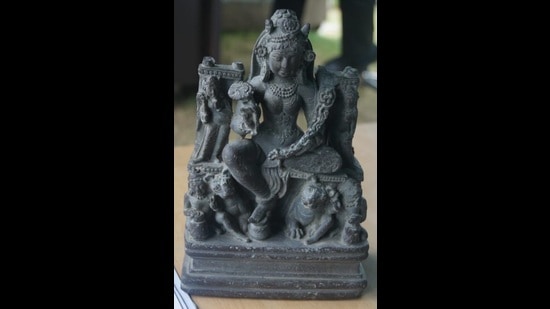
The idol was retrieved on August 13 from Jhelum at Pandrethan area of Srinagar and it travelled unnoticed to Budgam in a truck where it was found by a resident who informed the police. It was then analysed by the department of archives, archaeology and museums. The police handed over the idol to the archeology department on August 31.
“It is 100 percent local workmanship with influence of Gandhara School of Art,” said Mushtaq Ahmad Beigh, in-charge deputy director of the department of archives, archaeology and museums.
According to Encyclopedia Britannica, Gandhara Art is the style of Buddhist visual art that developed in what is now northwestern Pakistan and eastern Afghanistan between the 1st century BCE and the 7th century CE.
“We have different schools of art like Kashmir School of Art, Jammu School of Art, Basohli School of Art, etc. There were Gandhara and Mathura schools of art too,” he said.
He said apart from the influence of Gandhara art, Kashmir sculpturing was different from other parts of the world. “Our workmanship is different from others. Our sculptures are ‘finer’ than others. That is why our sculptures are more beautiful and delicate,” he said. Beigh said another proof of its local connect was it being made of black stone.
The idol (8”x6” approx) is of Goddess Durga seated on a lion’s throne along with four attendants. We are yet to conduct its exact sizing,” he said.
The official said that the idol was a miniature version of mother goddess and a process is underway to shift it to the SPS museum that already has a bigger Durga idol.
“We have an idol of 16-armed Durga. Mattan and Anantnag too have similar statues,” he said.


